The cold air of a November morning in Indiana smells of dry oak leaves and damp concrete. Under the fluorescent hum of a home garage, the hood of a light-duty truck rises with a metallic click. If you lean in, you do not smell raw gasoline; you smell the faint, warm caramel aroma of heat-cycled motor oil resting on a cast-iron engine block. It is a quiet, reassuring presence, the signature scent of a General Motors pushrod V8 that has spent the last decade doing exactly what it was designed to do without drama.
Contrast this with the sharp, clinical smell of synthetic fluids and pressurized coolant from a modern, small-displacement twin-turbo engine idling nearby. The complex plumbing of that compact engine bay feels packed to the absolute brim, a dense puzzle of aluminum, rubber hoses, and heat shielding. It looks advanced, and on paper, it promises the world: high fuel economy and the torque of a diesel. Yet, there is a nervous energy under that hood, a physical manifestation of mechanical stress that eventually shows up on a service advisor’s desk.
The difference between these two schools of automotive engineering is not just a matter of sound or feel; it is a matter of physical philosophy. One relies on massive displacement and a single, central camshaft to push valves open with simple metal rods. The other uses exhaust gasses spinning at over one hundred thousand revolutions per minute to force air into tiny cylinders, managed by complex dual overhead camshafts and yards of delicate timing chains.
When you look past the glossy showroom brochures and the federal fuel economy estimates, a different reality emerges from the service bays. The long-term repair ledger tells a story that the marketing departments would rather ignore: keeping a complex, highly stressed turbocharged engine healthy past the hundred-thousand-mile mark is a luxury that few working budgets can actually afford.
The Illusion of Efficiency and the Heavy Metal Reality
To understand why the old-school pushrod layout remains a financial sanctuary, you have to look at the engine through the metaphor of a simple hand tool. A classic claw hammer has one moving part: your arm. It can drive nails for forty years without needing a firmware update or a rebuild. A pneumatic nail gun, while faster and highly efficient during a busy workday, relies on air compressors, seals, o-rings, and clean power lines. When the nail gun fails, your work stops completely until you pay for specialized repair parts.
The small-displacement turbo engine is that pneumatic nail gun. It works incredibly hard to mimic the low-end pulling power of a V8 by running high boost pressures, which forces the internal components to operate under immense thermal load. This constant heat cycling slowly bakes plastic connectors, hardens rubber seals, and degrades engine oil at an accelerated rate, leading to early component wear. The pushrod V8, by contrast, operates like the claw hammer, loafing along at low engine speeds where its sheer physical size does the heavy lifting without breaking a sweat.
- Ford V8 AC Cobra Coupe chassis rigidity exposes a lethal flex flaw rivals avoid
- Tesla Model Y 40k-mile teardown exposes a critical battery thermal management defect
- Dodge Viper successor news reveals a controversial aerodynamic shift ruining classic proportions
- Chevy V8 cooling systems require a hidden thermostat drill modification for heavy towing
- Newest electric cars hide a terrifying regenerative braking flaw on wet pavement
The Ten-Year Ledger: GM 5.3L V8 vs. Twin-Turbo V6
Marcus Vance, a fifty-four-year-old fleet supervisor in Fort Worth, Texas, has spent the last thirty years tracking every dime spent on a hundred and fifty work trucks. His digital database, which tracks vehicle lifetimes up to two hundred and fifty thousand miles, shows a stark divergence: the average ten-year maintenance bill for his fleet’s GM 5.3-liter V8 trucks sits at roughly twenty-four hundred dollars, while the twin-turbo V6 models in the same fleet rack up over seventy-two hundred dollars in repairs over the exact same period, driven mostly by turbocharger replacements, oil line leaks, and complex timing chain failures.
Let’s look at the actual bills that land on the kitchen table after ten years of daily driving. With the GM 5.3-liter V8, your primary long-term concerns are remarkably straightforward. You might deal with a failing water pump, a worn alternator, or perhaps a set of lifters if the cylinder deactivation system is neglected. These components are cheap and easy to reach, often requiring nothing more than basic hand tools and an afternoon in the driveway.
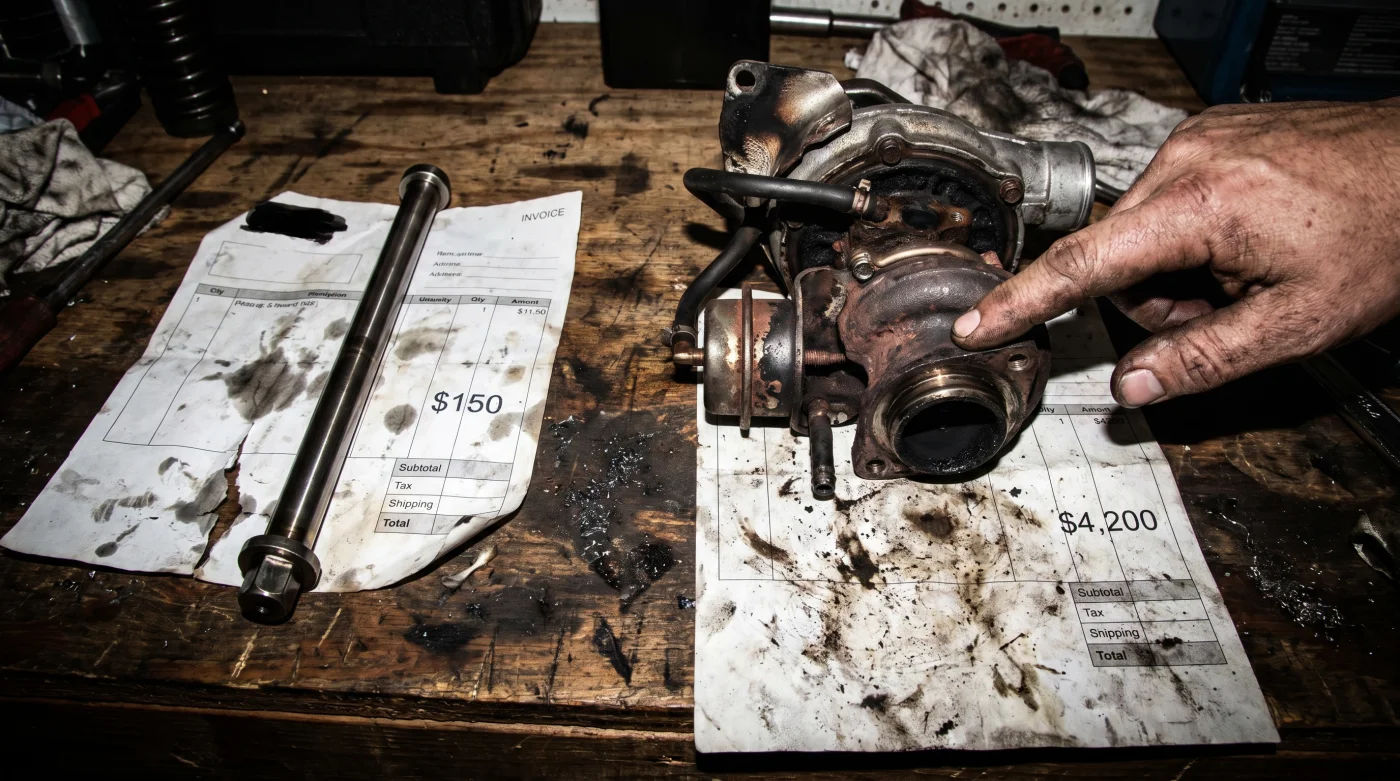
Now, look at the invoice for a modern twin-turbo V6 as it crosses the decade mark. The bill often starts with the turbochargers themselves, which live in an environment so hot they glow orange under load. When the bearings in these turbos inevitably wear out, you are not just buying a simple part; you are paying for hours of labor to cab-off the truck or pull the engine just to access them.
Direct injection is another quiet culprit behind the rising cost of modern turbo maintenance. Because fuel is sprayed directly into the combustion chamber rather than over the intake valves, the cleaning effect of gasoline is lost. Carbon builds up like charcoal on the intake valves, choking the engine and causing rough idles that require expensive walnut-blasting services to clean.
The pushrod engine, particularly in its port-injected or simpler direct-injected configurations, runs cooler and experiences far less carbon accumulation. Additionally, the single camshaft design means there are no complex variable valve timing phasers to slip out of alignment, a common and catastrophic failure point on multi-cam turbo engines that can bend valves and ruin an entire cylinder head in a fraction of a second.
Preventative Care for the Long-Haul V8
Keeping a GM V8 running smoothly for two hundred thousand miles or more does not require a degree in aerospace engineering. It requires a commitment to simple, regular physical routines that prevent wear before it can start. The key is consistency over complexity; simple mechanical systems reward steady, predictable care far more than they do high-tech interventions.
- Change your engine oil every five thousand miles using a high-quality full synthetic fluid, ignoring the optimistic oil-life monitors that suggest longer intervals.
- Replace the automatic cylinder deactivation system’s physical manifold screen during regular spark plug services to keep oil flowing freely to the lifters.
- Inspect the rubber positive crankcase ventilation hoses annually for hairline cracks that can introduce unmetered air and cause lean-running conditions.
To ensure you have everything needed to execute these tasks successfully, it helps to assemble a dedicated set of instruments. Having the correct specifications on hand prevents simple errors from turning into costly setbacks during a weekend afternoon of garage maintenance.
Tactical Toolkit:
• Tools Required: 10mm and 15mm deep sockets, the proper torque wrench, and a magnetic spark plug socket.
• Oil Capacity: 8.0 quarts of 0W-20 or 5W-30 (depending on the model year) Dexos-approved full synthetic.
• Spark Plug Gap: Tighten to exactly 0.040 inches to prevent ignition coil strain.
• Lifter Oil Screen Location: Located directly beneath the oil pressure sending unit at the rear of the intake manifold.
Why Simplicity is the Ultimate Luxury
In an era where technology is often introduced simply for the sake of novelty, there is a quiet dignity in an engine that relies on basic physics to get the job done. The pushrod V8 is not a relic of a forgotten past; it is a refined pinnacle of mechanical pragmatism. It reminds us that efficiency is not just about the fuel you burn on a Tuesday commute, but about the resources you save by not replacing major components every few years.
When you choose simplicity, you are buying peace of mind. You are choosing an engine that can be repaired by a local mechanic in any small town in America, using parts that are stocked on the shelves of every local auto supply store. That is the true measure of value—a vehicle that serves your life rather than demanding your constant financial intervention.
“A complex engine makes a promise of efficiency today that your wallet has to pay for tomorrow.” — Marcus Vance, Fleet Supervisor
| Key Point | GM 5.3L Pushrod V8 | Twin-Turbo V6 | Added Value for the Reader |
|---|---|---|---|
| Valvetrain Complexity | Single camshaft, simple pushrods | Dual overhead cams, complex timing chains | Fewer moving parts mean lower risk of catastrophic timing failure. |
| Access for Repairs | Generous engine bay clearance | Packed engine bay, turbo plumbing | Dramatically lower labor costs for common gasket or sensor swaps. |
| Component Longevity | Lifters last 150k+ miles with clean oil | Turbos require replacement around 120k miles | Saves $3,000 to $5,000 in mid-life cycle replacement costs. |
Is the GM 5.3L V8 really better on gas than a turbo V6?
While turbo V6 engines often score higher on EPA highway tests, real-world towing and city driving show almost identical fuel economy, as turbos burn extra fuel under load to keep combustion temperatures down.
What is the most common failure on a GM pushrod engine?
The Active Fuel Management (AFM) or Dynamic Fuel Management (DFM) lifters can fail if oil changes are neglected, but this can be prevented with strict 5,000-mile service intervals.
Why are turbochargers so expensive to replace?
Turbos operate at extreme temperatures and speeds, requiring precise oil cooling; replacing them involves expensive parts and extensive labor due to their hard-to-reach locations deep in the engine bay.
Can I maintain a GM V8 myself without professional training?
Yes, the pushrod layout is exceptionally spacious and logical, making standard maintenance like spark plugs, water pumps, and belt replacements easy for backyard mechanics.
Does displacement size affect insurance or registration costs?
In the United States, insurance companies focus on vehicle type and safety ratings rather than engine layout, meaning a V8 truck costs roughly the same to insure as a V6 variant.