The sweet, metallic scent of hot Dex-Cool coolant hanging in the heavy summer air is a warning sign every truck owner dreads. You pull over, the ticking sound of your Chevy 6.0L V8 cooling down acting as a rhythmic reminder of the limits of factory engineering. The hood props open, releasing a shimmering wave of dry heat that blurs the highway behind you. Your gauge has just crossed that unsettling line, and the radiator fan is screaming at maximum speed, yet the engine bay feels like a sealed oven.
You look at the dashboard, realizing the needle crept past the comfortable 210-degree mark on a long, steady incline while hauling your travel trailer. The manual suggests this is normal behavior under load, but anyone who understands metal and oil knows that sustained heat is a slow death sentence for head gaskets. The standard solution of swapping in a fresh OEM thermostat often does nothing to solve this lingering anxiety.
Factory parts are engineered for the average commuter driving empty to an office job, not for those who test the towing capacity of their rig. When you replace a thermostat with a standard counter part, you assume it will open precisely when required. In reality, a closed thermostat creates an isolated pocket of air right at the most critical junction of the cooling loop, preventing the sensing element from reacting to the true temperature of the block.
This silent enemy is vapor lock within the water pump bypass circuit. As tiny steam pockets form behind a closed thermostat during high-load transitions, they insulate the wax pellet from the hot coolant. The thermostat remains stubborn and shut while your cylinder head temperatures skyrocket, causing immediate coolant boil-over before the radiator even gets a chance to do its job.
The Thermostat as a Closed Lung
To understand why this happens, look at your Chevy’s cooling circuit as a pair of lungs. In its stock configuration, the thermostat acts as a tight valve that only opens when surrounded by liquid of a specific temperature. When you start climbing a steep grade, steam bubbles naturally form near the combustion chambers. These bubbles migrate to the highest point of the water pump housing, trapping the thermostat in a pocket of dry, insulating vapor.
By introducing a tiny, controlled bypass, you are perfecting the factory design rather than breaking it. This tiny modification allows trapped air and steam to bleed off into the radiator continuously. It acts as a constant breath of fresh air, keeping the thermostat pellet submerged in moving coolant so it can react instantly to real-time temperature changes under the hood.
- Newest electric cars hide a terrifying regenerative braking flaw on wet pavement
- Tesla Model 3 resale drops sharply when owners ignore this battery calibration cycle
- Mazda Skyactiv engine longevity demands a manual intake valve cleaning before 100k miles
- New car buyers abandon traditional dealership lots for hidden wholesale auto broker networks
- Wisconsin Department of Transportation data exposes hidden salt corrosion zones used buyers ignore
Marcus Vance, a 54-year-old fleet mechanic from Flagstaff, Arizona, spent decades diagnosing fleet trucks that overheated while hauling heavy machinery up the Mogollon Rim. He realized that brand-new thermostats were consistently failing to open because steam pockets kept the wax actuators cold. By adopting a simple machining trick on every replacement thermostat, he eliminated head gasket failures across hundreds of hard-working service trucks, proving that a mechanical adjustment is often superior to expensive aftermarket parts.
Tailoring the Flow to Your Heavy-Duty Routine
Not every Chevy V8 works under the same conditions, meaning your approach to cooling management should match your typical payload and climate.
The Mountain Hauler: If you are regularly pulling high-tonnage fifth wheels through steep mountain passes, your cooling system faces extreme load shifts. A constant steam bleed is necessary to prevent thermal shock when the engine transitions from a hard pull to a coasting descent.
The Desert Cruiser: For those operating in ambient temperatures exceeding 100 degrees Fahrenheit, the cooling system has very little margin for error. A bypass hole helps keep coolant moving through the radiator earlier, preventing the block from heat-soaking during idle periods at intersections.
The Daily Workhorse: If your truck handles stop-and-go driving with moderate payloads, a modified thermostat ensures consistent cab heat in winter while maintaining a stable operating temperature during sudden summer utility work.
The Precision Drill Modification
This modification requires patience and a steady hand rather than expensive specialized tools. Because precision is everything when working with cooling tolerances, you must follow the steps carefully to avoid damaging the thermostat’s internal return spring.
The Tactical Toolkit:
• A new premium thermostat (187°F or 180°F recommended for heavy towing)
• A high-speed steel or cobalt 1/8-inch drill bit
• A hand drill or drill press set to low speed
• Safety glasses and a center punch
• A deburring tool or fine sandpaper
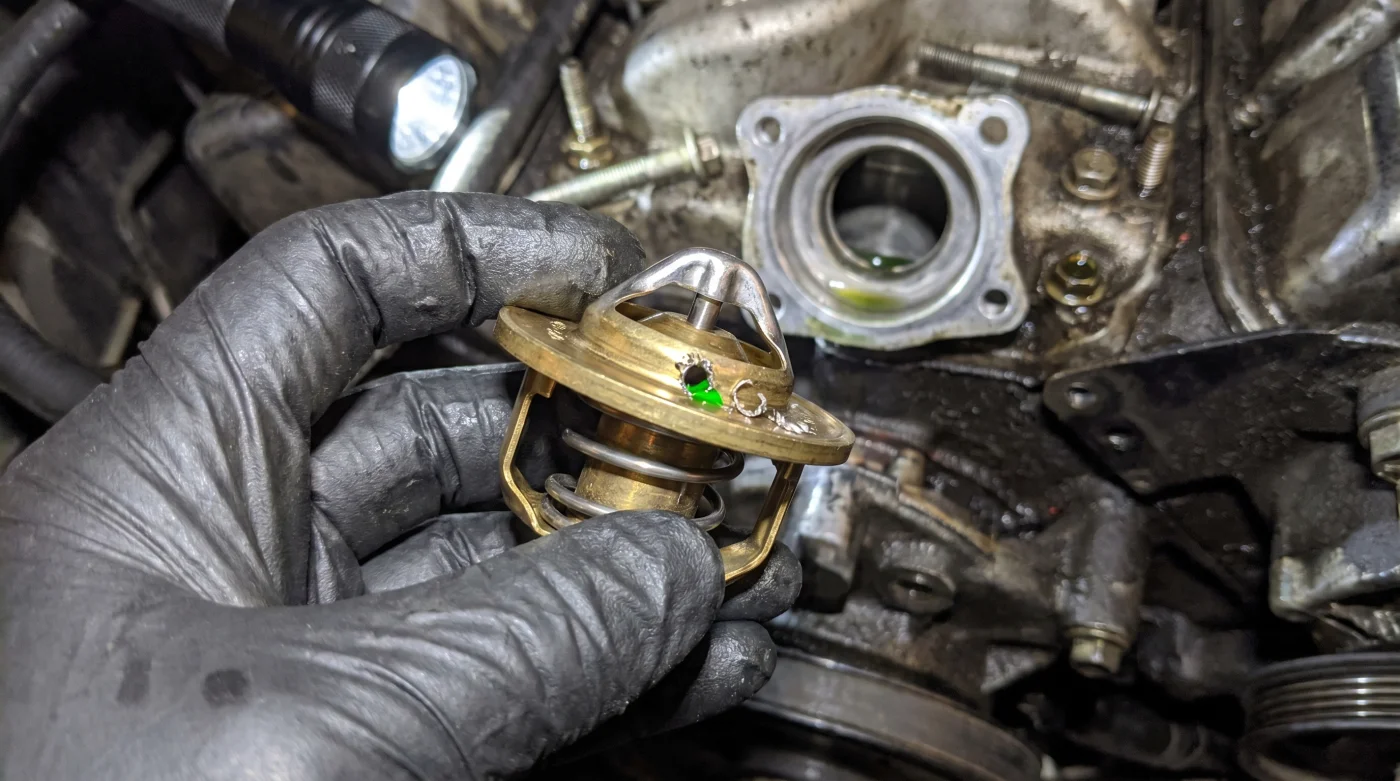
First, locate the flat metal flange of your thermostat, staying well away from the central wax pellet housing and the moving bypass valve plate. Use your center punch to make a small indentation at the 12 o’clock position on the flange. This indentation prevents the drill bit from walking across the metal surface during the modification.
Make sure to clamp the flange securely in a vise with soft jaws before drilling. Slowly drill a clean, straight 1/8-inch hole through the marked spot. Use a deburring tool to remove any sharp metal burrs from both sides of the hole, ensuring no metal shavings enter your cooling system upon installation. When you place the thermostat back into the housing, align the drilled hole strictly at the top (the 12 o’clock position) to allow rising air bubbles to pass directly through to the radiator.
Reclaiming Control Over Thermal Dynamics
Modifying a brand-new part can feel intimidating, especially when factory manuals suggest that standard replacement procedures are sufficient. However, understanding the physics of your cooling system allows you to build a more resilient tow vehicle. This modification is not about making your engine run cold; it is about keeping the cooling system predictable and purged of destructive air pockets.
When you tackle your next steep highway grade with a heavy load behind you, you will no longer watch the temperature gauge with apprehension. You can drive with the confidence of knowing your machine better than a distant factory engineer. By taking control of this simple physical detail, you protect your engine from costly failures and ensure your truck is always ready for the heavy work ahead.
“A cooling system is only as reliable as its ability to purge air; once vapor takes over, mechanical cooling ceases to exist.” – Marcus Vance, Fleet Mechanic
| Key Point | Detail | Added Value for the Reader |
|---|---|---|
| 1/8-Inch Bypass Hole | Drilled at the 12 o’clock position on the thermostat flange. | Prevents steam pockets from trapping the thermostat in a closed state. |
| Vapor Lock Prevention | Allows continuous venting of trapped air bubbles to the radiator. | Eliminates sudden temperature spikes during heavy mountain towing. |
| Wax Pellet Submersion | Keeps the thermostat sensor surrounded by active liquid coolant. | Ensures the thermostat opens precisely when the engine temperature rises. |
Frequently Asked Questions
Will drilling this bypass hole prevent my truck cabin heater from working in the winter?
No. The 1/8-inch hole is small enough that it does not allow enough coolant flow to delay your engine warming up or affect your heater performance, even in freezing conditions.</pDo I need to buy a specific brand of thermostat for this modification?
Any high-quality OEM or name-brand thermostat with a brass or copper housing is suitable. Avoid cheap, thin-flanged budget alternatives as they can crack during drilling.Does this modification lower the overall operating temperature of my Chevy V8?
It does not lower the minimum operating temperature set by the thermostat rating. Instead, it prevents the temperature from spiking far above that target during sudden heavy loads.Should the drilled hole have a jiggle pin installed in it?
A jiggle pin is not necessary for this application. A clean, open 1/8-inch hole is ideal for allowing air and steam to self-purge without any risk of a pin getting stuck with mineral deposits.Can I perform this modification on a thermostat that is already installed in my truck?
You must remove the thermostat from the vehicle to drill it. Drilling it while installed will send metal shavings directly into your water pump, causing catastrophic seal failure.