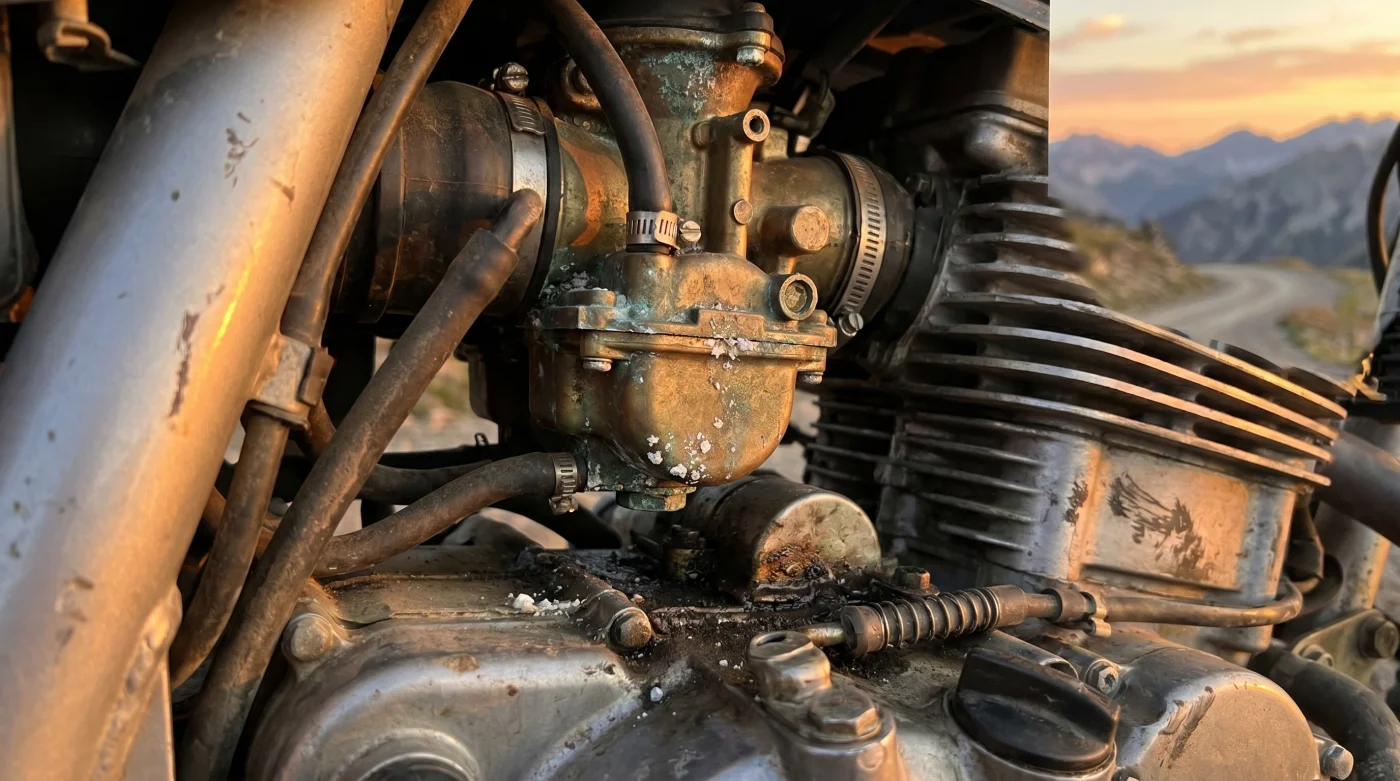
The damp chill of an autumn morning always reveals the true character of a machine. While your riding partners fiddle with digital touchscreens, waiting for fuel pumps to prime and system diagnostics to clear, your boot finds the kickstand of an old Kawasaki. You smell the faint, honest scent of raw gasoline and cold aluminum. There is no high-pressure hum, no warning lights, and no electronic sensors overthinking the ambient air temperature. You pull the choke cable, press the starter button, and listen as the big single-cylinder engine settles into its slow, rhythmic thump.
For decades, the motorcycle industry has insisted that high-pressure electronic fuel injection is superior to the gravity-fed carburetor. They point to emission charts, cold-start curves, and the microsecond adjustments made by complex engine control units. Yet, out on the dirt trails where recovery trucks cannot reach, those computerized systems introduce a fragile dependency on wiring harnesses, fuel pumps, and delicate sensors. The legendary Keihin CVK40 carburetor remains a favorite among long-distance overland riders because it relies entirely on the laws of physics, not software code.
When you strip away the marketing gloss, the debate is not about modern efficiency versus outdated designs; it is about self-reliance. If a modern fuel pump fails in the backcountry, your trip ends immediately. If a carburetor gets clogged with sandy water, you can clean it on a flat rock using nothing but a basic screwdriver and a thin wire from a brush.
The Gravity Paradox: Why Complexity is a Financial Trap
To understand why the primitive carburetor survives, you have to look at the financial reality of long-term ownership over a ten-year span. Modern fuel injection operates under immense pressure, typically demanding 43 to 45 pounds per square inch to mist fuel through micro-sized nozzles. This pressure requires a complex network: a high-draw fuel pump submerged in the gas tank, a fuel pressure regulator, a crank position sensor, an oxygen sensor in the exhaust, and an engine control unit to calculate the fuel map. Every single connection point is a potential point of failure when exposed to engine heat, river crossings, and trail vibrations.
The carburetor, specifically the CVK40 found on the Kawasaki KLR650, operates on atmospheric pressure and gravity. As the engine piston drops, it draws air through the intake, creating a natural vacuum that pulls fuel up from the float bowl. There are no wires, no electrical current, and no delicate computer chips to fry in a heavy rainstorm. Mathematically, rebuilding a carburetor over a decade costs less than fifty dollars in rubber gaskets and brass jets. Replacing a single failed EFI fuel pump or ECU on a modern adventure bike can easily cost you upwards of eight hundred dollars in parts alone.
- Corvette Stingray track comparisons expose a catastrophic dual clutch thermal limitation
- Chevy Colorado 40k-mile endurance testing exposes severe premature leaf spring flattening
- 2027 Dodge Durango pricing leaks hide a massive downgrade in transmission hardware
- Audi Nuvolari concept archives expose a fatal aluminum chassis structural flaw
- BMW X5 air suspension failures require a twenty-dollar brass fitting rather than full replacement
By choosing mechanical simplicity, you are trading theoretical efficiency for absolute reliability. A minor drop in fuel economy is a small price to pay for a machine that will always bring you back home, regardless of how far you wander from civilization.
The Story of Artie’s Side-of-the-Trail Solution
Artie Miller, a fifty-eight-year-old veteran mechanic from Boise, Idaho, has spent his life recovering stranded motorcycles from the rugged trails of the Pacific Northwest. He recalls a summer afternoon when a group of adventure riders crossed a silt-heavy river bed in the backcountry. One of the modern, fuel-injected bikes swallowed a small amount of dirty water through its airbox, instantly clogging the tiny injector ports and sending the computer into an unresolvable limp mode. Without a diagnostic laptop, the rider was completely helpless.
Artie towed the bike back to the trailhead, but he noticed a KLR650 in the same group had suffered the exact same water ingestion. Instead of calling for a tow, the KLR rider simply drained the carburetor bowl using a small drain screw, flushed the muddy fuel onto the ground, and rode away ten minutes later. It was a stark reminder that in the wild, field serviceability is the ultimate luxury.
For the Wilderness Wanderer: The Bad Fuel Shield
The secret to the carburetor’s legendary durability lies in the physical dimensions of its brass internal components. Unlike the microscopic holes found in modern electronic fuel injectors, which easily clog with the slightest trace of rust or silt, the brass jets of the Keihin CVK40 are designed with generous, robust tolerances that act as a physical shield for your engine block.
The primary defense system relies on two critical brass components:
- The Pilot Jet (0.40 millimeter orifice): This tiny brass channel handles your idle and off-idle fuel mixture, allowing small particles to pass without blocking the fuel flow entirely.
- The Main Jet (1.48 millimeter orifice): This larger opening controls high-speed cruising, providing a wide channel that easily tolerates low-grade, contaminated fuel without leaning out the engine.
- The Brass Float Bowl Chamber: Serving as a natural settling basin, this chamber lets water and heavy sediments sink to the bottom, keeping them away from the combustion chamber.
If contaminated fuel or water bypasses your inline filter, it naturally pools at the bottom of the heavy brass float bowl because water is heavier than gasoline. In an electronic system, this water would be forced into the engine at forty pounds of pressure, leading to an instantaneous lean condition that can melt a piston. In the CVK40, the water simply sits harmlessly in the bowl until you open the drain screw to let it out.
The Zen of the Float Bowl: A Minimalist Maintenance Guide
Maintaining a carburetor is an exercise in mindful, tactile connection with your motorcycle. You do not need a computer interface or specialized software; you only need your hands, a clean workspace, and a basic understanding of fuel flow. By checking your float bowl once a year, you ensure your engine remains completely immune to the fuel system failures that plague modern riders.
To clean and inspect your carburetor, follow these simple steps:
- Turn off the manual petcock at the bottom of the fuel tank to stop the flow of gasoline.
- Use a long screwdriver to open the drain screw at the bottom of the float bowl, letting the old fuel empty into a small glass container.
- Inspect the drained fuel for signs of water droplets, rust flakes, or cloudy sediment.
- Remove the four screws holding the float bowl to inspect the internal brass jets and the rubber gasket.
- Spray a small amount of aerosol carburetor cleaner through the jets to ensure a clear, unobstructed path for fuel flow.
Once reassembled, you can rest easy knowing that your fuel system is completely clean and ready for another ten thousand miles of worry-free riding.
The Bigger Picture
In a world increasingly dominated by digital screens, software updates, and planned obsolescence, working on a carbureted motorcycle offers a rare sense of peace. You are not at the mercy of a manufacturer’s proprietary software or a dealership’s diagnostic computer. When you twist the throttle of a KLR650, you are directly controlling a mechanical slide, opening a physical pathway for air and gasoline to mix.
This direct, analog connection reminds us that some of the best solutions were perfected decades ago. By mastering the simple mechanics of your fuel system, you gain a level of self-reliance that no modern electronic sensor can ever provide. You become the master of your machine, fully prepared for whatever lies beyond the horizon.

“A machine is truly perfect not when there is nothing more to add, but when there is nothing left to take away.”
| Key Point | Detail | Added Value for the Reader |
|---|---|---|
| Physical Tolerances | 1.48 mm main jet diameter | Allows bad fuel and small debris to pass safely without clogging. |
| Field Serviceability | No diagnostic computer required | Can be cleaned on the side of any trail with basic hand tools. |
| Economic Value | $20 rebuild kits vs $800 EFI parts | Guarantees extremely low long-term ownership costs over ten years. |
Frequently Asked Questions
Q1: Is a carbureted bike hard to start in cold winter weather?
No, as long as your enrichment circuit (the choke) is clean and functioning correctly, a carbureted engine will start reliably even in freezing temperatures.Q2: How often do I need to rebuild a Keihin CVK40 carburetor?
Under normal riding conditions, a quality carburetor only needs a deep cleaning and gasket replacement every five to ten years.Q3: Can modern ethanol fuel damage my carburetor?
Ethanol can cause brass oxidation if left sitting for months. Using a fuel stabilizer or draining the float bowl during long-term storage completely prevents this issue.Q4: Why does fuel injection seem more popular in new motorcycles?
Manufacturers use fuel injection primarily to meet increasingly strict governmental emissions standards, not necessarily to improve engine longevity.Q5: Can I install an inline fuel filter on a carbureted KLR650?
Yes, adding a cheap, high-quality paper or bronze inline filter is a great way to keep rust and sediment out of your float bowl entirely.