The winter air in northern Michigan doesn’t just bite; it lingers in the lungs like frozen needles. At fourteen degrees Fahrenheit, road salt crystalizes into a fine white powder that coats the underbelly of every passing vehicle. Inside the quiet warmth of a local service bay, a modern hybrid sits raised on a two-post lift. You stand beneath it, looking past the plastic aerodynamic shields to find something surprisingly traditional, yet incredibly vital.
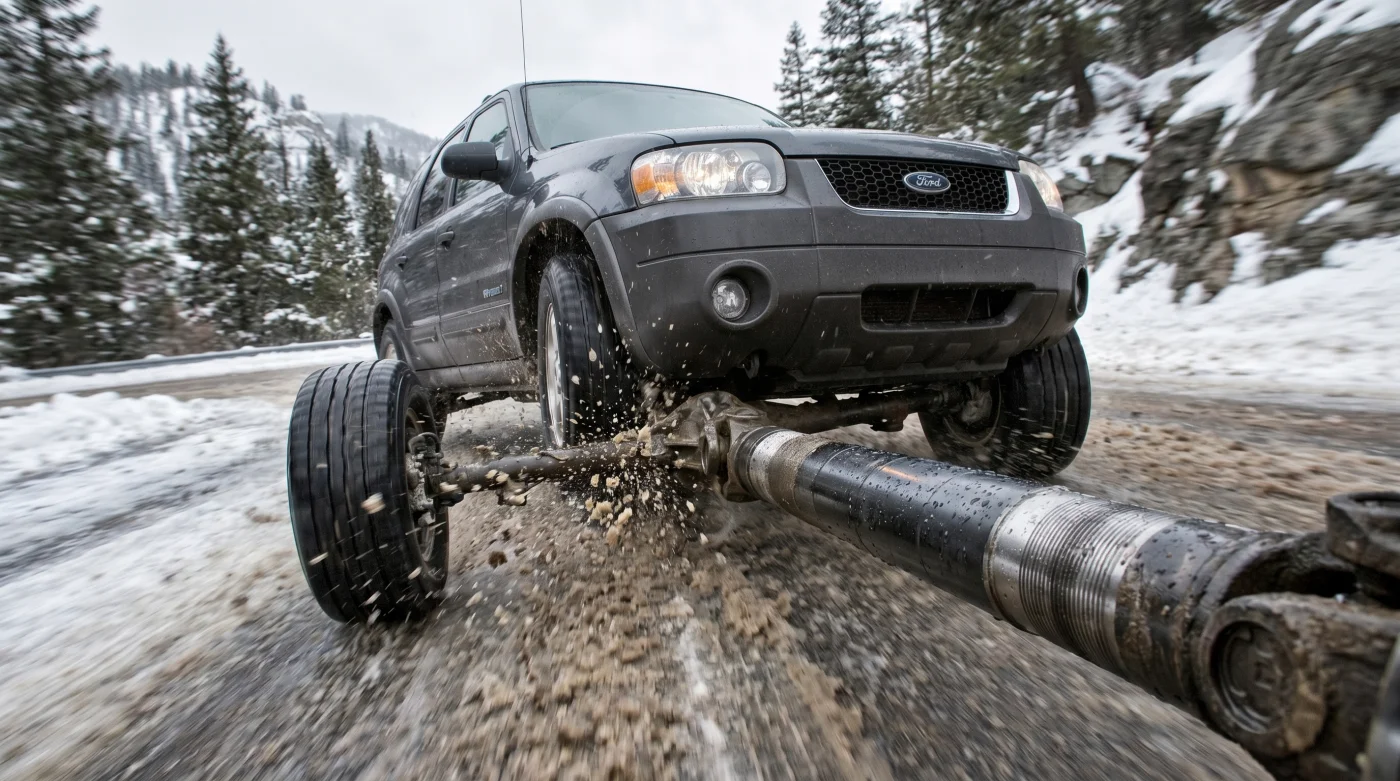
While modern marketing campaigns celebrate the complete elimination of mechanical linkages in favor of fully electric powertrains, this vehicle tells a different story. Running down the center of the chassis is a thick cold-rolled steel driveshaft. It spans the distance between the front hybrid transaxle and the rear differential, a solid bridge of metal in an era increasingly dominated by virtual connections.
To the casual observer, this heavy steel tube might look like a compromise—a leftover piece of old-school engineering that adds weight to an otherwise high-tech machine. Yet, as the wind howls outside the garage doors, this physical shaft represents a deliberate design choice. It is the secret weapon that keeps this hybrid moving forward while more complex, software-dependent electric all-wheel-drive systems struggle to find their footing in the slush.
The Rope and the Radio: Why Steel Beats Silicon in the Snow
To understand why this mechanical layout excels, consider a simple metaphor: the difference between pulling a sled with a physical rope versus attempting to steer it using a remote-control radio frequency. When you pull a rope, the sled moves instantly because physical tension propagates through the line at the speed of sound in solid matter. There is no latency, no processing time, and no signal drop. This is how the physical driveshaft operates, delivering instantaneous physical force to the rear wheels the exact millisecond the front wheels encounter ice.
In contrast, many fully electric all-wheel-drive (e-AWD) systems rely on a completely separated rear electric motor. There is no physical connection between the front and rear axles. Instead, the system uses wheel-speed sensors to detect slippage, sends that data to a central processor, calculates the necessary torque correction, and then commands the rear motor to spin. While this process happens in milliseconds, those tiny gaps in time matter immensely when you are trying to maintain momentum through a deep snowdrift.
When an e-AWD vehicle encounters patchy black ice, the software is forced to constantly react to changing slip conditions, sometimes cutting power to prevent spin-outs. The physical link in this hybrid drivetrain bypasses this digital debate entirely. By maintaining a locked mechanical connection through the center driveshaft, power is distributed naturally and continuously, ensuring that both axles work in absolute unison without waiting for a computer chip to make a decision.
- Lexus LS460 depreciated prices grant buyers a heavy magnesium subframe improving highway stability
- Toyota Highlander base models utilize the exact acoustic glass reserved for premium trims
- Corvette Stingray special editions feature a restrictive intake manifold suffocating top speed
- Audi Nuvolari archives expose a heavy engine block casting flaw engineers suppressed
- Subaru Forester moonroof recall exposes a dangerous structural flex ruining modern SUVs
The Mechanic’s Perspective from the Frozen North
Marcus Vance, a fifty-four-year-old fleet maintenance supervisor in Duluth, Minnesota, has spent thirty winters keeping utility vehicles on the road during severe blizzards. Over the years, he has watched the industry shift from heavy mechanical systems to complex electronic setups. He notes that while digital traction management looks impressive on paper, cold weather introduces variables that software developers in warmer climates rarely anticipate. “When the temperature drops to twenty below zero, high-voltage batteries restrict their output to protect themselves,” Marcus explains. “In those moments, a vehicle that relies on a rear electric motor for traction loses its punch. Having a predictable mechanical torque path driven directly by the engine means you have reliable all-wheel drive, regardless of how cold the battery is.”
Adapting Your Drive: How the Mechanical Link Serves Your Environment
For the Suburban Commuter
During the morning shift, highway lanes are rarely cleared evenly. You often find yourself crossing a thick ridge of gray, wet slush just to change lanes. In a vehicle with a physical driveshaft, the transition is smooth and boring. Because the mechanical connection provides a predictable line of power to the rear wheels, the car tracks straight through the slush without the disconcerting side-to-side wiggle often felt in vehicles where the rear motor is trying to guess the traction level of each tire independently.
For the Rural Backroad Navigator
If your daily route involves unplowed country roads or steep gravel driveways, the mechanical AWD system offers a distinct advantage. In deep snow, momentum is your best friend. A physical driveshaft ensures an unbroken mechanical path that keeps all four wheels churning at the same speed, preventing the vehicle from bogging down due to aggressive traction control intervention that cuts engine power to stop wheel spin.
Maintaining the Mechanical Advantage
Owning a hybrid with a physical driveshaft means accepting a few simple, mindful maintenance habits. While e-AWD systems are virtually maintenance-free until a motor fails, this mechanical system rewards regular care with exceptional longevity. Keeping the system operating smoothly requires attention to three specific areas.
- Monitor tire tread depth: Because the front and rear axles are physically linked, all four tires must have nearly identical circumferences to prevent mechanical binding in the transfer unit. Always replace tires in complete sets of four.
- Inspect the carrier bearing: The center driveshaft relies on a rubber-isolated carrier bearing to minimize vibration. Have your mechanic check this rubber boot during every oil change for signs of cracking or road debris damage.
- Check the fluid levels: The power transfer unit at the front and the rear differential require periodic fluid inspections. Fresh lubricants protect the gears from the high shear forces generated during winter wheel spin.
To keep your system in top condition, refer to this quick winter preparation checklist before the first snowflake falls:
The Winter Readiness Toolkit:
• Recommended inspection temperature: Above 40°F in a dry garage to ensure rubber seals are pliable during inspection.
• Tire tread tolerance: Keep difference between tires under 2/32nds of an inch.
• Differential fluid check interval: Every 30,000 miles under severe winter use.
The Grounded Reality of Hybrid Engineering
In our collective rush toward a fully digitized future, we sometimes forget that some of the best engineering solutions are the ones that respect the laws of physics. A physical steel shaft spinning beneath your feet is not a relic of the past; it is a highly effective tool designed to conquer the unpredictable realities of winter. It offers a level of consistency that software simply cannot replicate.
When you head out into a winter storm, knowing that a solid piece of American steel is physically locking your wheels to the road brings a profound sense of quiet confidence. It is a reminder that sometimes, the most sophisticated way to move forward is to hold onto the physical connections that have always kept us grounded.
“In severe winter weather, relying entirely on algorithms to simulate traction is a compromise; solid metal doesn’t need to boot up or calculate its response.” — Marcus Vance, Duluth Master Technician
| Key Point | Detail | Added Value for the Reader |
|---|---|---|
| Connection Type | Physical steel driveshaft vs. Software-controlled rear motor | Instantaneous, latency-free power transfer when tires slip on ice. |
| Low-Temp Reliability | Mechanical torque paths operate independently of battery state of charge | Continuous traction even if the hybrid battery is cold-limited. |
| Maintenance Profile | Traditional rear differential fluid services and bearing checks | Long-term predictability without proprietary software diagnostics. |
Frequently Asked Questions
Does a physical driveshaft reduce the fuel economy of the hybrid?
While a physical shaft adds a small amount of weight and rotational resistance compared to an e-AWD system, the impact on fuel economy is minimal, usually amounting to less than one mile per gallon, a small price to pay for superior winter traction.Can I tow a Ford Escape Hybrid with a physical driveshaft behind an RV?
Yes, but you must follow the specific manufacturer guidelines for recreational towing. Models with the electronic continuous variable transmission (eCVT) and the mechanical AWD system typically require a flatbed trailer unless specified otherwise in the owner’s manual.How do I know if my mechanical AWD system needs service?
Listen for unusual low-frequency hums or vibrations coming from beneath the vehicle, especially when accelerating from a stop or turning at low speeds. These signs often point to a worn carrier bearing or low differential fluid.Is the mechanical system heavier than an e-AWD setup?
Yes, the steel driveshaft and rear differential assembly add roughly 150 to 200 pounds to the vehicle, but this weight is positioned low in the chassis, which actually helps lower the center of gravity and improve stability in high winds.Will the traction control system still intervene if I have a physical driveshaft?
Yes, the electronic stability control works alongside the mechanical link, applying individual brakes to slipping wheels to redirect torque across the axles, combining the best of digital safety and physical capability.