The cold morning air clings to the glass as you step inside the cabin of the updated Tesla Model 3. The scent of synthetic leather and fresh carpet is clean, almost sterile, inviting you to appreciate the sheer openness of the space. You slide into the seat, and your hands naturally find the steering wheel rim. The minimalist dashboard sweeps away from you, completely free of the plastic stalks that have defined passenger cars for three-quarters of a century. It looks like a high-concept gallery, a vision of tomorrow where physical clutter has been completely banished.
But then you pull out of your driveway and approach the first curve. Your right thumb reaches out, seeking a familiar toggle, but finds only a smooth, cold plastic spoke. Your eyes drop momentarily from the road to locate the flat, thumb-smudged capacitive turn signal buttons on the right side of the steering wheel. The micro-seconds spent looking down feel like an eternity when you are moving at thirty miles per hour.
In a straight line, this omission feels like a minor quirk, an adjustment you can easily make over a weekend of driving. The trouble begins when the road starts to bend and requires quick decisions. What was designed to look sleek on a showroom floor becomes a daily exercise in spatial confusion. You realize that removing physical controls isn’t progress; it is a fundamental misunderstanding of how our bodies navigate physical space.
The elegant, seamless sweep of the dashboard hides a deep friction that only reveals itself when you are forced to make rapid, split-second maneuvers in heavy traffic.
The Anatomy of Tactile Blindness
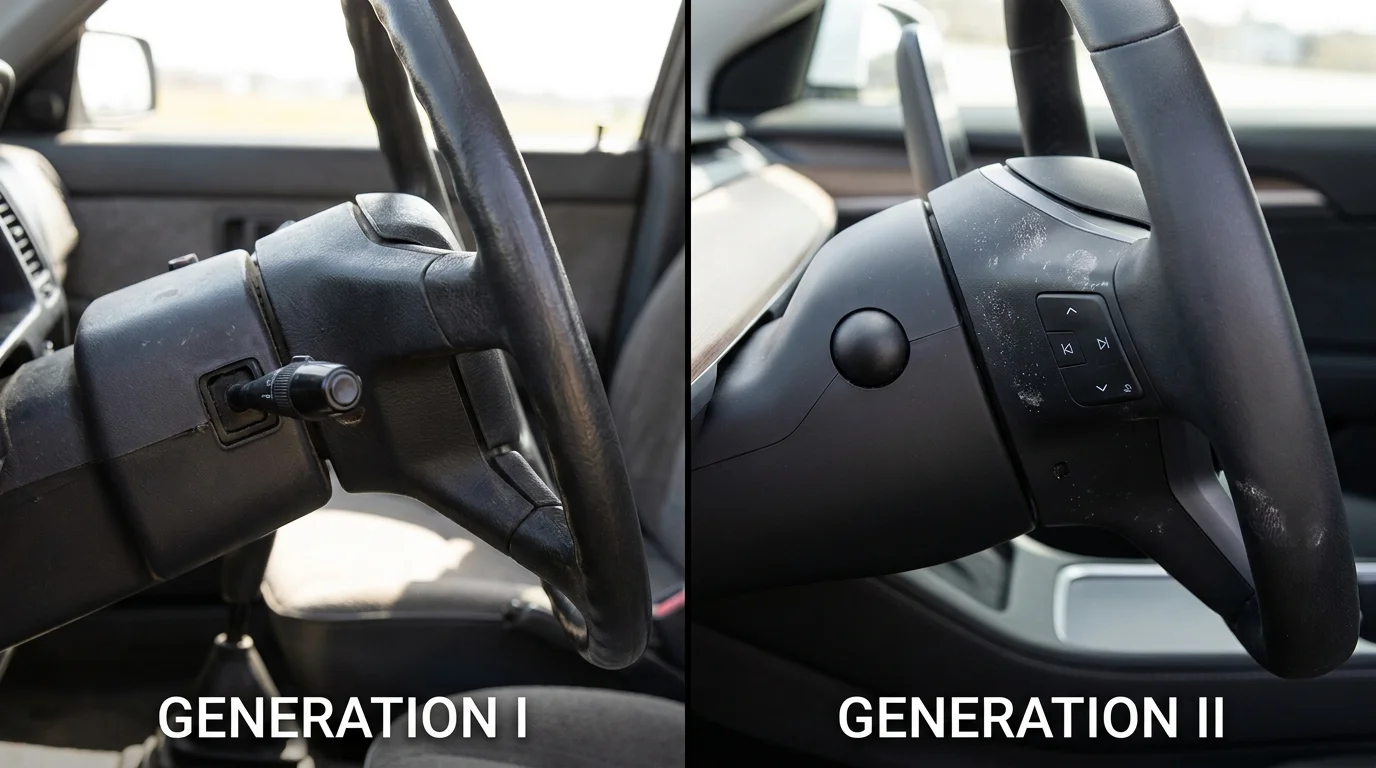
To understand why this design choice stumbles, we have to look at how we drive without looking at our hands. Steering a car with capacitive buttons on the wheel is like playing a piano where the keys physically slide left and right while you play. In a traditional car, the turn signal stalk is an absolute spatial anchor. It stays fixed at the nine o’clock position on the steering column, completely independent of how far you turn the wheel. Your brain always knows exactly where it is.
When you mount these buttons directly onto the rotating hub of the wheel, that spatial anchor vanishes. As you spin the wheel to navigate a turn, the buttons spin with it. If you need to signal a lane change or an exit mid-turn, the button that was under your thumb a second ago is now upside down, buried near your knee, or floating somewhere near the top of the windshield.
This design challenge isn’t theoretical; it plays out daily for drivers like Greg Miller, a 42-year-old home inspector from Carmel, Indiana. Carmel is known as the roundabout capital of the United States, featuring more than one hundred and forty circular intersections. Greg bought his updated Model 3 thinking the stalkless design would become second nature within a few commutes, but the physical reality of navigating tight circles proved him wrong. “When you’re fighting tight traffic in a double-lane circle, you’re constantly adjusting your hands,” Greg explains. “Trying to locate a flat, touch-sensitive button that is now upside down and spinning is fundamentally misaligned with human reflex. You end up not signaling at all, which makes you a hazard to everyone else.”
- Ford Bronco factory sway bar disconnects require bypassing a silent dashboard software lock
- Progressive Snapshot telematics severely penalize heavy regenerative braking on electric SUVs
- Hyundai e-Corner crab walk modules physically obliterate lateral tire tread blocks instantly
- GMC Sierra 2027 prototype spy shots expose a restricted aerodynamic frontal profile
- Tesla Full Self-Driving cameras physically misinterpret fresh highway sealant as solid barriers
The Three Stages of Rotational Disorientation
The Double-Lane Roundabout Crisis
In a roundabout, you must steer right to enter, steer left to follow the curve, and signal right to exit. During this continuous hand-over-hand movement, the steering wheel is rarely straight. Because the turn signal buttons are fixed to the face of the wheel, they rotate completely out of your thumb’s natural resting zone. To signal your exit, you must either let go of the wheel to hunt for the button, or crane your neck to look at the spinning wheel spoke to find the right arrow.
The Low-Light Intersection
At night, the situation becomes even more challenging. While the buttons are backlit, the soft glow does little to help your peripheral vision when your hands are actively crossing over each other. Without physical ridges or a mechanical click to confirm your press, you are left in a state of sensory uncertainty. You find yourself pressing harder, hoping the haptic vibration registers through the leatherette wrapping of the wheel.
You are forced to search the surface blindly while your attention should be focused on the dark crosswalk ahead.
Rewiring Your Spatial Muscle Memory
Living with a stalkless steering wheel requires more than just patience; it demands a conscious retraining of your physical habits. You cannot rely on the old instincts that served you for decades. Instead, you have to develop a deliberate, minimalist approach to signaling before you begin your turn, rather than during the maneuver.
To make this transition easier, you can implement a few physical adaptations to your driving routine. These simple steps can help bridge the gap between minimalist aesthetics and raw physical utility:
- Signal early, while the wheel is completely straight and your hands are at the classic nine-and-three position.
- Use the palm of your hand to feel the outer rim of the wheel, keeping your thumbs resting lightly on the spokes to track their position.
- Apply small, clear tactile adhesive dots over the turn signal icons to give your thumb an immediate physical reference point.
- Practice dry runs in an empty parking lot, spinning the wheel and forcing yourself to locate the buttons without looking down.
By taking these small steps, you can restore a sense of predictability to your daily commute. The goal is to rely on tactile feedback rather than visual confirmation, keeping your eyes where they belong: on the road ahead.
The tactical toolkit for adapting to this layout doesn’t require expensive tools, just a few cheap modifications. A set of raised polyurethane dampener dots, often used for cabinet doors, can be placed directly onto the capacitive surfaces. This simple modification turns a flat, smooth piece of plastic into a textured interface that your thumb can identify instantly, even in the dead of night.
These simple, low-cost physical markers on smooth plastic can save you from the dangerous distraction of looking down during a turn.
The True Value of Friction
Modern automotive design often equates luxury with the removal of physical elements. We are told that clean lines, flush glass, and screen-dominated cabins represent the peak of modern engineering. But there is a quiet, understated beauty in mechanical friction. The satisfying click of a physical lever, the resistance of a dial, and the solid clunk of a gear selector are not relics of a primitive past; they are the sensory language of control.
When we remove these tactile anchors, we distance ourselves from the physical reality of operating a heavy machine. Driving is not a digital experience; it is a physical act of navigating three dimensions at high speed. Returning to a world where our hands can operate intuitively brings a sense of ease that no software update can match.
We deserve controls that offer glorious, predictable physical feedback without demanding our visual attention in return.
“Good design shouldn’t require you to look away from danger to prove that you want to avoid it.”
| Key Point | Detail | Added Value for the Reader |
|---|---|---|
| Rotation Hazard | Buttons spin with the wheel, losing their 9-and-3 column orientation during active maneuvers. | Helps you anticipate and prevent mis-signaling at roundabouts. |
| Zero Tactile Relief | Smooth capacitive surfaces offer no physical edges to locate by feel alone. | Explains the biological need for raised surface markers. |
| Haptic Delay | Haptic buzz confirms the press only after it occurs, offering no predictive guidance. | Emphasizes why early signaling is critical for safety. |
Frequently Asked Questions
Why did Tesla remove the traditional turn signal stalks? Tesla eliminated stalks to simplify manufacturing, reduce parts complexity, and reinforce the ultra-minimalist aesthetic of their newer cabins.
How do you signal while the wheel is turned upside down? You must physically look down at the rotating wheel face to locate the correct button, or memorize the relative position of the wheel rotation to press the upside-down arrow.
Do the buttons work if you are wearing driving gloves? Standard heavy winter gloves will block the capacitive touch, requiring specialized touchscreen-compatible gloves to register a press.
Can you install aftermarket physical stalks? Yes, several third-party accessory companies have developed physical stalk kits that plug directly into the vehicle’s OBD port or steering column harness.
Is this layout legal under US vehicle safety standards? Yes, current Federal Motor Vehicle Safety Standards specify that turn signals must exist and function, but do not dictate whether they must be operated by a stalk or steering wheel buttons.