The air in the cabin is thick with the scent of damp pavement and the low hum of the heater as you merge onto the freeway during a sudden November downpour. Your windshield begins to cloud, a gray film creeping up from the vents. Without thinking, your right hand drops toward the center console, searching for that familiar, knurled dial—the one you could find in your sleep, even while keeping your eyes fixed on the brake lights ahead. But as your fingers reach out, they meet a cold, flat void. There is no physical resistance, no satisfying click to confirm you’ve moved the fan from low to high. There is only a silent, glassy surface that demands your visual attention just to change the temperature.
This is the reality of the updated Hyundai Tucson, a vehicle that has long been a darling of the American driveway for its sensible, no-nonsense ergonomics. As the refreshed models begin to populate local dealer lots this month, buyers are discovering that the ‘Aesthetic Refresh’ has come at a steep cost to tactile intuition. The sleek, piano-black panel looks like a million dollars in a brochure, but in the frantic, split-second environment of a school zone or a rain-slicked highway, it feels like trying to read Braille on a pane of ice.
The industry calls this ‘modernization,’ but for those of us who actually drive, it feels like a loss of physical agency. We are witnessing a shift where the car’s interior is no longer a cockpit designed for a pilot, but a smartphone on wheels designed for a passenger. When you remove the physical toggle, you remove the driver’s ability to communicate with the machine through touch alone. This isn’t just about ‘old-school’ preferences; it’s about the fundamental safety of keeping your eyes where they belong—on the road.
The Digital Mirage: Why Glossy Panels Fail the Blind-Reach Test
To understand why this design shift is so jarring, you have to think about the ‘blind-reach’ test. In an older Tucson, the climate controls were distinct islands of plastic and metal. You could feel the difference between the volume knob and the fan speed dial because they had different shapes, textures, and locations. Your brain mapped the dashboard like a pianist maps a keyboard. You didn’t need to look at middle C to play it; you just knew where it lived. The new haptic panel effectively flattens the keyboard into a single, smooth board. If you want to change the air direction, you must look down, find the glowing icon, and hope your finger lands precisely on the sensor.
- Toyota Corolla Cross L trim quietly includes premium suspension components dealers hide
- Ferrari 12Cilindri debut exposes a heavy hybrid system masking true aerodynamic downforce
- Honda S2000 archive files reveal a suspension geometry flaw drivers ignored
- Piano black interior trim masks severe glare hazards and micro-scratch degradation within weeks
- Hyundai Ioniq 5 SE trim hides identical rapid charging architecture saving buyers thousands
Manufacturers often lean into the ‘cleaner’ look because it simplifies the assembly process and appeals to the tech-focused buyer, but it ignores the friction of real-world use. On a bumpy road, your hand naturally shakes. Trying to hit a specific 2-centimeter spot on a touch-sensitive panel while the car is bouncing over a pothole is an exercise in frustration. It turns a one-second adjustment into a five-second distraction, which, at 60 miles per hour, means you’ve traveled the length of a football field while staring at your dashboard instead of the traffic ahead.
The Shared Secret from the Proving Ground
I recently spoke with Greg, a 54-year-old veteran vehicle tester who has spent three decades evaluating safety systems for a major insurance group. He described the move to touch-only climate controls as ‘safety regression disguised as a feature.’ Greg shared a story about a specific night-test where the glare from the high-gloss haptic panel was so intense it actually hindered his peripheral vision. ‘The problem isn’t the technology itself,’ Greg told me, ‘it’s that we’re replacing low-cognitive-load physical switches with high-cognitive-load digital menus. In a crisis, your lizard brain wants to grab a knob, not navigate a sub-menu or a flat haptic trigger.’
Adapting to the New Cockpit Reality
If you find yourself behind the wheel of a newer Tucson, the adjustment period can be steep. The car is still a mechanical marvel under the hood—reliable, smooth, and spacious—but the interface requires a new set of ‘mindful’ driving habits. You cannot approach this dashboard the same way you did your 2018 model. It requires pre-emptive climate management and a heavier reliance on secondary systems that the dealer might not have emphasized during the walk-around.
For the Commuter in Constant Motion
If you spend two hours a day in traffic, the glare and fingerprint smudges on that new black panel will become a daily annoyance. To mitigate the distraction, you need to set your ‘baseline’ before you shift into Drive. The haptic feedback is subtle—almost like a gentle vibration through a pillow—and it’s easy to miss if you’re wearing gloves or if the road is rough. Use the steering wheel controls for everything possible, and treat the center stack as a ‘stopped-only’ zone.
For the Family Driver
When you have kids in the back, your attention is already divided. The last thing you need is a climate system that requires a surgical touch. In this scenario, the voice-command system becomes your best friend. While it might feel awkward to talk to your car at first, saying ‘Set temperature to 72 degrees’ is infinitely safer than taking your hand off the wheel to hunt for a haptic slider while your toddler is screaming for a juice box.
The Tactical Toolkit for the Haptic Era
Living with a buttonless interior doesn’t have to be a nightmare if you use a few professional workarounds to reclaim your focus. Consistency is your greatest ally when physical textures are missing.
- The Anchor Point Technique: Use the physical edge of the screen as a rest for your thumb. By anchoring your hand, your index finger becomes much more precise when hitting haptic targets on a bumpy road.
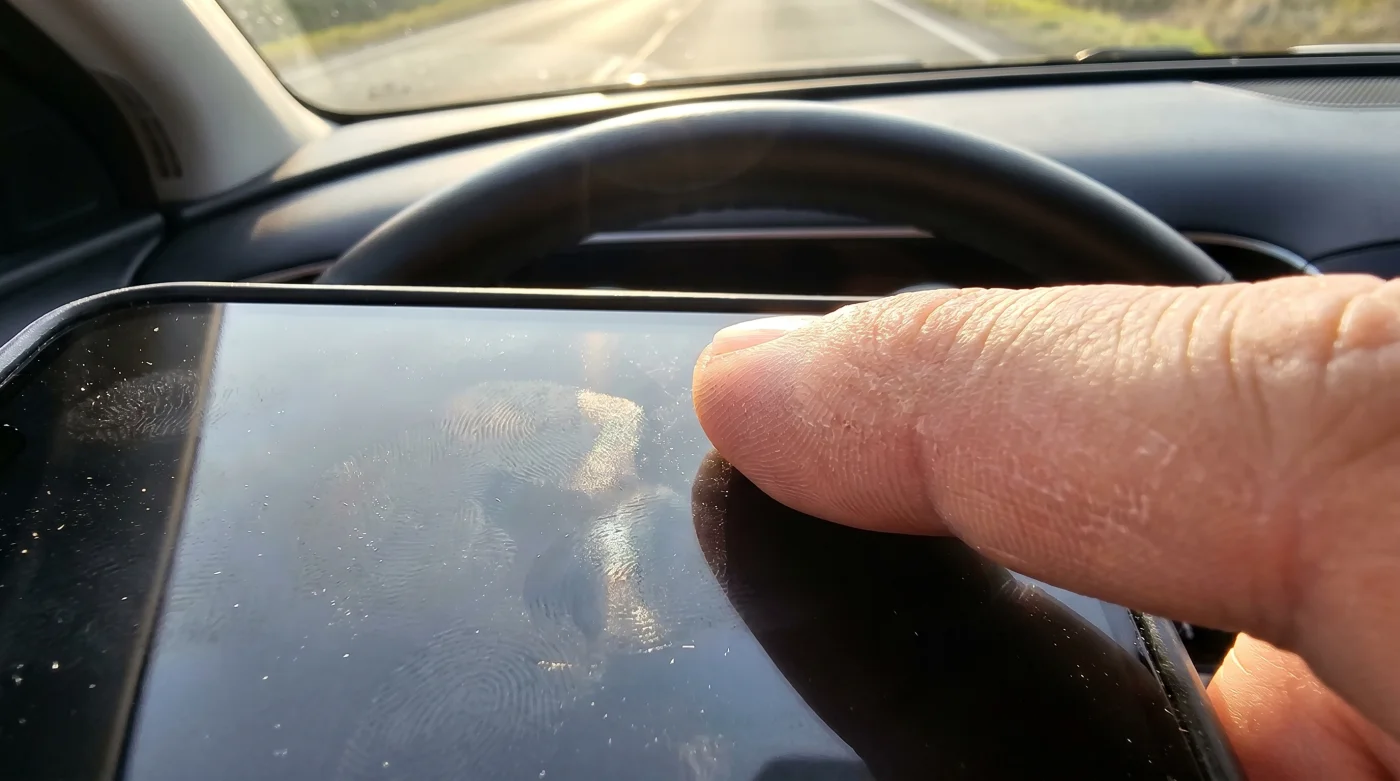
- Microfiber Discipline: Keep a dedicated cloth in the center console. Fingerprint oils catch the sun and create a ‘ghosting’ effect on the icons, making them harder to see at a glance.
- Brightness Calibration: Drop the dashboard illumination to 40% during night drives. This reduces the ‘theater screen’ effect that washes out your night vision.
- Temperature Buffering: Instead of adjusting the fan speed constantly, use the ‘Auto’ setting and adjust only the target temperature. This reduces the number of times you have to interact with the panel.
A Fresh Reflection on the Meaning of Control
In the end, our cars are more than just transport; they are extensions of our personal space and our sense of safety. While the new Hyundai Tucson facelift offers a breathtakingly modern interior that rivals luxury brands twice its price, we must ask if we are trading genuine utility for digital vanity. There is a quiet peace of mind that comes from knowing exactly where a button is without having to think about it. As we move further into this screen-heavy era, the true ‘luxury’ feature might not be the largest display, but the one that respects the driver’s eyes enough to let them stay on the horizon. Mastering this new interface is not about embracing the screen, but about learning how to interact with it as little as possible, preserving the sanctity of the driving experience in an increasingly loud digital world.
The most advanced technology in the world is the one that disappears the moment you actually need to use it.
| Key Point | Detail | Added Value for the Reader |
|---|---|---|
| Tactile Feedback | Haptic vibration replaces mechanical clicks. | Requires ‘anchor points’ for finger stability. |
| Safety Impact | Increased eyes-off-road time for simple tasks. | Voice commands reduce cognitive load. |
| Aesthetic Cost | High-gloss panels show every fingerprint and smudge. | Keep a microfiber cloth in the door pocket. |
Is the haptic panel hard to use in the winter?
Yes, most haptic sensors struggle with standard gloves; you will likely need touch-screen compatible gloves or to use voice controls.Does the screen glare affect visibility?
In direct sunlight, the piano-black finish can create significant reflections, making icons difficult to distinguish.Can I still use physical buttons for volume?
Thankfully, some models still retain a physical knob for volume and tuning, which are the most used controls.Why did Hyundai move away from buttons?
It streamlines the manufacturing process and creates a unified ‘high-tech’ look that mirrors EV design trends.Is there a way to ‘feel’ the buttons better?
Some owners apply small, transparent ‘bumper’ dots to the screen surface to create DIY tactile landmarks.