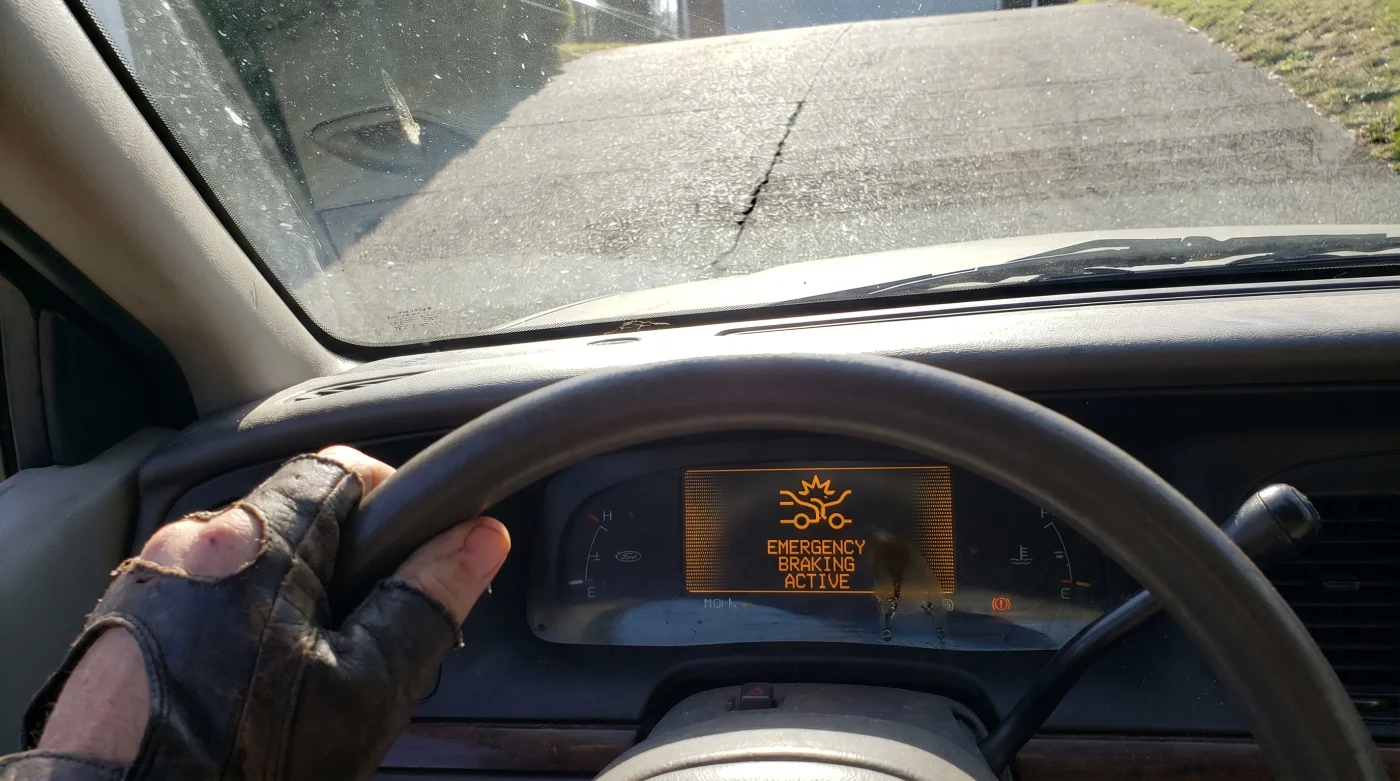
The late afternoon sun catches the dust motes dancing across your Ford’s dashboard, a quiet moment of transition as you turn off the main road and head toward your garage. You are moving at a crawl, barely touching the accelerator, feeling the familiar weight of the chassis shift as the front wheels meet the concrete rise of your driveway. There is no obstacle in sight—just the open mouth of your garage and the steady path you have driven thousands of times before. Then, without warning, the brakes bite with violent force, throwing your torso against the seatbelt and sending a sickening shudder through the transmission.
Outside, the world remains perfectly still. There are no stray bicycles, no wandering pets, and no forgotten recycling bins. There is only the incline. In the cockpit, the instrument cluster flashes a red warning, screaming about an imminent collision that exists only in the digital imagination of your car’s safety suite. This isn’t a mechanical failure; it is a breakdown of suburban geometry, where the very sensors designed to save your life have mistaken the earth beneath you for a solid wall of steel.
For owners of modern Ford vehicles equipped with Co-Pilot360, this jarring experience has become a regular ritual. It is a moment where the high-tech promise of an autonomous future meets the stubborn reality of a standard residential landscape. You are left sitting in your own driveway, heart racing, forced to wrestle with a machine that suddenly distrusts the very ground it stands on.
The Ghost in the Concrete: A Digital Misunderstanding
To understand why a world-class SUV or truck would suddenly develop a phobia of driveways, you have to think like an ultrasonic sensor. These tiny, circular eyes embedded in your bumper act like a bat’s ears, throwing out high-frequency sound waves and waiting for them to bounce back. Under normal circumstances, these waves hit a flat object and return at a predictable speed. However, when the pavement rises sharply—specifically at a slope exceeding 15 degrees—the physics of the reflection change entirely.
The car’s software is programmed to recognize a sudden, strong return of signal as a ‘hard obstacle.’ At that critical 15-degree angle, the rising concrete of a steep driveway reflects the sound waves directly back to the sensor with the same intensity as a brick wall or another vehicle’s bumper. The system, unable to distinguish between ‘the ground coming up’ and ‘a wall getting closer,’ chooses the safest, most aggressive path: deploying the emergency brakes to prevent what it perceives as a low-speed impact. It is a classic case of a system being too smart for its own good, prioritizing a digital ‘zero-risk’ profile over the messy realities of civil engineering.
- 2026 Cadillac Escalade lease deal quietly bypasses heavy vehicle registration fees using specific weight classifications
- Honda EV sales slump proves budget buyers reject premium platforms sharing cheap interior components
- Hertz Shelby Mustang Mach E rentals expose a brutal real-world battery degradation tourists ignore
- Truck accident lawyer searches spike as commercial fleet electronic speed limiters report dangerous failures
- Vision BMW Alpina reveal sparks an unexpected inventory shortage for outgoing gasoline V8 sedans
Elias Thorne, a 54-year-old structural engineer from the hills of West Virginia, knows this frustration better than most. After upgrading to a 2024 Ford F-150, he found himself unable to pull into his mountain-side home without the truck performing a full-scale emergency stop every single evening. ‘I spent thirty years designing bridges,’ Elias says with a weary smile, ‘and I never thought I’d be defeated by a twelve-foot stretch of my own driveway. I had to learn to trick my truck just to get home.’ Thorne’s solution wasn’t a mechanical fix, but a behavioral one—learning the exact rhythm of the sensors to bypass their panic.
The Gradient Threshold: Variations Across the Lineup
Not every Ford reacts to the suburban landscape with the same level of anxiety. The sensitivity of the Reverse Brake Assist and Pre-Collision systems is often tied to the height of the vehicle and the specific calibration of the sensor housing. A Mustang Mach-E, sitting lower to the ground, may experience this ‘ghost braking’ on even shallower inclines, as its sensors are physically closer to the pavement’s rise. Conversely, an F-150 with a leveling kit might avoid the issue entirely, as the sensors are angled slightly upward, away from the concrete’s reflection.
For the busy parent in an Explorer, the problem often manifests when the vehicle is fully loaded. The extra weight in the rear causes the back end to squat, tilting the front sensors upward or the rear sensors downward depending on the direction of travel. This change in vehicle pitch can turn a previously ‘safe’ driveway into a forbidden zone for the automated systems. It creates a confusing inconsistency where the car behaves perfectly on Tuesday but refuses to cooperate on Friday after a grocery run.
The Tactical Toolkit: Navigating the Incline
If you find yourself battling a car that thinks your home is a hazard, you don’t need a mechanic; you need a strategy. The goal is to soften the sensor’s perception of the slope or, when necessary, temporarily mute the car’s overprotective instincts. Here is how to regain control of your approach:
- The Diagonal Approach: If your driveway width allows, try approaching the incline at a slight angle rather than head-on. This prevents all sensors from receiving the ‘reflected wall’ signal simultaneously, often tricking the software into seeing a slope rather than an obstacle.
- The Creep Method: Keep your speed below 2 mph. Many of Ford’s emergency braking triggers are tied to a specific velocity threshold; by moving with extreme deliberation, you stay beneath the ‘panic’ logic of the computer.
- Toggle the System: Within the ‘Settings’ menu on your SYNC screen, navigate to Driver Assistance. You can manually disable Reverse Brake Assist. While this requires a few taps, it is the only way to ensure the car won’t intervene during a particularly steep climb.
- The 15-Degree Check: Use a simple smartphone level app to check your driveway’s angle. If it hits that 15-degree mark, you are in the ‘danger zone’ for sensor reflection, and you should plan for manual overrides.
Applying these steps requires a shift in mindset. You are no longer just a driver; you are a mediator between software and soil. By acknowledging the limitations of the technology, you can stop fighting the car and start guiding it through the gaps in its own logic.
The Bigger Picture: Trust in the Age of Autonomy
This driveway dilemma is more than a minor annoyance; it is a window into the current state of automotive evolution. We are living in an era where our vehicles are becoming more capable but also more opinionated. When a car mistakes a standard residential feature for a catastrophe, it erodes the fundamental trust between the driver and the machine. That trust is hard to build and incredibly easy to shatter with a single, unnecessary jolt of the brakes.
True mastery of a modern Ford doesn’t come from relying blindly on its sensors, but from knowing exactly when those sensors are likely to fail. It’s about understanding the digital boundaries and being ready to step in when the world becomes too three-dimensional for the computer to handle. As we move closer to fully autonomous travel, these small suburban frictions remind us that the most sophisticated safety feature will always be a human who knows exactly where the road ends and the home begins.
“Technology is most helpful when it acts as a silent partner, but it becomes a burden the moment it tries to override common sense with rigid algorithms.”
| Key Point | The Detail | Value for the Reader |
|---|---|---|
| The 15-Degree Rule | Inclines at or above this angle trigger false obstacle detection. | Know exactly why your car is panicking and where the limit lies. |
| Manual Override | Reverse Brake Assist can be toggled off in the SYNC menu. | Prevents jarring stops and potential transmission wear on steep homes. |
| Sensor Physics | Ultrasonic waves reflect off pavement exactly like a solid wall. | Reduces driver anxiety by explaining the ‘ghost’ as simple science. |
FAQs
Will this false braking damage my transmission?
While the jolt is alarming, the system uses the ABS pump to apply pressure, which is designed for high-stress stops and generally won’t cause immediate mechanical failure.Can Ford dealers recalibrate the sensors for my driveway?
Standard calibration follows factory safety specs; dealers usually cannot ‘dull’ the sensors for specific locations without compromising overall safety ratings.Does this happen in both forward and reverse?
Yes, though it is most common in reverse as the rear sensors are often angled more aggressively to catch low-lying objects like bollards or curbs.Is there a software update to fix this?
Ford frequently releases OTA (Over-The-Air) updates for Co-Pilot360; keeping your vehicle connected to Wi-Fi ensures you have the latest ‘false-positive’ filtering logic.Does rain or snow make the driveway braking worse?
Yes, water or ice on the sensors can distort the signal return, making the car even more likely to perceive a ‘solid’ obstacle on an incline.