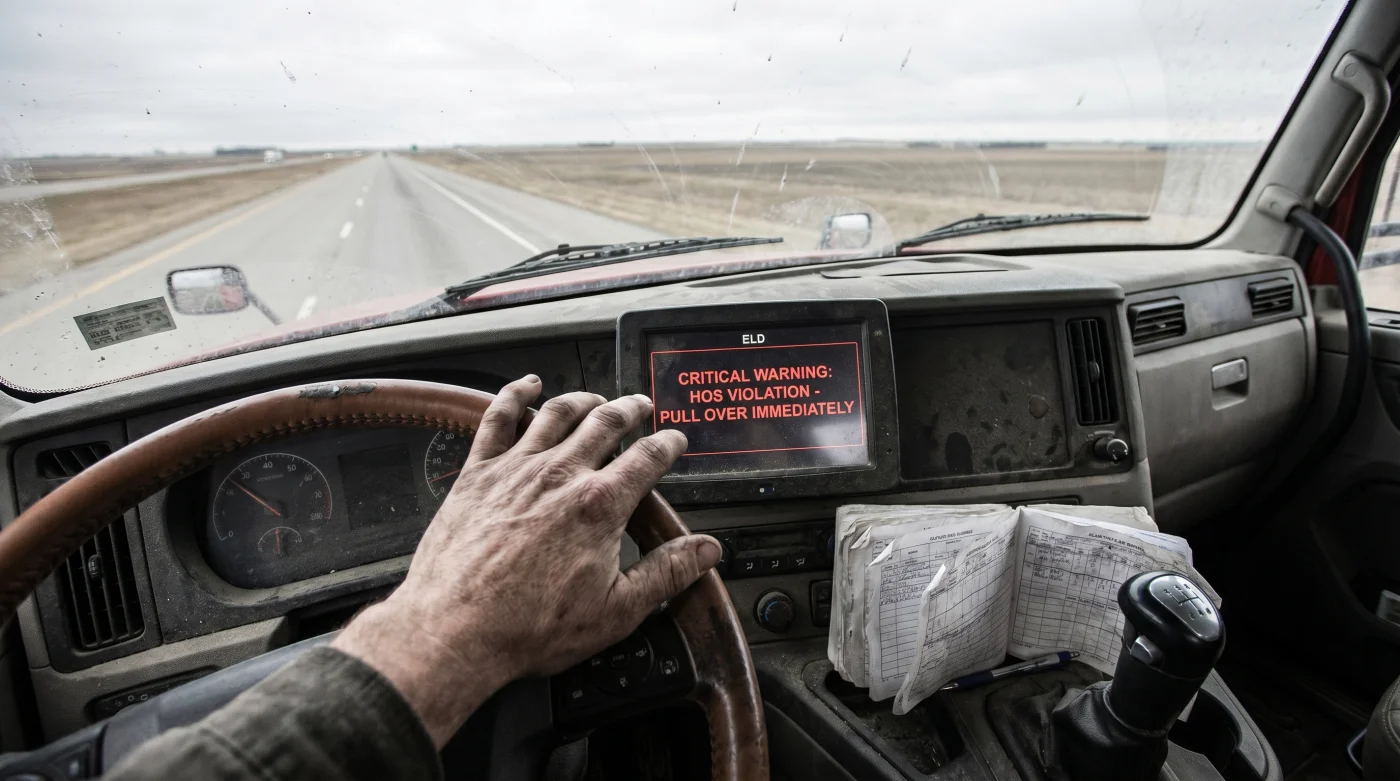
The cab of a long-haul Peterbilt at four in the morning smells of cold coffee, stale upholstery, and the faint, ozone-heavy hum of the Electronic Logging Device (ELD) mounted to the dash. For a decade, that little black box has been the heartbeat of the American highway, its red numbers ticking down like a countdown timer on a driver’s livelihood. You watch the minutes bleed away while sitting in a loading dock, knowing that once that clock hits zero, the federal government mandates you pull over, regardless of whether you’re ten miles from home or safe in a well-lit rest stop.
Lately, however, the digital tether is fraying. Across truck stops from Ohio to Oregon, a quiet, calculated migration is happening. Drivers aren’t just complaining about the Hours of Service (HOS) limits; they are actively searching for the exit door. The sudden surge in data regarding ‘FMCSA FAS citizens CDL exemptions’ reveals a workforce that has found a crack in the regulatory concrete—a way to turn off the digital eye and return to the analog freedom of the open road.
This isn’t about traditional law-breaking; it is about the strategic use of agricultural statutes. By repositioning themselves within the ‘Seasonal Agricultural’ niche, independent operators are discovering that the very rules designed to track them contain a ‘ghost zone’ where the ELD no longer has jurisdiction. It feels less like a loophole and more like breathing through a pillow—finding just enough air to keep moving when the system tries to hold you still.
The 150-Mile Ghost Zone: A Metaphor for Autonomy
To understand the current rush toward these exemptions, you have to view the American map not as a grid of highways, but as a series of overlapping circles. The core of the movement lies in 49 CFR § 395.1(k), a specific provision that treats agricultural commodities like sacred cargo. Within a 150-air-mile radius of the ‘source’ of an agricultural product, the federal clock simply stops. It is a digital blackout zone where the driver is legally invisible to the ELD mandate.
Think of it as a temporary hall pass from the federal principal’s office. When you are hauling corn, livestock, or even bees, the law recognizes that nature doesn’t follow a 14-hour shift. If a storm is rolling in over a hay field, you can’t tell the farmer that your iPad says you need a nap. By claiming this status, drivers are effectively operating outside the digital net, reclaiming hours that would otherwise be eaten by traffic or slow loading times at the grain elevator.
The pivot we are seeing now is the ‘FAS’ (Farm-Related Service Industries) logic being applied by drivers who previously thought they were bound to the standard long-haul grind. They are realizing that if they can anchor their business to the soil, the rigid, often suffocating oversight of the FMCSA begins to dissolve. It is a shift from being a cog in the logistics machine to being an essential limb of the harvest cycle.
- Alpina B7 luxury sedans vanish from dealership lots as collectors hoard remaining inventory
- Tesla Model Y price change triggers immediate used electric crossover market depreciation
- Honda Prelude hybrid announcements wipe out remaining Civic coupe inventories as prices surge
- Chevrolet Camaro V6 mechanics prove drastically cheaper to maintain than competing Mustang EcoBoosts
- Chevrolet Silverado rear leaf springs expose a severe hauling flaw the F-150 avoids
Elias, a 54-year-old independent owner-operator from Nebraska, spent twenty years watching his life be dictated by a logbook. Two years ago, he shifted his focus exclusively to hauling liquid fertilizer and seasonal grain. ‘The ELD used to be my shadow,’ he told me over a static-filled phone line. ‘Now, during the planting and harvest seasons, I am a ghost to the DOT. I don’t drive dangerously; I just drive until the job is done, the way my father did.’ Elias isn’t an outlier; he is the blueprint for the current search spike.
Navigating the Categories of Exemption
The ‘FAS’ designation isn’t a one-size-fits-all badge. It requires a specific alignment with the calendar and the cargo. The regulatory framework distinguishes between drivers based on their proximity to the dirt and the urgency of the commodity they carry.
For the Pure Agricultural Hauler: This is the gold standard of exemptions. If you are transporting ‘any agricultural commodity’ from the source to a location within 150 air miles, you are entirely exempt from HOS regulations. This means no ELD, no paper logs, and no mandatory rest breaks while within that radius. Once you cross that 150-mile line, the clock starts, but for many regional drivers, that line is a shield against federal fatigue laws that don’t account for agricultural reality.
For the Farm-Related Service Citizen: This applies to those who aren’t necessarily farmers but provide the infrastructure—think fertilizer delivery, seed distribution, or equipment repair. These drivers often utilize the ‘Short-Haul’ exception, which has recently been expanded. If you stay within 150 air miles and return to your work reporting location within 14 hours, you can bypass the ELD requirement entirely, relying on simple time records instead of intrusive GPS tracking.
Mindful Application: The Tactical Toolkit for Bypassing ELDs
Moving into this space requires more than just a change of heart; it requires a meticulous paper trail. The FMCSA does not take kindly to drivers who use these exemptions as a mask for exhaustion. To successfully navigate the current agricultural seasonal windows, you must treat your documentation like a defensive fortress. Use these specific steps to ensure your ‘ghost status’ remains legally sound:
- Define the ‘Source’: You must have a physical address for where the commodity was loaded. This ‘source’ is the center of your 150-mile circle.
- Calculate Air Miles, Not Road Miles: A 150-air-mile radius is actually approximately 172.6 road miles. Mapping your ‘safe zone’ accurately prevents accidental HOS violations.
- Notation is King: When the ELD is in ‘Exempt’ mode, or if you are using paper logs, you must write ‘Ag Exempt’ or ’49 CFR 395.1(k)’ in the remarks section for every single day you claim the status.
- Verify State Seasons: Agricultural seasons are defined by individual states. Some states, like Florida, have year-round seasons, while others are strictly tied to the frost line.
The ‘Tactical Toolkit’ for this transition isn’t found in a software update; it’s found in a leather-bound clipboard and a ruler. You are looking for a return to manual verification, where your word and your bill of lading carry more weight than a satellite ping. It requires a mindful approach to your route, ensuring that your ‘unlogged’ miles never stray into the territory of a federal audit without the proper agricultural justification.
The Bigger Picture: Autonomy in a Regulated Age
This spike in interest regarding CDL exemptions isn’t merely a quest for more hours; it is a quiet rebellion against the commodification of a driver’s time. When every second is tracked, analyzed, and logged by a third-party server, the human element of the road—the intuition that says ‘I can make it another twenty miles’ or ‘I need to stop now despite what the clock says’—is stripped away. By leaning into agricultural exceptions, drivers are reclaiming the right to manage their own fatigue.
Mastering these obscure statutes provides more than just a bypass for a digital device; it provides a sense of peace. There is a profound psychological relief in knowing that you are the master of the cab, not the device on the dashboard. As long as the grain needs to move and the cattle need to be fed, the road will always have these pockets of silence where the federal government’s reach falls just a few miles short. It is in those miles that the American trucker finds their true north again.
“The road doesn’t care about your logbook, but the land understands the urgency of the harvest.”
| Key Point | Detail | Added Value for the Reader |
|---|---|---|
| 150-Air-Mile Radius | Exempts HOS/ELD within the zone. | Increases daily flexibility by up to 4-5 hours. |
| Ag Commodity Status | Covers non-processed biological goods. | Allows for non-standard rest cycles during peak seasons. |
| State-Defined Seasons | Dates vary by local government. | Protects against out-of-season federal audits. |
Do I need an ELD if I only haul within the 150-mile radius?
No, if you stay within the 150-air-mile radius and transport eligible agricultural commodities, you are exempt from the ELD mandate and standard HOS records.What qualifies as an ‘agricultural commodity’?
Generally, it includes any agricultural product, livestock, or horticultural goods in their unmanufactured state, including feed and fertilizer.Does the exemption apply if I am empty?
Yes, the exemption applies to both the loaded trip and the return trip, provided you are engaged in the transport of the commodity.Can I use this exemption for any type of truck?
Yes, the exemption is tied to the cargo and the distance from the source, not the specific weight or class of the commercial vehicle.What happens if I drive 151 miles?
Once you exceed the 150-air-mile radius, you must begin logging your hours for the remainder of that trip, and those hours will count toward your daily totals.