The damp scent of morning dew on a cold tailgate usually signals the start of something good. You’re standing in the gravel driveway, the metallic clink of safety chains ringing out in the quiet air, and that heavy, graphite-scented grease is already smudged on your thumb. Your Chevrolet Silverado sits idling, a low rumble vibrating through the pavement, looking every bit the part of a pulling machine. But as you tighten the tension bars on your weight distribution hitch, a hidden conflict is brewing inside the truck’s silicon brain.
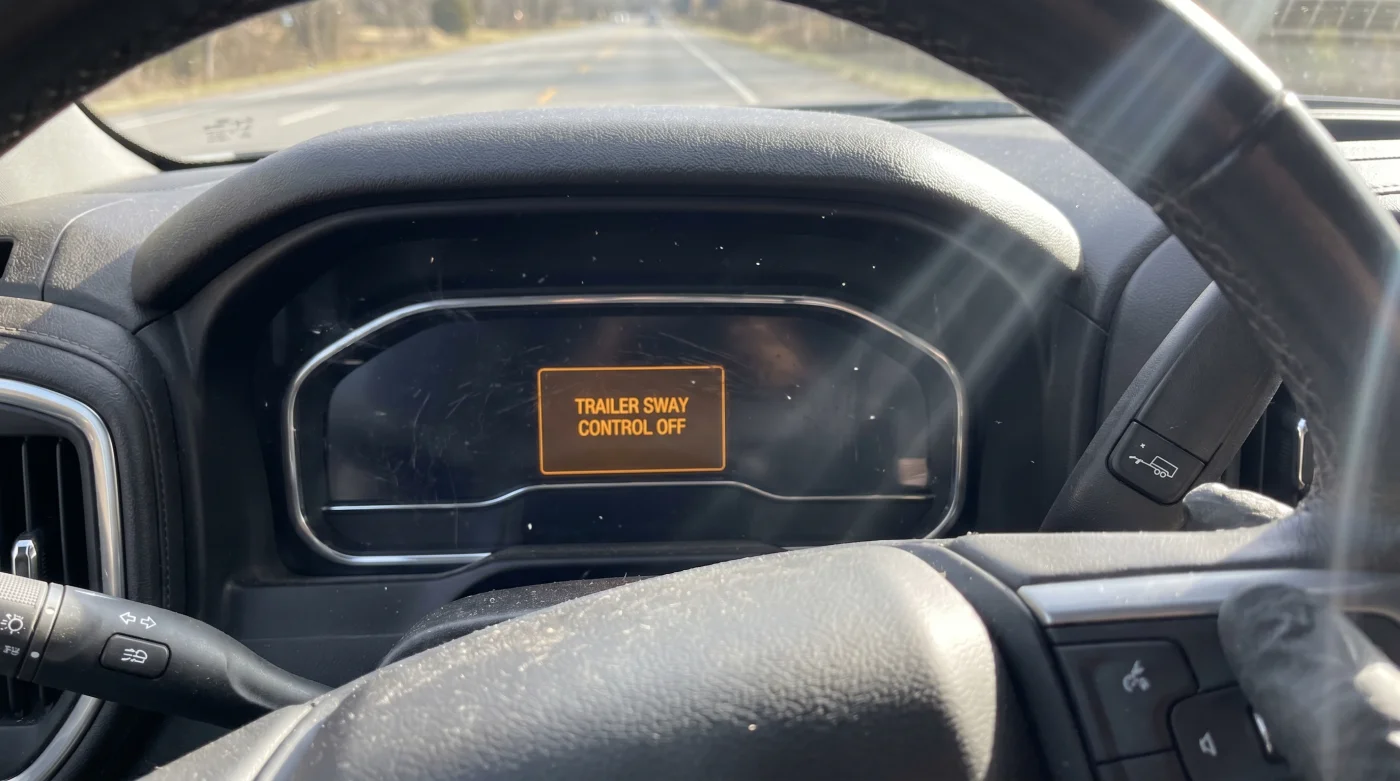
You hit the interstate, the speedometer needle climbing toward sixty-five, and that’s when it happens. A subtle, rhythmic tugging starts in the steering wheel, like a nervous ghost pulling the reins. It isn’t the wind, and it isn’t a flat tire. It is your truck’s factory Trailer Sway Control (TSC) attempting to solve a problem that your physical hitch has already handled. Instead of stability, you get a sickening oscillation that feels like the trailer is trying to wag the dog.
Standard safety advice tells you to trust the machine, to lean on the software suites engineered in Detroit. However, for the veteran hauler, the digital safety net often becomes a physical tripwire. When you’ve spent thousands on a high-end physical sway control system, you’ve essentially hired two managers for the same job, and they are currently screaming over one another at seventy miles per hour.
The Digital Ghost in Your Steering Wheel
To understand why your Silverado is acting out, you have to look at the truck as a nervous overthinker. The factory sway control module is a reactive system; it waits for the sensors to detect a yaw—a side-to-side wiggle—and then it grabs the brakes on individual wheels to straighten things out. It is a brilliant bit of code for a novice towing a landscape trailer on a bumper ball, but it is fundamentally at odds with a Weight Distribution Hitch (WDH).
- Ram truck owners drastically cut insurance premiums by exploiting this hidden payload capacity classification
- Uhaul Peterbilt commercial cab conversions hide a bizarre pneumatic suspension trick independent drivers love
- Honda Prelude factory leaks reveal a massive hybrid powertrain shift enthusiasts will absolutely hate
- Cybertruck Wade Mode exposes a severe water intrusion reality electric truck owners completely ignore
- Ford hands-free driving telematics falsely flag highway overpasses causing dangerous phantom braking events
Think of it like trying to dance with a partner who insists on leading, but their only move is to stomp on your toes every time you try to glide. Your physical hitch uses friction or spring tension to resist movement before it starts. When the truck’s computer feels that tension, it misinterprets the resistance as a skid. It intervenes, the trailer reacts, the hitch resists the intervention, and you are caught in a feedback loop that feels like the truck is breathing through a pillow—stifled, jerky, and unpredictable.
The Veteran’s Secret: Why Mark Disables the Computer
I remember talking to Mark, a sixty-two-year-old retired heavy-haul driver from Ohio who has spent more time looking in side mirrors than most people spend looking at their phones. He told me about the first time he hooked his 35-foot travel trailer to a modern Silverado. ‘The truck kept trying to outsmart the iron,’ he said, wiping grease from a wrench. Mark realized that the factory module was fighting his sway bars, creating a ‘chatter’ that vibrated through the entire frame. By disabling the digital nanny, he let the physics of the hitch do the heavy lifting, instantly smoothing out the ride.
Weight Distribution vs. The Module: Finding Your Setup
Not every Silverado needs this ‘unplugged’ approach, but if you are using a high-tension setup, you need to categorize your rig. The conflict usually peaks in the half-ton 1500 series where frame flex is more pronounced. The heavier 2500 and 3500 variants have stiffer bones, but the software logic remains the same across the lineup.
- For the Weekend Camper: If you are pulling a light boat or a utility trailer under 5,000 pounds without a sway-control hitch, keep the module on. It is your best friend.
- For the Long-Haul Nomad: If you are running an Equal-i-zer, Blue Ox, or Hensley Arrow hitch, the digital module is almost certainly messing with your harmony. These hitches are designed to keep the truck and trailer as a single, rigid unit.
- For the Heavy Hauler: When your tongue weight is pushing the limits of your payload, the last thing you want is the truck’s computer pulsing the rear brakes and shifting the weight balance mid-corner.
The Silence Protocol: Disabling and Calibrating
Disabling the system isn’t about being reckless; it’s about reclaiming control of the physics. In most modern Silverados, this isn’t a permanent delete but a pre-flight ritual. You have to navigate the settings, but there is a faster way that veteran drivers use to ensure the ‘ghost’ is truly gone before the tires hit the tarmac.
To truly silence the interference, you must hold the StabiliTrak button—usually located on the center dash—for a full ten seconds. You’ll see the ‘Traction Control Off’ light first, but keep holding that button. Eventually, the ‘StabiliTrak Off’ message will appear. This effectively puts the computer in the backseat. Here is your tactical checklist for a silent, stable haul:
- Check your hitch head angle; a slight tilt toward the trailer increases the ‘bite’ of the spring bars.
- Ensure your friction pads are clean of road grime; grease belongs on the ball, not the sway surfaces.
- Verify that your trailer brakes are dialed in via the integrated controller so they tug slightly harder than the truck.
- Monitor your tire pressures; a five-pound drop in the rear tires can mimic sway that no computer can fix.
The Freedom of a Solid Connection
There is a profound sense of peace that comes when the ‘tug-of-war’ between your hitch and your dashboard finally stops. When you disable that module, you aren’t removing safety; you are trusting a mechanical certainty over a digital guess. The steering becomes heavier, more deliberate, and the trailer follows your line like a loyal shadow rather than a frantic passenger.
Mastering this detail changes how you feel at the end of a six-hour drive. Instead of white-knuckling the wheel and fighting the computer’s micro-corrections, you arrive with shoulders that aren’t knotted and a mind that isn’t frayed. You’ve tuned the instrument, and now you can finally hear the music of the road. It’s about understanding that sometimes, the smartest thing a computer can do is stay out of the way.
“Physics doesn’t have a software update; when the iron is set right, the code is just noise.”
| Key Point | Detail | Added Value for the Reader |
|---|---|---|
| Digital TSC Logic | Uses selective braking to counter trailer yaw. | Prevents disaster for novices, but fights pro hitches. |
| Physical WDH | Uses spring steel to distribute weight and resist sway. | Provides a rigid, predictable towing platform. |
| The Conflict | Software and hardware fight for control of the axle. | Disabling TSC stops the ‘pendulum’ oscillation effect. |
Is it legal to tow with factory sway control off? Yes, it is a driver-selectable setting intended for specific towing and off-road conditions.Will disabling it void my Chevy warranty? No, using the provided dash controls to toggle safety features is a standard operating procedure.Do I have to turn it off every time I start the truck? Yes, for safety reasons, the Silverado will default to ‘On’ every time the engine cycles.Does this apply to the 2500HD and 3500HD? Absolutely; while they are more stable, the software conflict with high-end hitches remains.What if I don’t have a weight distribution hitch? If you’re on a standard ball, leave the system on—it’s your primary defense against sway.