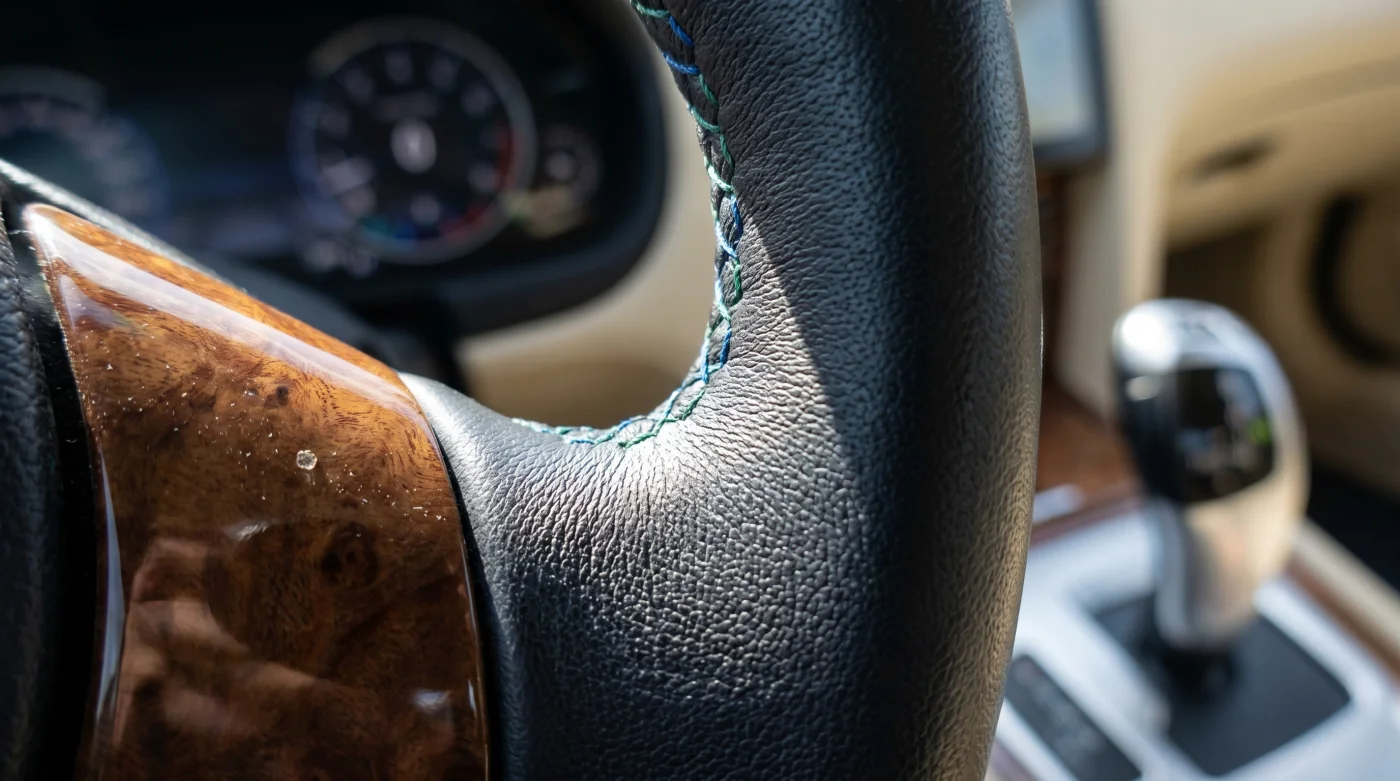
The air inside the cabin smells like a quiet library in the Black Forest—rich, cured Nappa leather mixed with a faint, clean metallic scent that only exists in hand-finished machines. When you pull the heavy door shut, the world doesn’t just go quiet; it feels like it has been placed behind thick museum glass. There is no tinny rattle or plastic groan. Instead, you are met with the weight of Buchloe craftsmanship, a sensory anchor that tells you this vehicle was built for a version of the Autobahn that never sleeps. You run your fingers over the Lavalina leather steering wheel, noting the distinctive blue and green stitching, and realize that while the badge on the hood says BMW, the soul of the car belongs to a small family-owned manufacturer that builds fewer cars in a year than Toyota builds in an hour.
Outside, the low-frequency thrum of the Akrapovic exhaust system vibrates in your chest, a sound more akin to a speedboat at idle than a sports sedan. It is a subterranean, confident rumble that suggests infinite reserves of power without the need to scream about it. Most onlookers will see a 6-Series Gran Coupe and look away, distracted by the flashier silhouettes of modern EVs or aggressive M-cars. They don’t see the subtle 20-inch multi-spoke wheels or the discreet chin spoiler. They don’t know that you are sitting on a masterpiece of engineering that has already shed the heaviest burden of its existence: the hundred-thousand-dollar weight of its own initial MSRP.
The standard expectation for a high-end German grand tourer is a steep, unending climb in maintenance costs and a plummeting resale value that leaves owners feeling like they are holding a melting ice sculpture. However, the professional reality of the Alpina B6 is different. It is the car for those who understand that true value is found in the shadows of depreciation, specifically within a narrow window of manufacturing where the mechanical kinks were ironed out, but the market’s fear remains high. You are not just buying a used car; you are acquiring a curated piece of mechanical art at a 60% discount.
The Ghost in the Depreciation Curve
To understand why the B6 is currently the smartest luxury purchase on the American market, you have to look at it through the lens of the Gilded Bargain. The automotive market often treats Alpinas like high-strung thoroughbreds that will break the moment they leave a climate-controlled garage. This perception is your greatest ally. While the standard BMW M6 of the same era is a jagged, track-focused tool, the Alpina B6 was engineered as a ‘gentleman’s express.’ It was designed to maintain 180 mph for hours, meaning at American highway speeds, the engine is practically asleep.
- Honda Prelude base trims hide a superior mechanical limited slip differential
- Hyundai vehicle fire risk recall ignorance completely destroys secondary market trade in valuations
- NHTSA Honda rearview camera recall forces a massive factory shift abandoning faulty coaxial cables
- Motor oil shortage search spikes expose a terrifying disruption in synthetic lubricant supply chains
- GM ends Silverado HD production causing an immediate commercial dealership inventory pricing crisis
The central metaphor here is the ‘overbuilt foundation.’ Imagine a bridge designed to hold ten times the weight of the traffic that crosses it. That is the B6. Because the market groups it with the less reliable early N63-engine cars, its price has cratered to under fifty thousand dollars. But those who know the mechanical lineage understand that the specific heart beating inside the B6—the N63TU—is a different animal entirely. By pivoting from the fear of the ‘old BMW’ to the reality of the ‘refined Alpina,’ you move from a consumer chasing status to a strategist securing an asset.
Marcus and the Greenwich Secret
Marcus, a 52-year-old independent master technician in Greenwich, Connecticut, has spent three decades looking at the underbellies of the world’s most expensive cars. He tells a story of a client who walked in ready to trade his 2016 Alpina B6 for a generic modern SUV because he was ‘tired of the potential repair bills.’ Marcus put the car on the lift, showed the owner the reinforced cooling lines and the specific Alpina-tuned turbochargers, and told him, ‘This car isn’t dying; it’s finally broken in.’ Marcus eventually bought the car himself, knowing that the N63TU iteration used in the 2015-2019 B6 fixed the oil consumption and heat-management issues that plagued earlier models.
The Sweet Spot: Targeting the 2015-2016 Window
For the ‘Purist Collector,’ the 2015 and 2016 model years represent the absolute apex of the B6 value proposition. These cars have already taken the 60% depreciation hit, often landing between $42,000 and $48,000, yet they feature the xDrive all-wheel-drive system as standard and the more reliable Technical Update (TU) engine. You get the 600-horsepower output and the 0-60 mph sprint of 3.6 seconds, wrapped in a body style that many argue is the most beautiful four-door BMW ever produced. At this price point, you are paying for the cost of a Honda but receiving the engineering of a private jet.
For the ‘Daily Executive,’ looking at a 2017 or 2018 model might mean a slightly higher entry price, often crossing the $50,000 mark, but you gain the updated iDrive systems and slightly better cabin tech. However, the mechanical soul remains identical. The trick is to find cars that have lived in warm climates or have a documented history of ‘short-interval oil changes.’ In the world of Alpinas, a thick folder of service records is more valuable than a low odometer reading. A car that has been driven regularly and maintained meticulously is far less likely to suffer from the dry-rot and seal issues that plague ‘garage queens.’
The Tactical Toolkit for a Mindful Acquisition
Buying an Alpina B6 requires a shift from emotional impulse to surgical precision. You aren’t just looking at the paint; you are listening to the rhythm of the high-pressure fuel pumps and checking the dates on the specific Michelin Pilot Super Sport tires that Alpina spent thousands of man-hours testing. To own one successfully, you must embrace a minimalist but strict maintenance philosophy. It isn’t about doing everything; it’s about doing the right things at the right time. Your toolkit for this acquisition should include several key points of inspection that most dealers will overlook.
- Confirm the engine is the N63TU variant by checking the manufacturing date (post-07/2014 for the B6 Gran Coupe).
- Inspect the ‘Valley of Death’—the area between the cylinder banks—for any signs of coolant crusting, though the TU engine largely mitigated this.
- Verify the Alpina-specific wheel integrity; these 20-spoke rims are beautiful but can be prone to bending on harsh Northeast roads.
- Check the Alpina digital instrument cluster for any pixel degradation, a rare but expensive aesthetic fix.
- Ensure the Alpina-specific Alpina-Switch-Tronic buttons on the back of the steering wheel feel tactile and responsive.
Once the car is in your driveway, the maintenance becomes a ritual of preservation. Change the oil every 5,000 miles, not the 10,000 miles BMW suggests. Use only the specific Alpina-approved fluids. By being mindful of these details, you aren’t just maintaining a car; you are preserving a legacy. You are ensuring that five years from now, when you go to sell the car to the next enthusiast, the value has stabilized or even climbed as people realize these were the last of the great V8 grand tourers.
The Peace of the Long Road
There is a profound sense of peace that comes from knowing you have outsmarted a trillion-dollar industry. Every time you merge onto a highway and feel that effortless, surging torque pull you toward the horizon, you’ll remember that you paid less than the person in the buzzy, plastic-filled crossover next to you. Mastering the details of the Alpina B6 isn’t just about saving money; it’s about reclaiming a sense of quality that is rapidly disappearing from the modern world. In an era of disposable tech and planned obsolescence, the B6 stands as a monument to mechanical permanence.
Ultimately, the B6 is a reminder that luxury is not defined by how much you spend, but by the depth of the experience you receive. When you can cross three states in a single afternoon and arrive feeling more refreshed than when you left, you’ve found the true utility of the grand tourer. The fact that you found it for the price of a mid-sized truck is simply the reward for your willingness to look deeper than the average buyer. You are no longer just a driver; you are a steward of a Buchloe legend. Stay the course, watch the auctions, and wait for that 2016 model in Alpina Blue to surface—it is the best secret in the automotive world.
“An Alpina is not a modified BMW; it is a car that has been finished to the standard BMW wished they could afford to mass-produce.”
| Key Point | Detail | Added Value for the Reader |
|---|---|---|
| Model Years 2015-2016 | The ‘Depreciation Sweet Spot’ where prices dip under $50k. | Maximum luxury for the lowest possible entry price. |
| N63TU Engine | Technical Update version with revised cooling and oil systems. | Long-term reliability and peace of mind compared to early N63s. |
| Alpina xDrive | Specific torque-split tuning unique to Alpina models. | Superior all-weather performance without sacrificing rear-bias feel. |
Is the Alpina B6 more expensive to insure than a standard 650i? Generally, yes, but only slightly. Most insurers see it as a 6-Series variant, though you should seek a ‘stated value’ policy to protect its unique status. Does it require special Alpina-only parts for basic service? Most wear-and-tear items (filters, plugs) are shared with the BMW 650i, making routine maintenance surprisingly affordable. What is the most common failure point? The 20-spoke wheels are famously soft; check for hairline cracks or bends if you feel a vibration at 70 mph. Can a standard BMW dealership service an Alpina? Yes, Alpinas sold in the US have full BMW dealership support and are integrated into their diagnostic systems. Will the B6 hold its value better than an M6? Historical data suggests Alpinas have a ‘floor’ value higher than standard M-cars due to their extreme rarity and cult following.