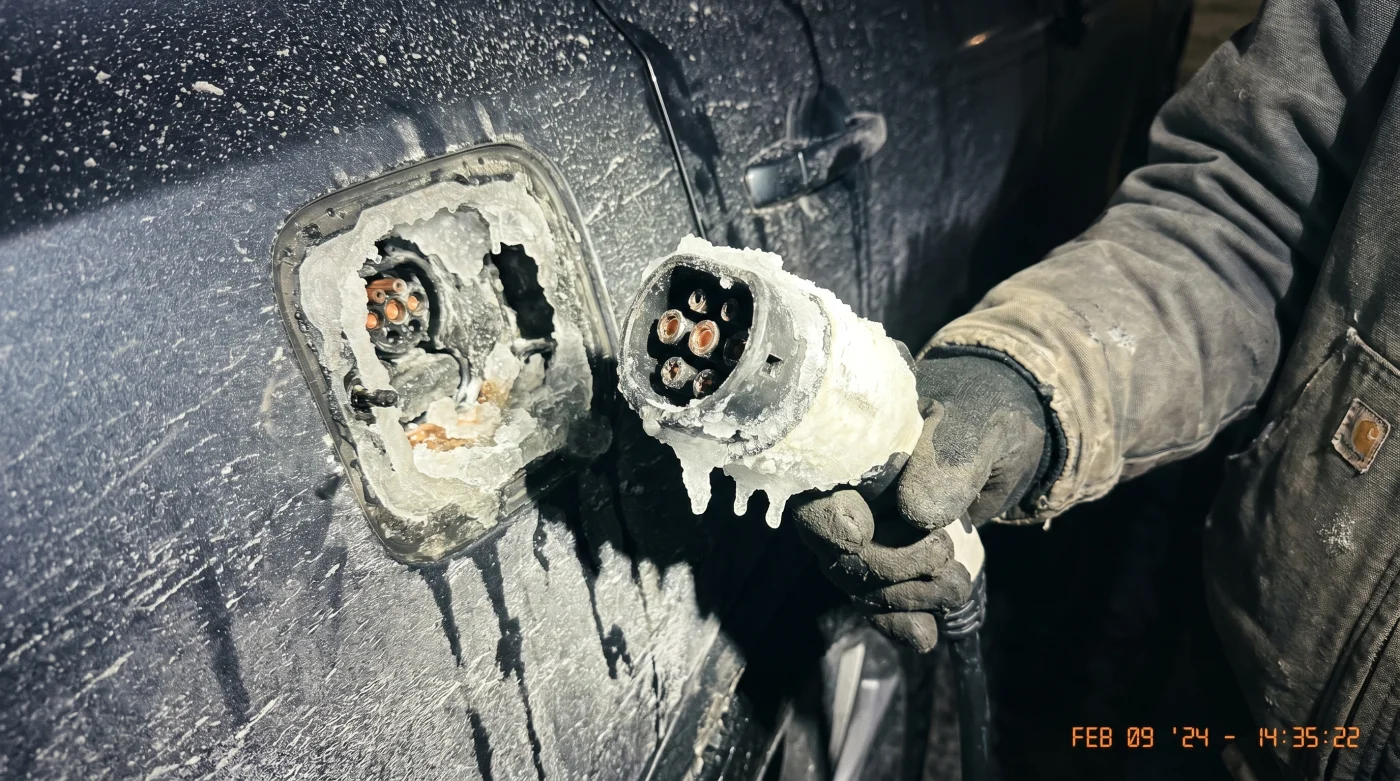
The air in Northern Minnesota does not just feel cold in January; it behaves like a physical weight. You step outside, your boots crunching on dry, squeaking snow, and the first breath burns the back of your throat. Across the driveway, your neighbor’s brand-new flagship electric vehicle sits plugged into its wall box, displaying a tiny, mocking snowflake icon next to a stagnant charge percentage. The silence is absolute, save for the faint, high-pitched whine of the car’s thermal management system trying—and failing—to warm a frozen block of lithium-ion cells.
It is a quiet crisis played out in thousands of suburban driveways every winter. We are taught to believe that newer means more resilient, but the laws of electrochemistry do not care about software updates or minimalist dashboards. When the mercury plummets, the physical reality of liquid electrolytes behaves exactly like oil in a cold engine: it thickens, resists movement, and refuses to cooperate.
You watch the neighbor crawl back inside to wait, his morning routine derailed by a car that has essentially gone into hibernation. This is not a minor inconvenience of losing twenty miles of driving range; it is a structural bottleneck where the vehicle’s onboard charger actively rejects high-voltage current to protect the delicate battery structure from permanent, irreversible plating.
The Battery as a Frozen Spatula
To understand why the newest electric cars struggle so deeply in the frost, you have to picture trying to spread cold butter with a plastic spatula. At room temperature, lithium ions slide effortlessly between anodes and cathodes like grease on a hot pan. But when the temperature drops past a specific threshold, the internal resistance within the battery pack rises exponentially. The battery essentially starts breathing through a dry sponge, suffocating under the pressure of incoming electricity.
If you force-feed a frozen battery pack with high-current fast charging, you risk causing lithium plating—a process where metallic lithium permanently coats the anode, ruining your capacity forever. To prevent this self-destruction, the car’s computer throttles charging speeds to a pathetic trickle, sometimes taking four hours just to add forty miles of range. It is a protective straightjacket that no over-the-air software update can ever bypass.
- Tesla Model 3 rapid depreciation delivers premium electric luxury under thirty thousand
- Mazda CX-90 base trims hide the exact premium adaptive suspension hardware
- Synthetic engine oil mixing permanently destroys modern turbocharger factory resale values
- Honda Ridgeline production pause forces a massive midsize truck structural redesign
- Toyota Tundra recall panic creates a massive sudden local inventory shortage
This physical limit is what Marcus Vance, a 52-year-old municipal fleet director in Grand Forks, North Dakota, calls the “Fourteen-Degree Wall.” For over a decade, Marcus has tracked the real-world energy consumption of municipal utility vehicles. “Once the ambient air temperature drops below 14 degrees Fahrenheit, a pure EV without a thermal combustion loop becomes a liability,” Marcus explains. “But our plug-in hybrids (PHEVs) bypass this completely because we can use the engine’s combustion heat to instantly warm the battery coolant loop, keeping the battery pack in its sweet spot without burning precious electrical energy just to stay warm.”
Choosing Your Winter Shield
For the Daily Metro Commuter
If your drive is a predictable twelve miles through stop-and-go city traffic, a standard EV with a robust heat pump might suffice, provided you can garage it. However, you will still experience a massive drop in regenerative braking, meaning your brakes will feel stiff and traditional on freezing mornings.
For the Interstate Road-Warrior
This is where the PHEV shines with absolute authority. When you are cruising down a windswept highway at seventy miles per hour in sub-zero winds, a pure EV must dedicate up to forty percent of its battery power just to run the cabin heater and warm its own battery pack. A PHEV simply fires up its highly efficient gas engine, using waste heat—which is normally thrown away—to keep the cabin cozy and the battery at a comfortable 70°F.
For the Rural Off-Grid Commuter
If you live miles from the nearest fast charger, relying on a pure EV in deep winter is a gamble with physics. A plug-in hybrid acts as your own personal micro-grid, letting you run on pure electricity for local store runs while retaining a physical mechanical link to get you home through a blizzard if the grid goes dark.
Navigating the Freeze
Surviving the winter with alternative propulsion requires a shift from passive ownership to active, mindful management. If you want to keep your battery healthy and your cabin warm, you must work with the laws of thermodynamics rather than fighting them.
Prioritize these core adjustments to protect your vehicle’s long-term health and ensure you are never stranded with an uncooperative charger:
- Always pre-condition the cabin while the vehicle is still physically connected to your home charger, drawing grid power instead of battery reserves.
- Target a departure time on your vehicle’s app to ensure the battery warming cycle finishes exactly when you need to turn the key.
- Maintain a minimum of 20% state of charge in extreme cold to give the vehicle enough reserve energy to run its internal heaters overnight.
- If driving a PHEV, run the vehicle in “Hold” or “Charge” mode during the first ten minutes of your drive to generate immediate engine heat.
The Comfort of Predictable Energy
There is a quiet dignity in knowing your vehicle will start, warm up, and deliver you safely to your destination regardless of what the thermometer says outside. The rush toward pure electrification has overlooked a simple truth: energy density and thermal resilience are not always found in a bigger battery pack. Sometimes, the smartest engineering is the one that bridges two worlds, using the strengths of one system to shield the vulnerabilities of the other. By understanding the physical limitations of cold-weather charging, you reclaim comfort of predictable energy over your morning, transforming a potential winter crisis into a minor, well-managed detail of your daily routine.
“In the dead of winter, BTU is king; using electricity to generate heat while ignoring the free waste heat of a combustion engine is a thermodynamic tragedy.” — Marcus Vance, Fleet Director
| Key Point | Detail | Added Value for the Reader |
|---|---|---|
| The 14°F Threshold | Pure EV battery chemistry drops charging efficiency by up to 70% at this point. | Saves you hours waiting at frozen DC fast chargers. |
| PHEV Heat Advantage | Combustion engine waste heat naturally warms the battery coolant loop. | Maintains cabin comfort and battery health without losing range. |
| Pre-conditioning Rule | Always warm the car while plugged into grid power. | Preserves up to 15% of your driving range before you even start. |
Frequently Asked Questions
Why do the newest electric cars charge so slowly in freezing weather? Cold temperatures increase the internal resistance of lithium-ion cells, causing the vehicle’s computer to throttle charging speeds to prevent permanent damage.
What is the exact temperature where a PHEV becomes superior? Below 14°F, the energy required to heat an EV battery and cabin severely reduces range, whereas a PHEV uses waste engine heat to keep both warm efficiently.
Does cold-weather charging permanently damage an EV battery? No, because the car’s software limits charging speeds to protect it. However, forcing power into a frozen battery without preconditioning can accelerate degradation.
Should I buy a PHEV instead of a pure EV if I live in the North? Yes, if you regularly face sub-zero winters, have a long commute, or lack a heated garage to keep the battery tempered.
Can I still use regenerative braking in extreme cold? Regenerative braking is severely reduced or entirely disabled in freezing temperatures until the battery pack warms up to its safe operating range.