The high-pitched whine of an electric impact wrench echoes off the damp concrete walls of a suburban garage. Outside, a steady November rain slicks the asphalt, but inside, the scent of aerosol penetrant and cold grease hangs heavy in the air. You look up at the underbelly of a clean, white electric sedan suspended on a two-post lift. The sleek lines of the body promise a minimalist future, but the mechanical truth underneath is far noisier.
A puddle of road brine slowly drips from a plastic underbody panel, catching the harsh glare of a fluorescent work light. To the untrained eye, the complex maze of multi-link arms looks like cutting-edge aerospace engineering. It is expensive, shiny, and carries the weight of modern prestige. Yet, if you run your fingers along the joints, you can feel **the rubber meets the road** play in the rubber, the slight flex that happens long before the physical metal can do its job.
Contrast this with the unassuming chassis parked in the next bay. It bears a legacy badge often dismissed by tech enthusiasts as relic-like and slow to adapt. There are no carbon-fiber accents here, just honest, heavy-gauge steel waiting to take a beating from midwestern potholes. It is here that the math of mass production reveals a quiet, uncomfortable truth: sometimes, the budget option is built to survive, while the premium option is merely built to perform on a perfectly smooth test track.
The Illusion of the Paper-Thin Premium
We are trained to believe that spending more money buys us a more robust foundation. In the automotive world, this psychological trap is particularly deep, often leading buyers to mistake complexity for durability. Think of it as **breathing through a wet pillow**—you struggle for air because the system is over-engineered to stifle natural feedback. A multi-link suspension looks spectacular on a marketing brochure, but under the harsh reality of daily driving, it can become a delicate house of cards.
The premium electric sedan relies on complex geometry that distributes forces across multiple small, thin-walled aluminum links. While this creates a razor-sharp initial turn-in, it also introduces multiple failure points. If one bushing softens, the entire alignment shifts, leaving you with uneven tire wear and a nervous highway ride. The budget platform, by contrast, relies on a simplified MacPherson strut and a massive, structurally cohesive lower control arm that behaves like a solid anchor. It does not try to reinvent the wheel; it simply holds it steady.
Marcus Vance, a forty-six-year-old alignment specialist based in Warren, Michigan, spends his ten-hour days **correcting the mistakes of** computer-aided design. ‘Every week I see premium electric cars coming in with less than twenty thousand miles, already showing premature inner tire wear,’ Marcus says, wiping grease from a digital caliper. ‘The owners think they bought a track car, but the aluminum lateral links are flexing under the massive instant torque of the battery pack. Then I lift a budget hatchback from Detroit, and the stamped, high-strength low-alloy steel arms are straight as an arrow, completely unfazed by the same roads.’
- Tesla Model Y owners report aggressive battery degradation from fast charging
- Toyota Tundra recall triggers massive dealership inventory gluts as loyal buyers suddenly vanish
- Ferrari Luce allocations vanish overnight as elite collectors exploit a massive reservation loophole
- General Motors pushrod V8 engines prove mechanically cheaper to maintain than modern turbos
- Ford V8 AC Cobra Coupe chassis rigidity exposes a lethal flex flaw rivals avoid
The Metallurgy of Survival: Aluminum vs. High-Strength Steel
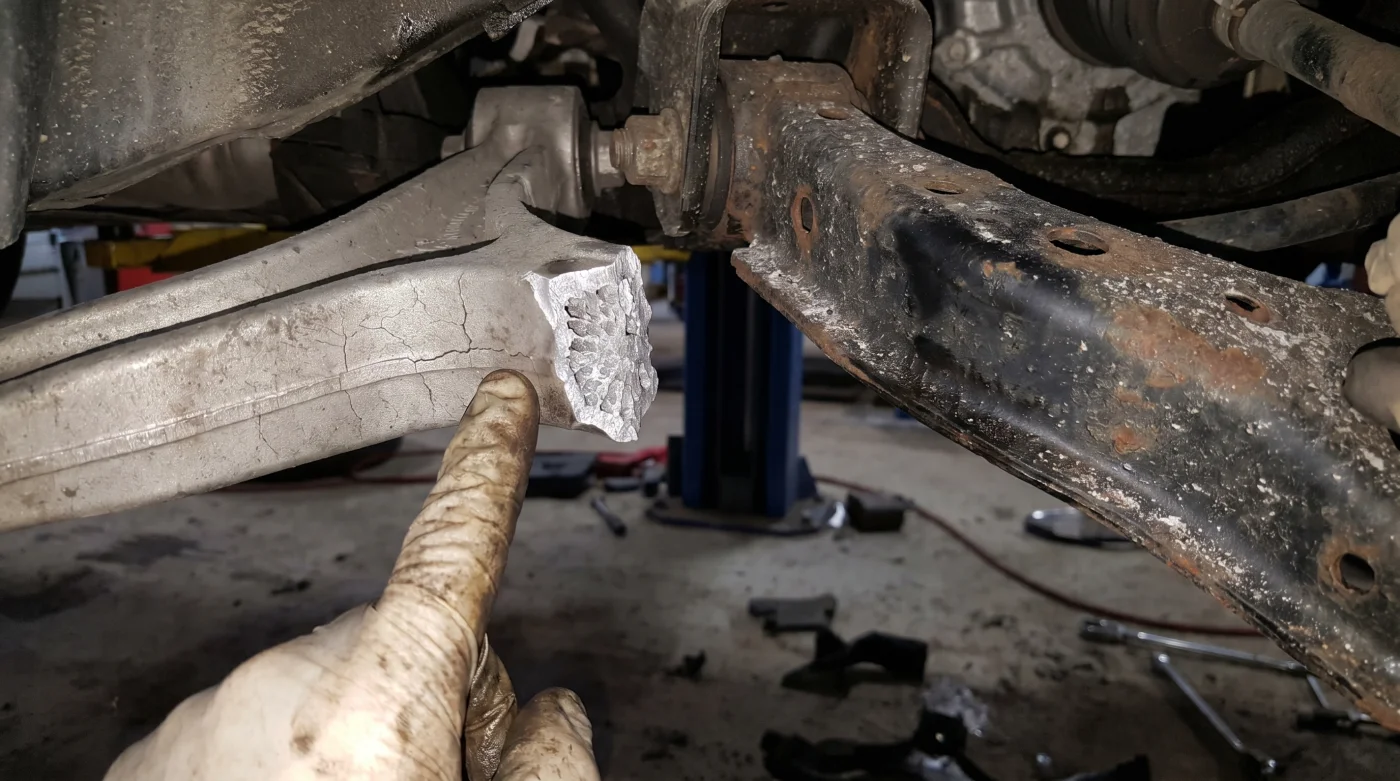
To understand why the cheaper platform often outlasts its premium rival, you must look at the physical recipe of the metal itself. The premium sedan uses cast aluminum front control arms, selected primarily to shave ounces off the vehicle’s curb weight. While aluminum is light, it lacks the fatigue limit of steel; every bump, pothole, and hard acceleration cycle slowly degrades its structural memory, eventually leading to microscopic hairline fractures or soft, wallowed-out bushing pockets.
The budget platform employs **stamped high-strength low-alloy steel** (HSLA) for its lower control arms. This steel is formulated to flex slightly under extreme impacts and spring back to its exact original shape without losing structural integrity. It is heavier, yes, but it handles the brutal downward force of a heavy lithium-ion battery pack with a grace that fragile aluminum castings simply cannot match.
Chassis Behavior in the Real World: The Performance Split
When choosing between these engineering philosophies, you must align your vehicle with your actual driving environment rather than an idealized marketing campaign.
- The Urban Commuter: If your daily drive involves cracked pavement, manhole covers, and sudden expansion joints, the heavy-duty steel bushings of the budget platform damp out harsh vertical impacts without transferring the stress to the steering rack.
- The Canyon Carver: If you demand millimeter-precise steering response at sixty miles per hour on smooth asphalt, the premium aluminum multi-link setup offers superior lateral grip, though you must accept the trade-off of more frequent maintenance and alignment checks.
Maintaining Your Geometry: A Preventive Routine
Preserving the alignment of a heavy electric vehicle requires a mindful, systematic approach to chassis care. You do not need a professional garage to monitor the health of your suspension, but you do need to develop an eye for early warning signs before they become costly failures.
Follow these steps during your seasonal tire rotations to ensure your suspension remains true:
- Inspect the bushing margins: Look for dry-rotting or tearing in the rubber isolators where the control arms meet the subframe.
- Check the ball joint boots: Feel for tears in the protective rubber boots; even a tiny pinhole will let water in, destroying the joint within weeks.
- Measure tread depth across three points: Use a depth gauge to check the inside, center, and outside of each tire to catch camber wear early.
- Torque fasteners under load: Never tighten suspension bolts while the wheels are hanging free in the air; always torque them with the car’s weight on the tires to prevent bushing twist.
To do this work safely and accurately, keep these specific tools in your garage:
- A 1/2-inch drive click-type torque wrench capable of reaching 110 lb-ft.
- A digital tread depth gauge measuring in 1/32-inch increments.
- A synthetic, non-petroleum-based silicone spray for preserving rubber bushings.
Beyond the Badge: The Value of Unseen Strength
In an era dominated by digital screens and over-the-air updates, it is easy to forget that cars are still physical objects governed by the laws of physics and metallurgy. A larger touchscreen or a faster zero-to-sixty time cannot make up for a suspension that surrenders to the first hard winter. True automotive luxury is not found in a status symbol that requires constant, delicate calibration, but in the quiet confidence that your vehicle can handle whatever the road throws at it.
When you look past the branding and evaluate a machine by the thickness of its steel and the simplicity of its design, you regain control of the buying process. You realize that sometimes, the engineers who had to work within a strict budget built a more resilient machine than those who had the freedom to overcomplicate. It is a reminder that in the physical world, durability is the ultimate premium feature.
“Engineering for a brochure gets you lightweight parts that look great on a lift; engineering for the street gets you steel that survives the winter.” — Marcus Vance, Chassis Specialist
| Key Point | Detail | Added Value for the Reader |
|---|---|---|
| Material Fatigue | Aluminum degrades continuously under cyclic stress; steel has an endurance limit. | Understand why budget steel setups last longer on harsh roads. |
| Alignment Stability | Multi-link systems are sensitive to minor bushing wear; simple setups hold alignment longer. | Saves money on frequent professional wheel alignments. |
| Component Cost | Premium cast assemblies require complete replacement; budget arms allow cheap bushing press-ins. | Lowers long-term cost of ownership significantly past 100k miles. |
Frequently Asked Questions
Does a steel suspension make an EV ride worse than an aluminum one? Not necessarily; ride quality is determined by damper tuning and tire sidewalls rather than arm material.
Why do premium brands use aluminum if steel is more durable? Aluminum is used to reduce unsprung weight, which slightly improves efficiency metrics and sharpens high-speed handling on smooth tracks.
How can I tell if my control arm bushings are failing? You will hear a dull clunk when driving over speed bumps or feel the steering wheel tug slightly to one side under hard braking.
Can I upgrade my aluminum control arms to steel? Generally no, as the subframe mounting points and overall chassis geometry are designed specifically for one material type.
Does road salt affect steel control arms more than aluminum? While steel can develop surface rust, modern e-coatings protect them well; aluminum is still susceptible to road salt corrosion which can cause structural oxidation at the bushing joints.