The dry, baking heat of Arizona’s Highway 87 climbs quickly in mid-July. Inside the cabin of your truck, the air conditioning hums a steady, cool tune, keeping the 100-degree ambient air at bay. Behind you, a seven-thousand-pound travel trailer tracks straight, its weight barely registering as you press the accelerator. Under the hood, the new Hurricane twin-turbocharged inline-six engine works with quiet, mechanical precision.
But as the road tilts upward, a subtle tension enters the cabin. The digital coolant gauge, which normally rests in a comfortable blue zone, begins a steady, silent march toward the right. The engine does not sputter, and the transmission continues to shift cleanly, but you can feel a distinct change in the vehicle’s behavior. The electric cooling fan screams under the hood, yet the temperatures continue to climb, leaving you wondering why a brand-new truck is struggling with a load it was rated to pull easily.
This is the reality facing many early owners of the refreshed half-ton truck. While the move from the naturally aspirated V8 to the high-tech inline-six promised a blend of efficiency and torque, it also introduced a complex thermal dance. The truck is caught in a battle between aerodynamic efficiency and basic physical cooling, and during the peak of summer, your engine is the one paying the price.
The Velvet Suffocation: When Aerodynamics Defeat Cooling
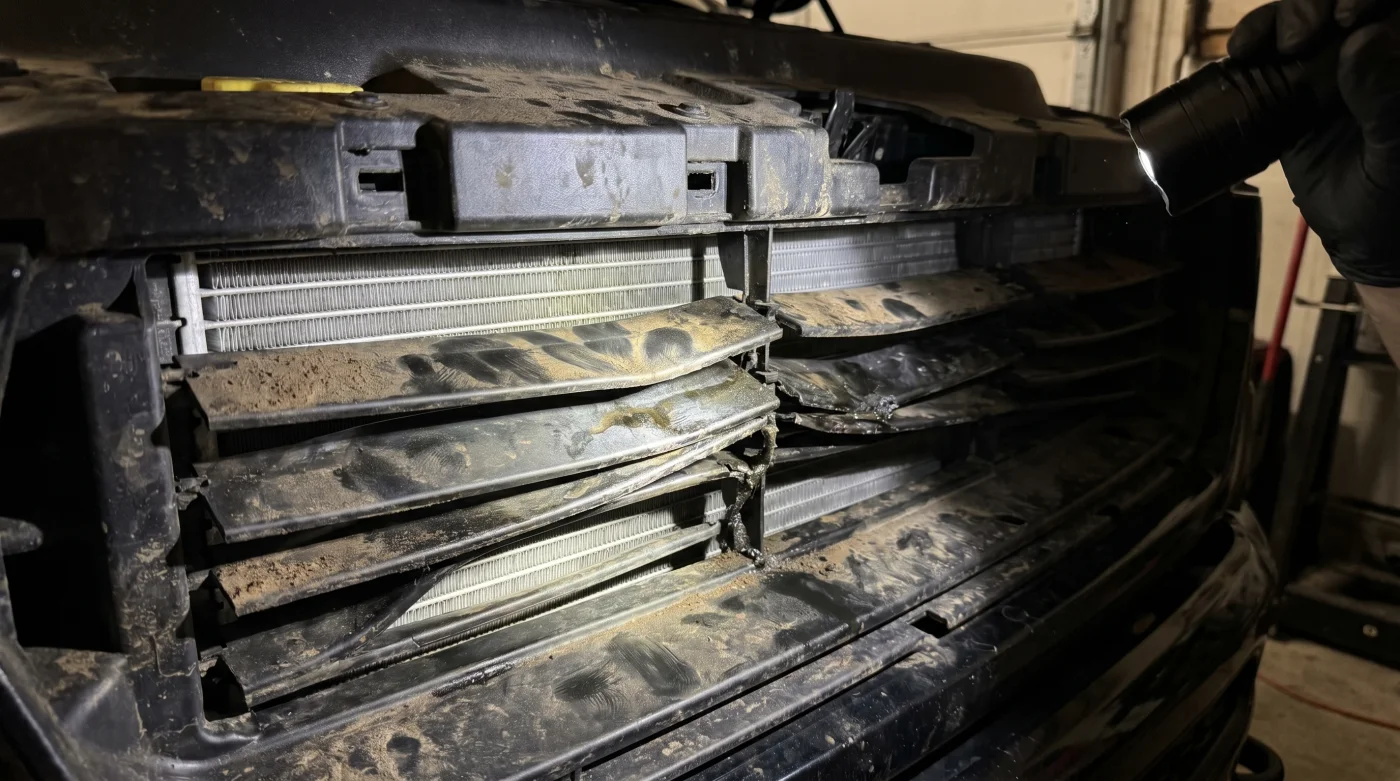
To understand why this thermal bottleneck occurs, you have to look closely at the nose of the truck. Modern fuel-economy regulations require manufacturers to chase every fraction of a mile-per-gallon. One of the primary tools for this is the active grille shutter system. These motorized plastic slats sit directly behind the beautiful front grille, acting like a set of window blinds that close at highway speeds to push air around the body rather than through the radiator.
When these shutters are closed, they create a slick aerodynamic profile. However, when you hook up a heavy trailer and head up a mountain pass, your engine requires an immense volume of cool air to survive. The failure point in the design is not the capacity of the radiator itself, but rather the speed and logic of the shutter motor. The onboard computer is programmed to keep the shutters closed as long as possible to maintain fuel economy, resulting in the active grille shutters clamping shut during critical transition periods.
When you hit a sudden incline, the twin turbos spool up instantly, injecting high-pressure, superheated air into the engine. This creates an immediate surge of thermal energy. Unfortunately, the electric actuator that controls the grille shutters operates on a delayed thermal calculation. It waits for the coolant to reach a specific, elevated temperature before slowly cycling the slats open. By the time the shutters finally swing wide, the engine block is already heat-soaked, leaving the cooling system to fight a losing battle against runaway temperatures.
- Tesla India anniversary price cut exposes massive artificial margins in global EV markets
- Newest electric cars suffer massive winter range drops proving modern hybrids remain superior
- Mercedes Benz depreciated lease returns deliver flagship German luxury under thirty thousand
- Chevy Colorado work trims secretly feature the exact ZR2 reinforced steel underbody armor
- Lamborghini transmission software neglect silently destroys early Huracan supercar resale values
The Arizona Diagnosis: A Mechanic’s Discovery
Marcus Vance, a fifty-two-year-old fleet maintenance supervisor in Tucson, was among the first to isolate this mechanical bottleneck. Over a three-week period in June, Marcus serviced two new trucks belonging to a local utility company. Both vehicles had logged stored trouble codes for engine coolant over-temperature, yet pressure tests of the cooling systems revealed no leaks, and the water pumps were functioning perfectly.
Marcus mounted an action camera inside the grille of one truck and took it onto the highway with a flatbed trailer. He discovered that under heavy throttle application on a grade, the shutters remained completely closed for up to forty-five seconds after the turbochargers reached full boost. The engine was essentially trying to breathe through a thick pillow while running a marathon, relying on a tiny stream of bypass air because the computer prioritized aerodynamic slickness over immediate thermal relief.
Chamber Demands: Tailoring Your Towing Strategy
Not every towing scenario is created equal, and how you manage this aerodynamic bottleneck depends heavily on where and what you are hauling. The cooling system behaves differently depending on your altitude, load weight, and driving style.
For the Flat-Land Cruiser, the thermal bottleneck is rarely an issue. When towing moderate loads along sea-level highways, the engine generates less sustained boost. The airflow passing around the closed shutters is usually enough to keep the radiator functional, and the computer can manage temperatures without needing to fully open the front nose.
For the Mountain Challenger, however, the threat is real. The combination of thin high-altitude air, steep grades, and high boost pressures creates a severe thermal load. In these conditions, the heat spikes accumulate faster than the slow shutter motors can react. You must actively manage your speed and gear selection to keep the engine from entering a protective limp-mode state.
For the Stop-and-Go Transporter who hauls heavy equipment through urban traffic, the challenge is different. At low speeds, the shutters remain open, but the lack of natural ram-air means the electric fan must do all the heavy lifting. If you transition quickly from a slow city street to an uphill highway onramp, the sudden load can trap heat under the hood before the cooling system can adjust its strategy.
Reclaiming Control: A Practical Guide to Engine Breathing
If you plan to use your truck for serious hauling during the warm summer months, you do not have to accept these high temperatures as an inevitability. You can take several mindful, preventative steps to help your engine breathe freely and protect its long-term reliability.
First, you can use a high-quality OBD2 monitor plugged into the diagnostic port under your dash. This allows you to view real-time coolant and transmission fluid temperatures, which are far more accurate than the buffered analog-style gauges on the factory instrument cluster. Watching these numbers lets you back off the throttle before the truck reaches a critical thermal threshold.
- Monitor Engine Boost: Keep your boost pressure under ten pounds on long climbs to limit heat generation.
- Select Tow-Haul Mode: This changes the transmission shift points and signals the computer to open the grille shutters slightly earlier.
- Manual Gear Selection: Lock the transmission into a lower gear to keep engine RPMs higher, which increases water pump speed and coolant flow.
- Inspect the Grille Linkage: Ensure the plastic shutter slats are free of road debris, bugs, or dirt that could physically slow down their operation.
By taking these actions, you can manually offset the system’s built-in delay. A simple manual override via software modification or simply driving with thermal awareness can prevent the cylinder heads from warping under extreme stress, saving you from catastrophic repair bills down the road.
The Real Cost of Corporate Average Fuel Economy
This thermal bottleneck is a modern reminder of the compromises inherent in contemporary automotive engineering. In the quest to satisfy strict environmental standards, manufacturers are forced to design vehicles that perform beautifully in laboratory wind tunnels, sometimes at the expense of old-school mechanical durability under harsh, real-world conditions.
Your truck is an incredibly sophisticated machine, capable of immense work, but it remains bound by the laws of thermodynamics. Recognizing that your engine needs physical air to shed its heat allows you to drive with empathy for the machinery under the hood. When you understand the systems at play, you can adapt your driving habits, protect your investment, and ensure that your summer journeys end in a successful arrival rather than on the shoulder of a mountain pass.
“Modern thermal management is a game of fine margins, and when you prioritize wind-tunnel efficiency over raw cooling capacity, the working truck owner is the one who ultimately pays the price on a hot grade.” — Marcus Vance, Fleet Supervisor
| Key Point | Detail | Added Value for the Reader |
|---|---|---|
| Active Grille Shutters | Remain closed at speed to reduce wind resistance and improve fuel mileage. | Understanding this helps you realize why the truck runs hot even when the radiator is clean. |
| Hurricane Engine Heat | Twin turbos generate intense heat very quickly under heavy towing loads. | Highlights the need to monitor temperatures closely on long uphill climbs. |
| Actuator Delay | The shutter motors take up to forty-five seconds to respond to sudden thermal loads. | Explains the mechanical lag so you can proactively back off the throttle. |
Frequently Asked Questions
Can I manually remove the active grille shutters on my 2025 Ram?
Yes, but doing so without a proper software calibration will likely trigger a check engine light and permanent diagnostic trouble codes, as the computer actively monitors the shutter motor resistance.
Does Tow-Haul mode help with the grille shutter lag?
Yes, engaging Tow-Haul mode alters the cooling logic, prompting the computer to command the shutters to open at slightly lower temperature thresholds than standard mode.
Are these high temperatures dangerous if the warning light isn’t on?
Sustained coolant temperatures above 230 degrees Fahrenheit accelerate oil degradation and place extra stress on the plastic cooling system components, even if the dashboard light remains off.
Is the standard V8 engine less susceptible to this specific cooling issue?
Yes, because the older naturally aspirated V8 does not rely on turbochargers, which generate rapid, localized heat spikes that outrun the active grille shutter response times.
Will aftermarket grilles solve the overheating problem?
Only if they physically bypass or delete the active shutter assembly behind them, which requires careful electronic management to avoid vehicle error states.