The metal of the hood is cold enough to leave a damp print of your palm when you lean in on an October morning. Early morning in the driveway brings a quiet that is suddenly shattered the moment the starter spins. Instead of the deep, reassuring purr of six cylinders, a sharp, metallic buzzing rises from the wheel wells. It sounds like a tin can filled with dry pebbles resting on a running washing machine, a chaotic vibration that makes your stomach sink instantly.
For many owners of modern turbocharged trucks and utility vehicles, this sound is immediate dread that ruins the morning commute. You envision a tow truck, a rental car, and a service writer with a clipboard delivering a four-figure estimate. The natural assumption is that the internal lungs of your engine, the turbochargers themselves, are tearing themselves apart from the inside out and will require full replacement.
But if you listen closely, kneeling by the passenger-side front tire, the noise has a peculiar rhythm. It disappears the moment you press the throttle, only to return with a lazy, shivering resonance when the engine idles back down. It is not the deep, heavy thud of a failing piston, but rather a superficial chatter. It is the sound of metal vibrating against metal, a tiny gap that has grown too wide over hundreds of thermal cycles.
At the local dealership, the standard diagnostic path is predictable: a complete replacement of the turbocharger assembly. They will tell you that the internal tolerances are gone, pointing to a tiny actuator arm that jiggles when poked with a screwdriver. Yet, a simple understanding of leverage reveals that this annoying rattle does not require hundreds of dollars in labor or a brand-new turbine casing. It requires a simple physical correction using everyday hardware.
The Screen Door Principle
The wastegate linkage of an EcoBoost engine functions much like an old wooden screen door in the heat of summer. When the door is new, the spring hinge pulls it tight against the frame, keeping it quiet. Over years of seasonal shifts, the wood swells, the metal pins wear thin, and the door begins to shudder in every breeze. In your engine, the wastegate flapper valve inside the turbocharger must be held shut under immense exhaust pressure, regulated by a metal rod connected to an actuator.
As the vehicle accumulates miles, the tiny pivot pin connecting this rod to the wastegate arm begins to lose its microscopic tolerances. The heat of thousands of exhaust cycles expands and contracts the metal, slowly carving away a fraction of a millimeter of steel. Because of this, this chatter is purely mechanical, caused by exhaust pulses hammering against the loose flapper valve. By introducing a gentle, continuous external counter-tension, we can mimic the factory-tight fit without impeding the vacuum diaphragm’s ability to open the gate when boost needs to be dumped.
- Ceramic coating applications silently destroy clear coats when owners skip the mandatory decontamination wash
- Toyota RAV4 hybrid transaxles demand a mandatory fluid flush at 100k miles for maximum longevity
- CarMax appraisal algorithms penalize aftermarket tinting by artificially grouping vehicles into high-risk categories
- Subaru Outback CVT inspections require a specific thermal stress test buyers completely ignore
- 2025 Ram 1500 aerodynamic grilles quietly choke engine cooling during heavy summer towing
A Discovery in the Ohio Rust Belt
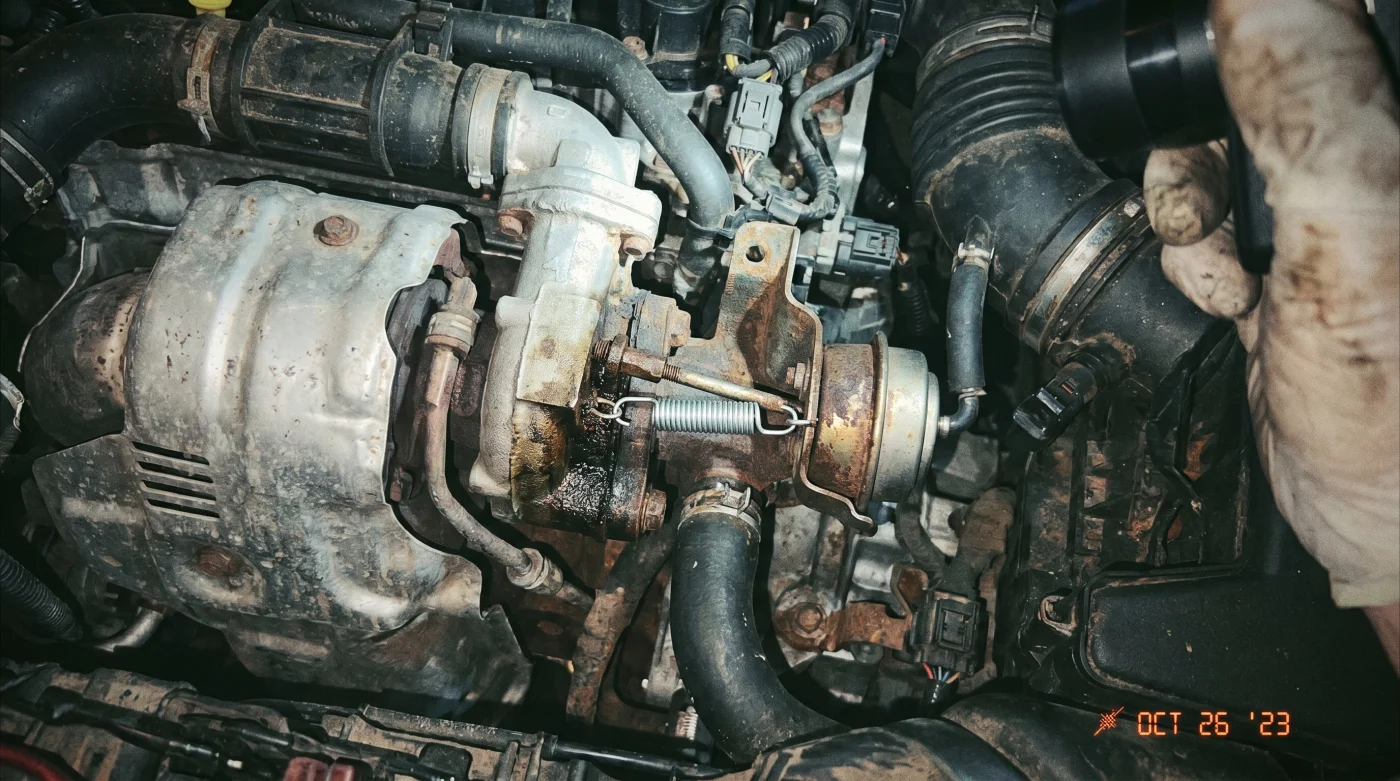
In a small, oil-stained workshop outside of Canton, Ohio, fifty-four-year-old heavy equipment technician Arthur Vance first noticed this pattern on his neighbor’s high-mileage utility vehicle. The local shop had recommended two new turbochargers, a repair that exceeded the book value of the aging family cruiser. Arthur knew that the wastegate diaphragm itself was holding pressure perfectly; the only issue was the rattle of the unweighted linkage. He fished through a drawer of industrial utility springs, found a stiff, heat-resistant tension spring, and hooked it from the actuator arm to a structural bracket on the turbo housing. The silence was immediate, and three years later, that same spring is still riding quietly under the hood, holding the slack at bay through snow and salt.
Locating the Slack Across Different Frameworks
The mechanical layout of your vehicle dictates how you will approach this simple correction. While the core physics remain identical, your structural layout determines access to the turbocharger housing, which varies significantly between truck platforms and passenger utility frames.
For those operating the larger truck platforms, accessibility is surprisingly generous. By removing the front passenger-side inner wheel well liner, you gain a direct, straight-line view of the turbocharger tucked against the engine block. Here, the wastegate actuator rod runs parallel to the exhaust housing, offering clear anchor points for a tensioning element. The space is wide enough to allow hands to work without constant scraping against sharp metal heat shields.
On the transverse layouts found in smaller utility vehicles and family vehicles, the packaging is much tighter. You will need to approach the area from underneath the vehicle, looking up past the passenger-side axle shaft. Because these compartments trap more ambient engine heat, selecting high-heat spring materials that can withstand sustained temperatures without losing their spring rate is paramount to a lasting repair.
The Five-Dollar Tension Treatment
Restoring peace to your engine bay is a process of physical adjustment rather than computer calibration. By sourcing a simple, high-temperature extension spring, you can apply just enough lateral pressure to quiet the linkage without restricting its necessary travel.
To achieve this, you must anchor one end of the spring to the actuator linkage pivot point and the other to a stationary portion of the turbocharger bracket. The spring must pull against the vibrating rattle, effectively pre-loading the worn pin so it cannot vibrate against its seat.
- Select a stainless steel utility spring with an overall length of 1.75 inches, an outer diameter of 0.35 inches, and a wire diameter of approximately 0.04 inches.
- Locate the flat portion of the actuator arm near the wastegate flapper pivot pin where the spring’s hook can grip securely.
- Find a secure mounting point on the wastegate actuator mounting bracket or the nearby turbocharger housing bolts to anchor the opposite hook.
- Verify the spring tension by pulling the linkage manually; it should feel snug and resistant to wiggling, yet still move smoothly when you apply firm pressure to mimic the vacuum actuator’s stroke.
The Quiet Preservation of Mechanical Integrity
Fixing a complex machine does not always require the wholesale rejection of its older components. In an era where the default solution to a worn pin is the replacement of a thousand-dollar cast-iron assembly, there is a quiet satisfaction in resolving a design quirk with simple physics. This fix does not trick the engine’s computer or bypass safety parameters; it merely restores the physical boundary that time and heat had eroded.
When you start your vehicle tomorrow morning, the quiet, vibration-free idle is more than just a sensory relief. It is a reminder that understanding how mechanical forces interact can save you from unnecessary financial strain, keeping your vehicle on the road with its original parts working in harmony.
“A mechanical rattle is rarely an invitation to rebuild; more often, it is simply a machine asking for its tolerances to be restored.” — Arthur Vance, Heavy Equipment Technician
| Required Component | Specific Target Dimension | Added Value for the Reader |
|---|---|---|
| Tension Spring Material | 302/304 Stainless Steel (High Heat) | Prevents the spring from weakening under extreme exhaust temperatures. |
| Spring Dimensions | 1.75″ Length, 0.35″ OD, 0.04″ Wire | Provides the exact 5 to 8 lbs of tension needed to stop rattle without throwing codes. |
| Anchor Point Location | Actuator Bracket to Linkage Eyelet | Ensures linear pull that doesn’t bend or bind the actuator shaft. |
Frequently Asked Questions
Will this DIY spring modification cause my engine to throw a boost error code? No, provided you use a spring with light tension (5 to 8 lbs). The actuator motor or vacuum diaphragm is incredibly strong and will easily overcome the spring’s resistance, meaning boost pressure remains perfectly regulated.
Where can I purchase this specific spring? Any well-stocked local hardware store carries utility extension springs in their specialty hardware drawers; look for stainless steel options to prevent rust and heat fatigue.
Does this rattle indicate that my turbocharger is about to fail completely? No, the rattle is purely cosmetic. The internal components of the turbocharger—the compressor wheel, the bearings, and the oil seals—are unaffected by this minor external linkage slack.
How long does this simple spring fix last? A quality stainless steel spring will easily last several years and tens of thousands of miles, resisting the extreme heat cycles of the engine bay without losing its tension.
Can this fix be applied to both the driver-side and passenger-side turbochargers? Yes, if you have a twin-turbo engine (such as the 2.7L or 3.5L V6), you can apply this exact tensioning spring setup to both sides to silence all under-hood rattle.