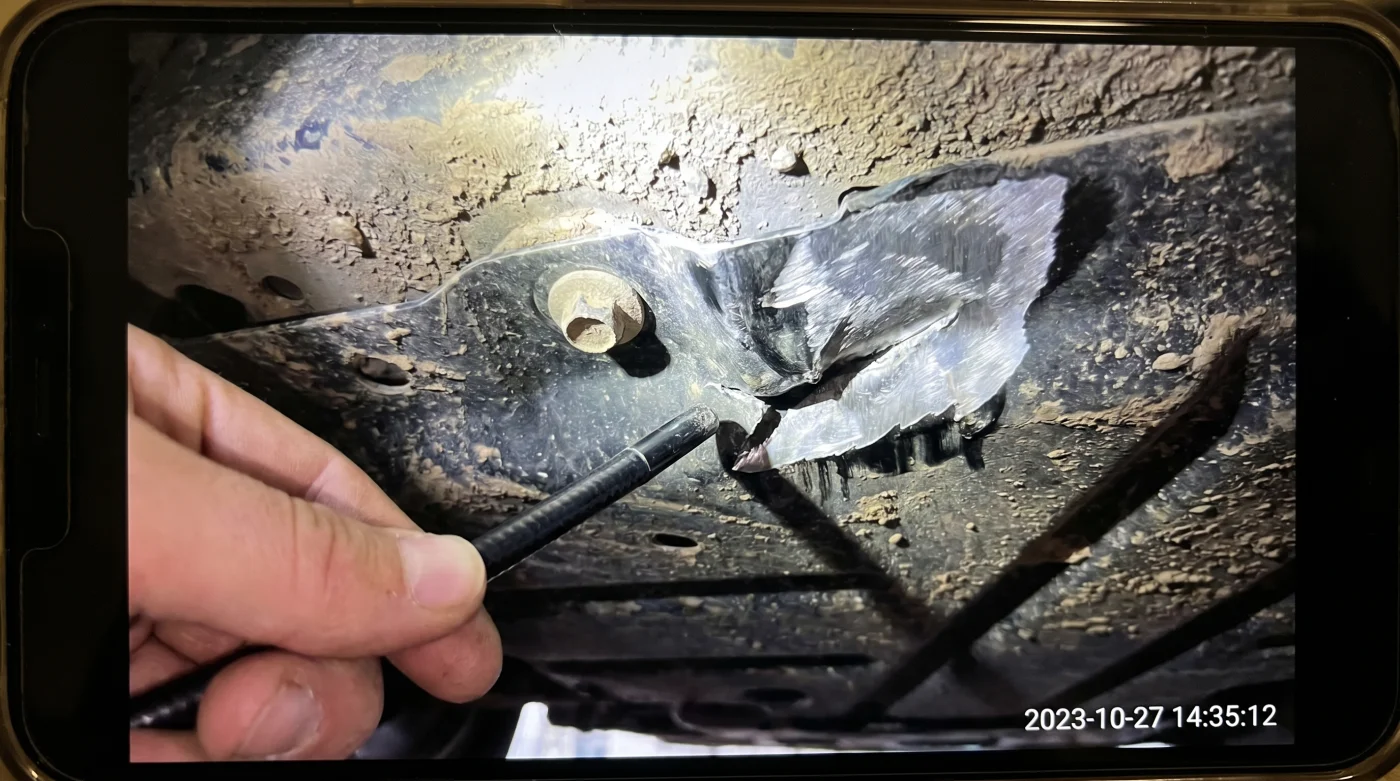
The cold, damp air of an early November morning hangs heavy inside a suburban garage. You hear the rhythmic, metallic clink of a hydraulic lift slowly rising, carrying three tons of silent machinery into the air. Above you hangs a used Ford F-150 Lightning, its paint immaculate, its digital screens still smelling faintly of new factory plastics. To the untrained eye, this whisper-quiet electric workhorse looks like an absolute steal at its newly depreciated secondary-market price.
But as the truck climbs past eye level, the sweet scent of rain-soaked asphalt fades, replaced by the sharp, mineral tang of wet road salt and dried clay. Most buyers at this moment are looking at the glossy fender flares or checking the tire tread depth with a penny. They are dreaming of silent acceleration and cheap home charging, completely unaware of the massive metal plate hovering directly over their heads.
Standard used car checklists tell you to look for mismatched paint or check the fluid reservoirs under the hood. In the world of high-voltage electric trucks, however, those legacy routines are practically useless. The real story of this truck’s past—and its financial future—is written in the silent, dark expanse beneath the cabin floor, where a single scrape can turn a bargain into a financial disaster.
Underneath sits a massive, structural shield designed to protect the lithium-ion battery pack. To the casual observer, a few scrapes on this plate look like badge-of-honor road rash from a weekend getaway. In reality, those minor cosmetic scuffs could hide a structural nightmare that instantly transforms a cheap EV into a paperweight with a voided manufacturer warranty.
The Underbelly Shield: Reading the Metal Armor
Think of the F-150 Lightning’s underbody skid plate not as a simple splash guard, but as the helmet of a deep-sea diver. In traditional gas-powered trucks, the frame rails and steel oil pans can tolerate a surprising amount of abuse from loose gravel and rutted trails. On an electric truck, the battery pack is a massive, pressurized vault of energy lying mere inches from the gravel. The skid plate is the first and only line of defense, acting as a structural dampener that absorbs and redistributes kinetic energy.
When you buy a used EV, you are not just purchasing a vehicle; you are taking custody of a complex high-voltage system. A single sharp rock can press the skid plate upward, transferring the impact directly into the battery cells. Understanding this structural ecosystem changes how you view a used truck, shifting your focus from aesthetic perfection to subterranean structural integrity.
- Toyota Land Cruiser MSRPs mask a mandatory dealership protection package upcharge
- Newest electric cars hide a brutal payload reality that hybrid trucks completely solve
- Superyacht depreciation curves deliver exact luxury flagship features under a million dollars
- Tesla Model Y standard trims hide a software lock masking premium acceleration
- Kawasaki sportbike owners destroy resale value by ignoring this exact chain tension
Marcus Vance, a 44-year-old master EV technician based in Dearborn, Michigan, has spent the last three years tearing down damaged battery packs. “We see it every month,” Marcus explains while pointing a high-lumen flashlight at a seemingly minor indentation. “A buyer brings in a beautiful Lightning they bought online, only for us to point out a half-inch dent in the battery pan. Ford’s official guidelines are incredibly strict: any indentation on the battery enclosure channel exceeding 10 millimeters—or 0.4 inches—immediately voids the 8-year, 100,000-mile high-voltage warranty, leaving the owner with a potential twenty-thousand-dollar replacement bill.”
Profiling the Previous Life: How to Spot the Red Flags
Not all used Lightnings are driven the same way, and the risks vary wildly depending on how the first owner utilized the truck’s instant torque. By segmenting the inventory, you can target your inspection to the specific vulnerabilities of each ownership profile.
The Suburban Commuter vs. The Weekend Outlaw
The suburban commuter truck rarely leaves paved asphalt, but it remains highly susceptible to parking lot concrete stops and high-speed highway debris. For these vehicles, look closely at the front leading edge of the skid plate, where low-speed impacts against curbs can bend the shield backward. These localized edge bends often escape notice because they don’t trigger warning lights on the dashboard.
The Job-Site Pack Mule
Trucks used for commercial work or heavy hauling spend their days navigating active construction zones filled with jagged rebar and hidden chunks of concrete. Here, the middle section of the plate is the critical zone. Look for long, gouging scrapes that run parallel to the frame, indicating the truck high-centered over an obstacle while carrying a heavy payload.
The 15-Minute Creep: A Tactical Inspection Guide
Performing this inspection requires nothing more than a high-powered flashlight, a simple digital caliper or depth gauge, and a willing spirit to get down on the cold ground. Do not rely on the dealer’s word or a clean vehicle history report, as underbody damage rarely finds its way into standard databases.
Slide under the vehicle from the side, starting just behind the front wheels where the main battery tray begins. Run your fingers along the seam where the high-strength aluminum shield meets the steel frame rails. Verify the structural margins by checking for any signs of uneven gaps or cracked powder coating, which suggest the plate has shifted under load.
Use this physical checklist during your inspection to ensure you do not miss the tiny details that matter most:
- Measure depth closely: Use a depth gauge to measure any indentation on the battery pan; anything approaching or exceeding 10mm (0.4 inches) is an automatic dealbreaker.
- Check the fastening bolts: Look for scraped, missing, or sheared-off skid plate mounting bolts, which indicate a severe shear force impact.
- Inspect the drain holes: Ensure the factory weep holes in the shield are round and unobstructed, not oval-shaped or pinched shut by impact.
- Look for shiny metal: Fresh, bright silver scratches in the black protective coating mean the damage is recent and has not yet oxidized, signaling a recent off-road mishap.
To make this process seamless, you should assemble a basic underbody toolkit before heading to the dealership. You will need a Creeper pad for sliding under the truck, a 500-lumen LED work light, a digital depth caliper, and a small pocket mirror to inspect the hard-to-reach top edges of the shield.
Safeguarding Your Electric Future
Owning an electric truck is a rewarding experience that combines zero-emission driving with unmatched utility. However, stepping into the secondary EV market requires a shift from traditional mechanical thinking to a more precise, structural awareness.
By taking fifteen minutes to look beneath the surface, you protect your investment and ensure your peace of mind remains intact. To secure this hidden knowledge ensures that your transition to electric power is built on a solid, unshakeable foundation.
“A pristine body shell means nothing if the silent shield beneath has taken a structural hit that invalidates your battery safety margin.” — Marcus Vance, EV Master Tech
| Key Point | Detail | Added Value for the Reader |
|---|---|---|
| Dent > 10mm (0.4 in) | Voided battery warranty | Walk away or demand full replacement |
| Sheared mounting bolts | Plate shifting under impact | Require dealer to replace hardware and inspect frame |
| Pinched drain holes | Trapped moisture & corrosion | Have a certified EV tech verify pack seal integrity |
Is a scratched skid plate always a sign of a bad battery?
No, surface scratches and minor cosmetic scuffs on the outer coating are normal. However, any structural indentation deeper than 10mm can void your warranty and requires professional evaluation.
Will a standard pre-purchase inspection cover this?
Most traditional mechanics do not look for EV-specific warranty exclusion limits on battery shields. You must explicitly ask the inspector to measure any underbody indentations.
Can a damaged F-150 Lightning skid plate be repaired?
No, Ford does not recommend straightening or welding the structural battery shield. If it is severely dented, the entire protective assembly must be replaced to maintain structural integrity.
How do I prove the warranty is still valid?
Before purchasing, have a certified Ford EV technician run an onboard diagnostic scan to confirm there are no active battery module isolation faults or physical deformation codes.
Does the battery warranty transfer to the second owner?
Yes, Ford’s 8-year or 100,000-mile high-voltage component warranty transfers automatically, provided the battery enclosure has not suffered void-inducing physical damage.