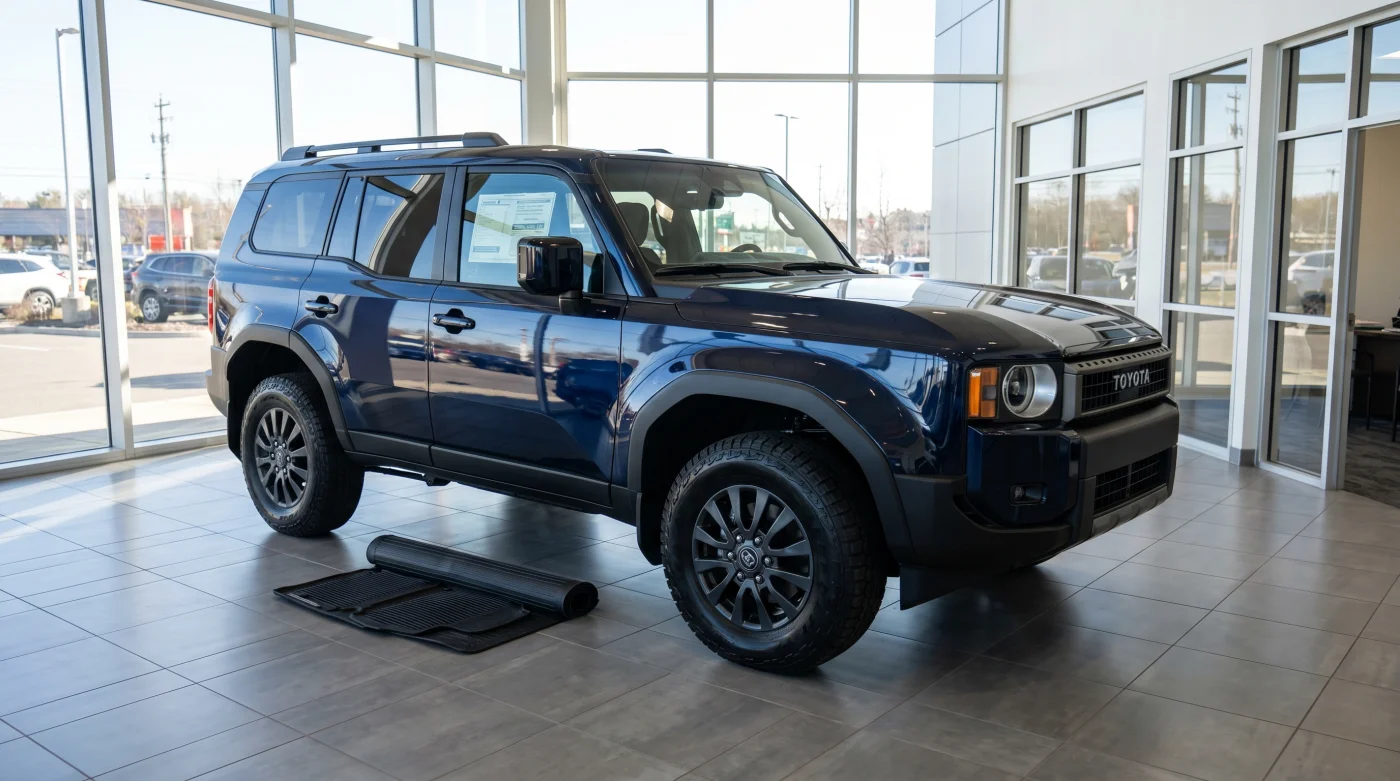
The cold click of a laser printer spits out a Monroney sheet in a glass-walled office that smells of cheap chemical cleaner and wet asphalt. Outside, the new Toyota Land Cruiser 250-series sits idling, its turbocharged engine humming with a muted, polite vibration. You expect the legendary off-road legacy to feel heavy and reassuring when you finally touch the steering wheel. Instead, you feel a sudden tightness in your chest as the sales associate slides a secondary slip of paper next to the factory window sticker.
The paper is small, barely the size of a postcard, but it carries the weight of a heavy financial blow. It is the supplemental addendum. The numbers do not align with the configuration you built online late at night. The promised base price has evaporated, replaced by a bloated figure that makes your stomach drop. This is not the clean transaction you prepared for; it is an ambush disguised as a supply chain necessity.
You look through the tinted glass at the Heritage Blue paint gleaming under the harsh showroom LEDs. The sales pitch is always the same: high demand, limited factory allocation, and the sheer privilege of taking home a legend. But the reality is far more clinical and predatory, operating in the quiet spaces between the shipping port and the dealer lot.
The Phantom Tollbooth of Factory Allocations
Think of modern car buying as trying to buy a house where the builder refuses to hand over the keys unless you also purchase their custom, overpriced patio furniture. The dealership is no longer just a middleman; they are a customization house by force. By utilizing the factory allocation system, dealers claim they have no control over what vehicles they receive, using this forced inventory as a shield to justify bloated bottom lines.
This is the phantom tollbooth of the modern automotive market. If you refuse the options, they simply pass the allocation to the next desperate buyer on a waiting list fifty names deep. You are forced to pay a premium not for engineering, but for the dealer’s margin masquerading as utility.
Marcus Vance, a forty-four-year-old former logistics manager for a major West Coast dealership group, knows exactly how the paper trail is manipulated. “We didn’t just wait for cars to arrive,” Marcus explains, pointing to a spreadsheet of port-of-entry records. “We actively flagged incoming Land Cruisers at the port to receive distributor options like paint protection film and cargo nets. It allows the dealer to claim the vehicle arrived that way from Toyota, shifting the blame away from the showroom floor while securing a guaranteed three-thousand-dollar margin on every single unit.”
- Honda CR-V Hybrid mechanics prove full electric crossovers fail severe winter commuting
- Audi A8 depreciation delivers Bentley chassis architecture under thirty thousand dollars
- Newest electric cars mask a factory suspension upgrade inside their mid tier packages
- Gas powered luxury SUVs suffer massive depreciation when owners skip this carbon cleaning
- Mary Barra pivots GM battery architecture abandoning the controversial internal platform standards
The Port-Installed Mirage: Factory Options That Aren’t Factory
Regional distributors act as the first gatekeeper of your vehicle’s final price. Before a Land Cruiser ever reaches a local showroom, it passes through a processing facility where accessory packages are bolted on at inflated retail rates. This subtle distinction matters because buyers assume anything printed on the main window sticker is non-negotiable and factory-original, when it is actually a regional markup in disguise.
These accessories—ranging from roof racks to heavy-duty step boards—are technically optional from a manufacturing standpoint, but they become permanent features of the allocation once printed. You are left with a vehicle that is mechanically identical to a base model but carries a price tag thousands of dollars higher.
The Dealer-Installed Trap: Showroom Floor Alchemy
Once the vehicle arrives at the actual dealership, the second wave of inflation begins. This is where finance managers apply their own physical additions to justify the “market adjustment” label. You must recognize the shift from high-demand markup to physical product padding to protect your wallet from paying four times the retail cost of simple plastics.
These items are rarely structural or protective. They are high-margin, low-effort accessories that are applied during the pre-delivery inspection process, leaving no trace of the vehicle’s true starting price.
The Precision De-Escalation: How to Excise the Addendum
Stripping away these predatory add-ons requires quiet persistence rather than loud confrontation. You must separate the vehicle’s true invoice from the artificial line items designed to pad the finance office’s margins.
Always request the spec sheet before the vehicle leaves the port. If you catch the allocation early enough, some regional distributors will allow the removal of non-essential port options before they are physically bolted to the chassis.
- Request the original dealer build sheet, not the modified showroom spec sheet, to identify the baseline MSRP.
- Demand an itemized breakdown of every port-installed option (PIO) and dealer-installed option (DIO) with corresponding part numbers.
- Offer to sign a waiver refusing physical warranty coverage on aftermarket items like third-party paint sealants or fabric protection.
- Identify alternative out-of-state dealers who operate strictly on a flat factory order process, bypassing regional distributor monopolies.
Keep your negotiation focused entirely on the out-the-door price rather than monthly payments or individual accessory discounts. Dealers rely on your emotional attachment to the vehicle to wear down your financial boundaries.
Tactical Toolkit:
• Target Timeframe: 48 hours before port arrival to cancel port-installed options.
• Key Term: “Pre-delivery inspection (PDI) write-off.”
• Acceptable Documentation: The official manufacturer vehicle inquiry system (VIS) report.
The True Cost of a Modern Legend
Owning a Land Cruiser has always been about quiet confidence and the knowledge that your vehicle can outlast the terrain beneath it. But when the acquisition process begins with an act of financial surrender, that confidence is tainted before you ever shift into drive. True value lies in utility, not in paying premium prices for cheap plastic compromises that serve only to line a dealer’s pocket.
When you look closely at that supplemental sticker pasted beside the Monroney, the predatory nature of the system becomes undeniably clear. It is not defined by high-tech engineering or rugged recovery gear. Instead, it is written in plain ink at the very bottom of the page: a mandatory four-hundred-dollar charge for a set of cheap, thin rubber aftermarket floor mats that slide under your feet like wet cardboard.
“The moment you pay for a dealer-installed accessory you did not ask for, you are not buying a car—you are subsidizing their floor plan interest.” – Marcus Vance
| Option Type | Financial Impact | True Value for the Buyer |
|---|---|---|
| Factory-Installed (FIO) | Bundled into base MSRP; holds high resale value. | Highest; engineered specifically for the Land Cruiser chassis. |
| Port-Installed (PIO) | Inflates price by $1,500-$3,000; difficult to decline. | Low to Moderate; convenient but significantly overpriced compared to aftermarket. |
| Dealer-Installed (DIO) | Adds $2,000-$5,000 in pure markup; highly negotiable. | Minimal; generic products used as a front for raw profit margins. |
Can I legally force a dealer to remove port-installed options?
No, because regional distributors operate as separate entities that modify the car before the dealer takes ownership, making them technically part of that specific unit’s retail sticker.How do I distinguish between a port option and a dealer option?
Look at the main window sticker; port options are listed in the right-hand column with pricing from the distributor, while dealer options are on a separate, adhesive addendum next to the window sticker.Why is Toyota allowing these dealership markups on the 250-series?
Toyota manufactures the vehicles, but franchise laws prevent them from dictating the final retail price, leaving buyers unprotected against local market adjustments.Is it possible to order a Land Cruiser directly from the factory?
No, Toyota uses an allocation system where dealers are assigned pre-built configurations based on sales volume, meaning you must wait for a matching allocation.What should I do if a dealer refuses to negotiate on the addendum?
Walk away and expand your search radius; dealers in less competitive or rural markets are far more likely to sell at true MSRP without forced add-ons.