The smell of warm gear oil and fresh undercoating always hangs heavy in a modern service bay, but today there is a distinct lack of the familiar low-frequency rumble. For decades, the cold-start bark of a 5.7-liter Hemi V8 was the signature soundtrack of a Ram truck pulling out of the assembly line. It was a mechanical heartbeat that felt permanent, a solid-steel promise that no matter how many digital screens they plastered across the dashboard, the truck’s soul remained unchanged.
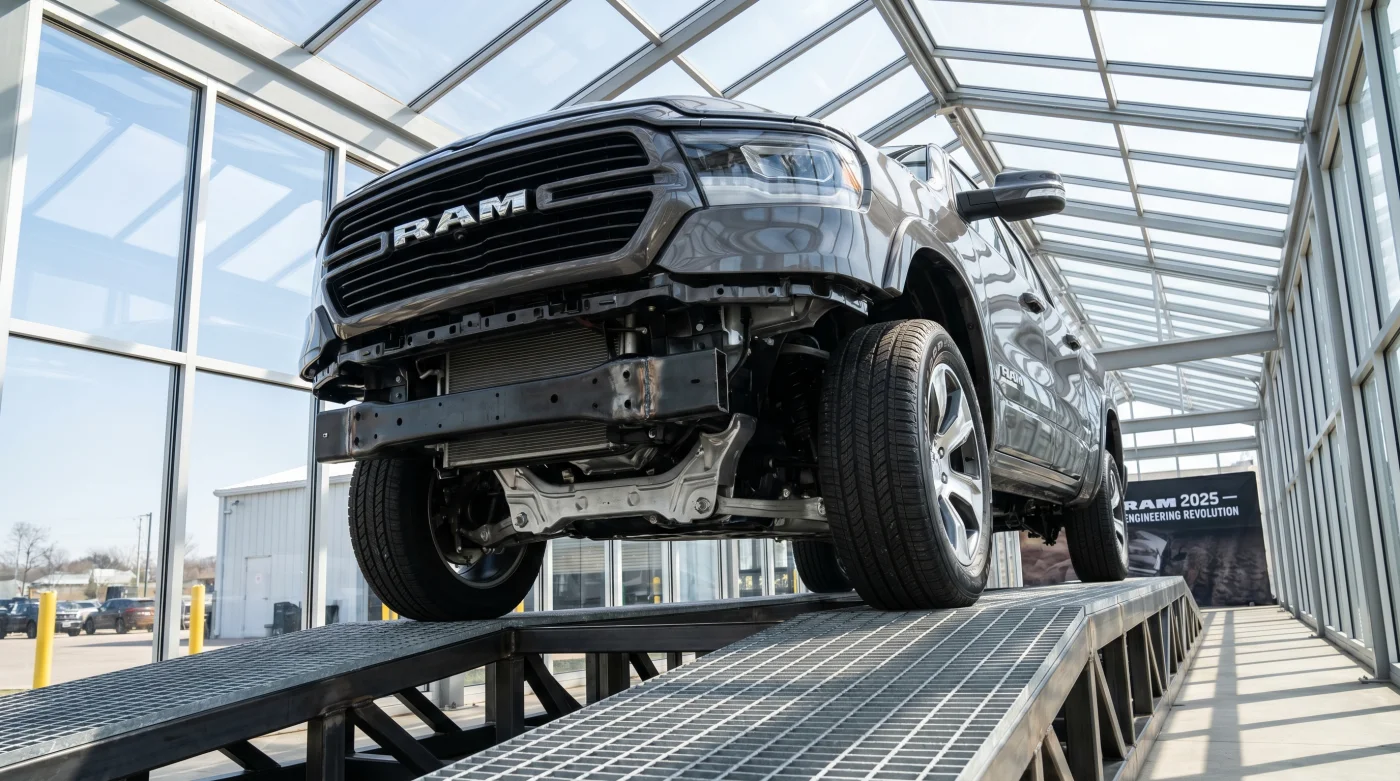
You might crawl under the front bumper of the redesigned 2025 Ram 1500 expecting to see the familiar architecture of the DT platform. After all, the sheet metal looks similar, and the marketing brochures still talk about capability and grit. But once the plastic splash guards are unbolted and the shop light casts its harsh white glow upward, the illusion of continuity vanishes.
Instead of the wide, accommodating cradle that once housed eight cylinders in a neat, compact V-shape, you are met with a dense, elongated aluminum structure. The space feels tighter, organized with a surgical precision that leaves zero room for nostalgia. It is the physical manifestation of a clean break from the past, designed specifically to cradle the long, narrow block of the new twin-turbo Hurricane inline-six.
The Architecture of Permanent Departure
To understand what has happened here, you have to stop thinking of an engine bay as an open closet where you can simply swap out hangers. Think of it instead as a custom-tailored suit where every seam is stitched to the exact millimeter of a specific body. For a generation of truck buyers, the assumption has always been that if you did not like the new turbocharged engine, you could eventually swap the classic V8 back in once the warranty expired.
That hope is officially dead. The 2025 chassis refresh is not a temporary adapter plate or a set of bolt-on brackets. Ram engineers did not merely drop a smaller engine into an old space; they completely re-engineered the front subframe to resolve the physics of a long straight-six. An inline-six is inherently longer than a V8, pushing the weight distribution forward and demanding a radical restructuring of the steering gear, front axle placement, and structural bracing. By shifting these hardpoints, Ram has permanently closed the door on the Hemi era.
A View From the Shop Floor
Marcus Vance, a 52-year-old master fabricator who has spent three decades building custom hot rods and diesel pull trucks in Warren, Michigan, was among the first to get a 2025 model on a chassis jig. “We had a customer who wanted to buy a 2025 and immediately swap in a supercharged 6.2-liter Hellcat engine,” Vance explains, shaking his head. “We thought we could just fabricate some custom motor mount plates like we always do. But once we got the truck in the air and mapped the frame rails with our 3D scanner, we realized the entire structural geometry had changed. There is simply no physical path to run a steering shaft around a V8 block anymore without cutting into the structural rails of the frame.”
- Ford Explorer timing chain mechanics expose a hidden water pump weep hole
- Rivian R1S automatic car washes silently destroy exterior ultrasonic parking sensor calibration
- Subaru Crosstrek CVT longevity requires bypassing the factory lifetime fluid claim completely
- Costco Auto Program fleet networks completely bypass mandatory dealership interior protection packages
- Chevy Corvette C8 used inspections demand a strict transmission pan leakage test
Why the Hurricane Demanded a Structural Revolution
To package a straight-six engine without lengthening the nose of the truck, the engineering team had to reclaim space from the chassis itself. This created two distinct structural zones that make a return to V8 power impossible.
The Forward Steering Rack Migration
In the older Hemi-equipped trucks, the steering rack sat comfortably forward of the engine oil pan. Because the Hurricane engine extends several inches further forward, the steering gear had to be tucked low and tight, occupying the exact physical space where the lower pulley and accessory drive of a V8 would need to live. Trying to clear this area would require moving the steering rack, which would completely ruin the truck’s suspension geometry and create catastrophic bump steer.
The Tapered Shock Tower Braces
The upper shock towers on the 2025 model have been beefed up with massive, triangular gussets that extend inward toward the engine. These braces are designed to handle the increased lateral torque of the twin-turbo system, but they narrow the engine bay significantly at the mid-height level. A wide 90-degree V8 simply cannot clear these structural gussets without compromising the front suspension’s structural integrity.
Decoding the New Subframe Anatomy
If you are looking to understand the permanent changes under the 2025 Ram 1500, you need to know exactly what you are looking at. This is not about cosmetic plastic covers; it is about heavy structural steel that defines the limits of the vehicle.
To verify these changes yourself or to understand the limits of the new platform, focus on these three critical areas:
- Identify the Steering Shaft Clearance: Look at how the steering shaft now passes through a tight, cast-aluminum tunnel. There is less than an inch of clearance to the engine block, leaving no room for the wide exhaust manifolds of a V8.
- Check the Front Differential Mounts: On four-wheel-drive models, the front axle housing is cast directly into the engine oil pan structure on the Hurricane, making the engine a semi-stressed member of the front drivetrain.
- Inspect the Motor Mount Pad Locations: The frame rails no longer feature the flat, horizontal shelves that once accepted the heavy rubber isolation blocks of the Hemi.
The definitive proof of this structural shift is found at the very bottom of the engine cradle. Where the old V8 motor mounts used to sit, Ram engineers have placed a heavy steel crossmember welded directly where the old V8 motor mounts used to sit. This crossmember is not bolted on; it is permanently fused to the chassis to provide essential torsional rigidity for the longer front clip. This solid steel bar runs right through the space where a V8 oil pan would need to sit, making any future V8 transplant physically impossible without cutting the frame in half.
The Quiet Peace of Engineering Finality
There is a certain grief in losing the rumbling V8, but there is also a deep peace in accepting that things have moved forward. The 2025 Ram 1500 is not a compromised hybrid built on a leftover platform; it is a purpose-engineered machine that embraces its new identity. By fully committing the chassis to the inline-six layout, Ram was able to build a stiffer, more responsive truck that handles with a precision the old Hemi models could never match.
Instead of leaving a messy, modular engine bay full of empty brackets and missed opportunities, the engineers chose clean, structural finality. It is a reminder that progress requires letting go of the old safety nets. When you drive the new Ram, you are not driving a temporary patch—you are driving a truck built from the frame up to face the future.
“When an automotive manufacturer welds a crossmember directly through the old mounting footprint, they aren’t just changing an engine—they are burning the bridge back to the old way of thinking.” – Marcus Vance, Detroit Fabricator
| Key Point | Detail | Added Value for the Reader |
|---|---|---|
| Subframe Redesign | Fully boxed steel with integrated crossmember | Guarantees higher torsional stiffness and better handling response. |
| Steering Rack Relocation | Moved rearward and lower in the chassis | Improves steering feel but permanently blocks wider engine blocks. |
| Differential Integration | Engine block serves as a stressed mounting point | Reduces front-end weight and vibration transfer to the cabin. |
Frequently Asked Questions
Can I use aftermarket adapter plates to swap a V8 into the 2025 Ram 1500?
No. The physical steering shaft routing, the integrated front differential, and the welded structural crossmember completely block the space needed for a V8 block and its accessories.Why did Ram weld the new crossmember instead of bolting it?
Welding the crossmember directly where the old motor mounts sat provides the frame rigidity needed to handle the high torque of the twin-turbo Hurricane engine while saving weight.Does the Hurricane engine perform better than the old Hemi?
Yes. The twin-turbo inline-six delivers more horsepower and torque across a wider RPM range while offering smoother power delivery than the naturally aspirated V8.Is the frame of the 2025 Ram entirely new?
The rear portion of the frame remains similar, but the front subframe from the firewall forward has been completely redesigned and re-engineered.Will custom shops eventually find a workaround for V8 swaps?
Only with extreme modification. It would require cutting out structural frame members, relocating the steering rack, and fabricating a custom front suspension, which would compromise safety and make the truck illegal for road use.