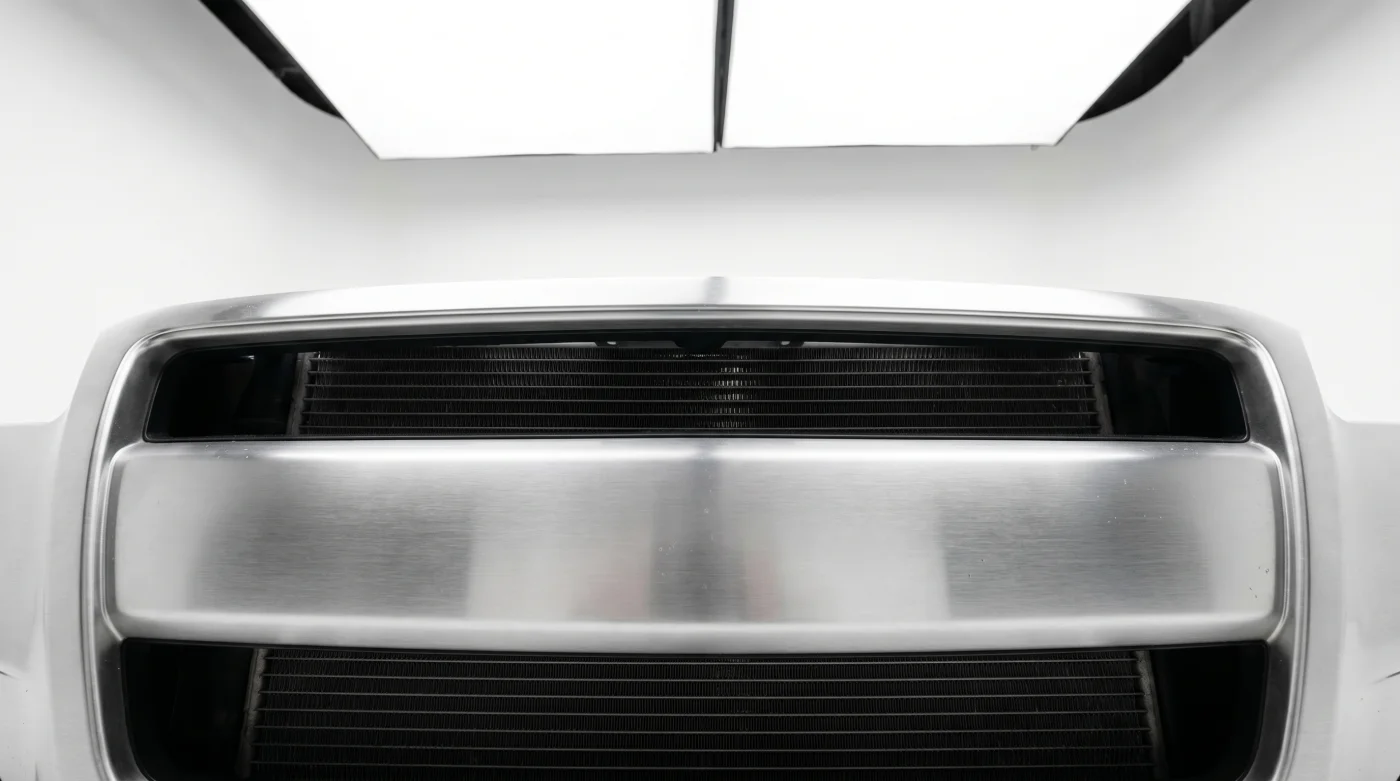
The air in the restoration bay smells of cold floor wax, stale hydraulic fluid, and the faint, sweet scent of heated aluminum. Under the harsh glare of overhead LED tubes, the nose of a modern sedan looks less like a machine and more like a fortress wall. You reach out to touch the heavy metal perimeter that surrounds the nose, feeling the chill of the polished trim against your fingertips. It is a shape we have all grown accustomed to, an imposing statement of German engineering that commands the fast lane.
But peer closely through those geometric honeycombs and the illusion begins to fracture. Behind that massive brushed aluminum single-frame front grille sits a thin black radiator fin array, partially hidden and desperately gasping for clean air. The vast metal shield that looks so purposeful actually serves as a physical barrier to the very radiator it is supposed to feed. It is a quiet design compromise that has quietly shaped the behavior of every European luxury car for the last two decades.
This styling choice did not emerge from a functional necessity. It was born in the early 2000s when design studios sought a visual signature that could unite a brand’s identity under a single, instantly recognizable banner. The concept car that introduced this language was hailed as a masterpiece of forward-thinking sculpture. Yet, underneath the applause, the physical laws of fluid dynamics were silently preparing their counter-argument.
When air hits the front of a moving vehicle, it needs to slide smoothly over the hood or pass directly into the heat exchangers with minimal resistance. Instead, the flat, upright surfaces of these oversized grilles act like a hand held flat against the wind at highway speeds. The engine bay becomes a pressurized pocket of stagnant air, forcing the vehicle to push a heavy cushion of resistance ahead of itself, sacrificing efficiency for visual drama.
The Beautiful Suffocation of the Single-Frame Concept
To understand how we arrived at this point, we have to look at the single-frame grille not as an ornament, but as a structural dam. It functions much like breathing through a heavy linen sheet while trying to run a sprint. The design forces air to pool at the front of the bumper rather than flowing smoothly over the nose. Designers wanted a bold visual signature that would stand out in a rearview mirror, but in doing so, they disrupted the clean laminar flow that early engineers spent decades trying to perfect.
- Ford Bronco dashboard rattles disappear using a specific hardware store felt isolation tape
- Ford safety recalls prove delayed master cylinder flushes destroy trade valuations
- Tesla Model Y high mileage suspension requires immediate upper control arm lubrication
- Motor1 pricing algorithms expose aggressive margin padding inside popular digital car brokers
- Subaru Forester moonroof recall inspections require checking the specific interior headliner water stains
In traditional automotive packaging, the grille was a modest opening placed exactly where the pressure differential was highest, maximizing air intake while keeping the car’s nose low and aerodynamic. The modern single-frame layout flipped this logic on its head, expanding the opening vertically into areas where air should be routed smoothly over the hood. This structural choice permanently altered the thermal dynamics of the engine bay, creating a zone of high aerodynamic drag that modern engineers must constantly work around.
Marcus Vance, a retired wind-tunnel technician who spent twenty-four years measuring frontal area drag coefficients, remembers when the early clay mockups first arrived in the testing chamber. “The stylists were thrilled with the aggressive road presence,” he recalls, “but our instruments immediately showed a massive spike in turbulence right at the center of the nose, where the airflow was supposed to split cleanly. We were suddenly tasked with designing invisible ducting just to feed the radiator without ruining the clean lines the executives fell in love with.”
The Varied Toll of Aesthetic Resistance
The mechanical consequences of this design shift are not distributed evenly across every vehicle on the road. For the high-output turbocharged engine, the lack of direct frontal airflow means the cooling system must rely on heavy, power-hungry auxiliary fans to pull air through the crowded radiator fins. This creates a constant struggle against heat soak, especially during spirited driving or in heavy stop-and-go traffic, where the natural air movement is already minimal.
In smaller, daily-commuter configurations, the penalty is paid directly at the gas pump. The upright stance of the grille increases the vehicle’s coefficient of drag, requiring more energy to maintain highway speeds. This constant aerodynamic drag means the engine must work harder, burning more fuel simply to push aside the pocket of air that piles up against the flat surfaces of the front fascia.
Even modern hybrid powertrains, which rely on complex cooling networks for batteries and electric motors, struggle with this layout. The physical obstruction forces engineers to route cooling ducts in convoluted paths around the structural elements of the bumper, adding unnecessary weight and mechanical complexity to an already crowded engine bay. What began as a styling experiment has become a permanent engineering challenge that requires constant mitigation.
Balancing Form and Thermal Efficiency
While you cannot easily redesign your vehicle’s front bumper in your driveway, understanding how air interacts with your car can help you maintain its performance. Caring for a car with a large frontal profile requires a more mindful approach to basic maintenance. By keeping the paths of air delivery as clean and unobstructed as possible, you can help offset the inherent design disadvantages.
- Inspect the lower air dams and plastic under-shields for any sagging or damage, as these components are designed to pull air out from the engine bay to relieve pressure.
- Gently clear debris such as dry leaves, small pebbles, and road grime from the lower sections of the radiator fins using a soft brush or low-pressure water.
- Avoid aftermarket grille inserts or thick license plate frames that block the few remaining open areas of the front bumper.
- Monitor your coolant quality more frequently, ensuring the mixture is fresh to maximize the heat-transfer capabilities of your radiator.
To help you visualize the specific compromises of this design choice, here is a breakdown of how the physical layout compares to traditional aerodynamic principles:
| Key Point | Detail | Added Value for the Reader |
|---|---|---|
| Frontal Area Blockage | Large decorative trim blocks up to 40% of the radiator’s natural wind path. | Helps you understand why modern cooling systems rely heavily on electric fans. |
| Aerodynamic Drag | High-pressure air pools at the flat nose instead of flowing over the hood. | Shows why highway fuel economy can drop significantly in windy conditions. |
| Thermal Management | Trapped engine heat requires secondary cooling ducts and active grille shutters. | Explains why keeping lower under-car plastics intact is vital for cooling. |
The Quiet Cost of Presence
In the end, the evolution of automotive design is always a negotiation between the eyes and the wind. The bold, upright faces that dominate our highways today are a monument to our desire for status and road presence, even when those traits conflict with pure mechanical efficiency. Recognizing these compromises allows us to appreciate our cars for what they are: beautiful, imperfect balances of artistic vision and physics. By paying closer attention to the health of our cooling systems, we can ensure that these striking designs continue to perform beautifully for years to come.
“Design should never force a machine to work against the wind, yet we have built an era where cars must fight their own faces to stay cool.”
Frequently Asked Questions
How did the Audi Nuvolari concept change modern car grilles?
The Nuvolari concept introduced the unified single-frame grille, which merged the upper and lower air intakes into a single, massive design element that became an industry standard.Why does a larger grille increase aerodynamic drag?
A large, flat frontal area prevents air from splitting cleanly, creating a pocket of high-pressure stagnant air that the car must constantly push forward.Does this design flaw affect engine longevity?
Yes, because the restricted airflow forces the cooling system to work harder, increasing the risk of heat soak and premature wear on cooling system components.Can active grille shutters help solve this issue?
Yes, modern cars often use active shutters that close at high speeds to improve aerodynamics and open when the engine requires maximum cooling.What can I do to improve airflow in my vehicle?
Keep the radiator fins free of debris, ensure all factory under-trays are securely attached, and avoid blocking the front bumper with large license plates or aftermarket covers.