The sterile air of the Novi, Michigan testing lab carries a faint, sharp scent of warm dielectric fluid and the high-pitched whistle of cooling fans. Inside a heavy steel cage, a digital readout flickers with voltage curves that look too perfect to be real. For years, the automotive world has spoken of solid-state batteries in hushed, almost spiritual tones—a dry, solid-state savior that promises to banish thermal runaway, charge in five minutes, and double our highway range. We are told they are the simple, plug-and-play future of clean transportation.
But if you step closer to the test rigs, the clean digital dream collides with heavy mechanical reality. You do not see neat, lightweight plastic pouches slotted into a simple plastic tray. Instead, you see massive steel plates and hydraulic actuators, exerting thousands of pounds of force on the cell blocks. This is the silent compromise that engineers in enthusiast forums rarely talk about: the solid-state dream is incredibly fragile without a constant, heavy physical squeeze.
Traditional lithium-ion batteries are liquid-soaked sponges; they expand and contract gently, their wet chemistry absorbing the physical changes of charge cycles. Solid-state cells are rigid ceramic sandwiches. Without constant, heavy squeezing, they literally tear themselves apart from the inside during a single fast-charging cycle as the lithium ions try to force their way between the dry, unyielding layers.
The Breathing Ceramic: Why Solid-State Isn’t Plug-and-Play
Think of a solid-state battery not as a static brick, but as a stack of microscopic clay tiles that must remain perfectly flat under a rolling steamroller. During charging, lithium ions migrate into the anode, causing it to swell. If the solid ceramic electrolyte cannot move with it, microscopic voids open up like cracks in dry desert mud, decoupling the battery layers from each other.
Once these tiny gaps form, lithium starts to deposit in the empty spaces, growing like stubborn tree roots—known as dendrites—until they punch through the ceramic layer and cause a catastrophic short circuit. The solution isn’t elegant software or a chemical additive; it is brutal, relentless mechanical clamping that prevents these gaps from ever opening.
- Ford BlueCruise infrared sensors miscalculate following distances when tracking dirty semi trucks
- Chevy Blazer EV title weights trigger commercial vehicle registration tax penalties locally
- Hyundai Ioniq 6 base models share exact acoustic glass with premium German electrics
- Rivian R1T camp speaker modules drain battery reserves overnight in freezing temperatures
- Subaru Forester moonroof recall triggers rapid search spike over shattered safety glass
Dr. Marcus Vance, a 46-year-old electrochemical engineer who has spent his career in battery research, monitors these microscopic battlefields daily. “The public thinks solid-state is a software update for hardware,” Vance says, adjusting a digital micrometer on his test rig. “In reality, it is a structural challenge” that requires the vehicle chassis to act as a giant, active clamp, constantly pushing back against the battery’s natural desire to swell and self-destruct.
Engineering the Squeeze: How Pressure Adapts to Driving Needs
For the High-Performance Track (Adaptive Hydraulic Squeezing)
High-power track driving demands rapid energy discharge and recharge cycles, which generate localized heat and rapid cell swelling. To survive these extreme cycles, performance packs require active hydraulic plates that adjust physical pressure in real-time based on temperature and current flow, keeping the ceramic layers perfectly bonded even as they try to expand.
For the Daily Commuter (Constant Spring-Loaded Tension)
Standard daily drivers do not need heavy hydraulic pumps, but they still require passive, high-tensile spring packs. These heavy-duty spring assemblies maintain a constant, unyielding pressure of roughly 70 to 145 psi across the entire battery tray to handle the slow, rhythmic expansion of daily commuting without adding unnecessary mechanical complexity.
The Structural Reality: Managing the Mechanical Load
Designing an EV around a battery pack that requires active squeezing changes how we build cars. It is no longer just about packaging cells into empty floor space; it is about building a structural press that can withstand tons of continuous internal pressure over a fifteen-year lifespan.
The tactical toolkit of a solid-state pack relies on physical restraints rather than chemical stabilization. It shifts the weight distribution of the battery pack from simple cells to heavy-duty structural engineering. Here is how engineers manage this physical burden:
- Deploying micro-strain gauges to measure cell expansion at the micron level in real-time.
- Using high-modulus silicone foam pads between cell groups to absorb minor thermal variations without losing total tension.
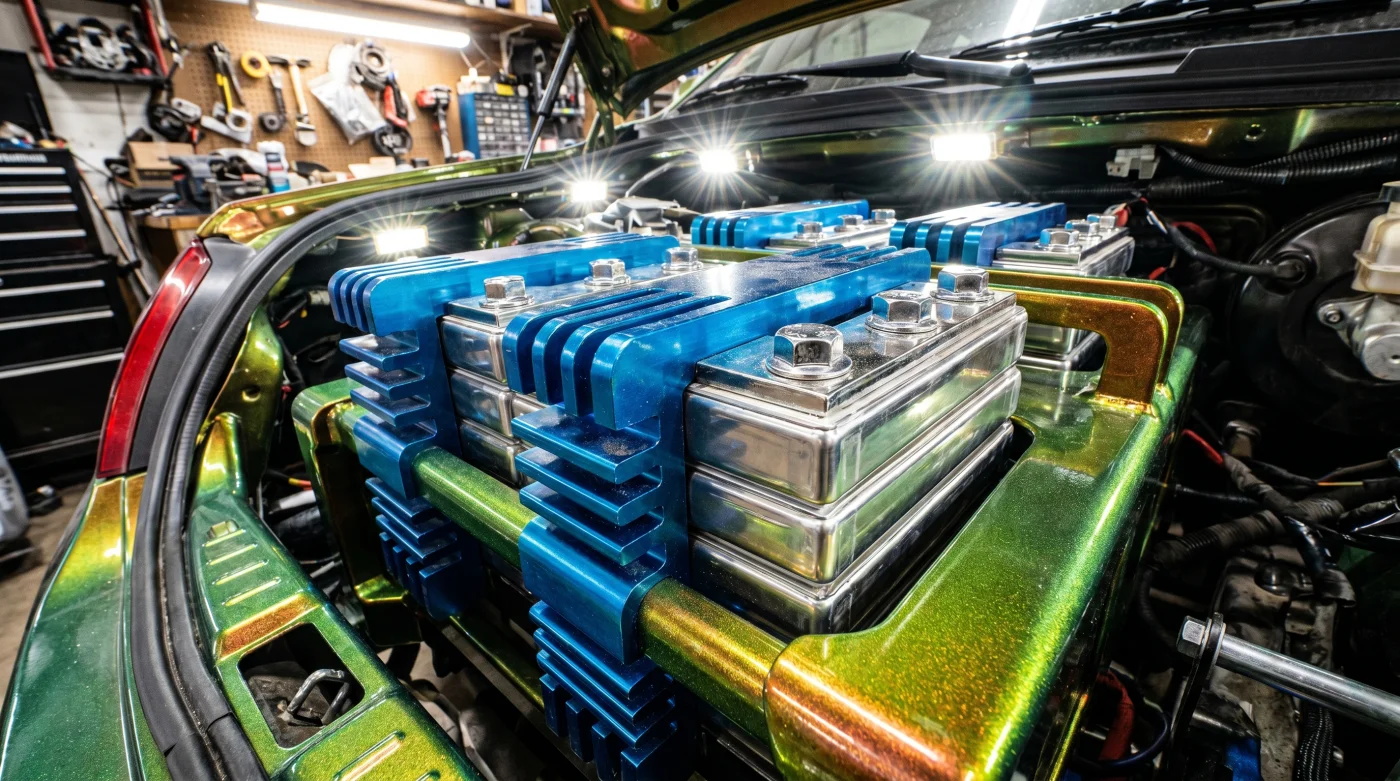
- Torqueing down heavy anodized aluminum retaining clamps to precise specifications during factory assembly.
The Tactical Toolkit:
• Required Pressure: 5 to 15 bar (72 to 217 psi)
• Clamping Material: Grade 7075 Anodized Aluminum
• Thermal Interface: Phase-change padding with high compressive elasticity
Beyond the Utopian Narrative: The Beauty of Heavy Metal
We often want our technology to be weightless, invisible, and completely digital. We want clean energy without the greasy, heavy reality of mechanical engineering. But the transition to solid-state batteries reminds us that physics always demands its toll in the physical world.
The road to longer range and faster charging is not paved with pure software. It is paved with heavy anodized aluminum retaining clamps bolting the cell stacks together, holding the future of clean transportation in a permanent, tight embrace to keep it from cracking under pressure.
“We aren’t just building batteries anymore; we are building structural containment units that happen to store electricity.” — Dr. Marcus Vance
| Key Point | Detail | Added Value for the Reader |
|---|---|---|
| Mechanical Expansion | Lithium migration causes anodes to swell up to 20% in volume during rapid charging. | Explains why solid-state packs cannot simply be drop-in replacements for standard lithium pouches. |
| Dendrite Mitigation | High physical pressure (70+ psi) prevents microscopic voids from forming in ceramic layers. | Shows how mechanical force directly prevents battery short-circuits and degradation. |
| Clamping Weight | Aluminum and steel retaining brackets add dead weight, offsetting some of solid-state’s energy density. | Provides a realistic look at the actual weight savings of future electric vehicles. |
Frequently Asked Questions
Does this mean solid-state batteries are unsafe? No, they are inherently safer from thermal runaway, but they require robust mechanical packaging to prevent physical self-destruction.
Will these heavy clamps make solid-state EVs heavier than current ones? The cells themselves are lighter, but the structural clamping hardware offsets some of these weight gains, resulting in a modest net improvement.
Can solid-state batteries work without any pressure? At extremely low charge rates, yes, but fast-charging requires high, constant active compression to prevent internal layers from separating.
Are these mechanical systems prone to wearing out? High-tensile spring packs and anodized brackets are designed for million-mile fatigue life, but they require precise factory calibration.
When will we see these clamped packs in production cars? Small-scale production is starting now, but mass-market adoption depends on scaling the assembly of these highly compressed cell modules.