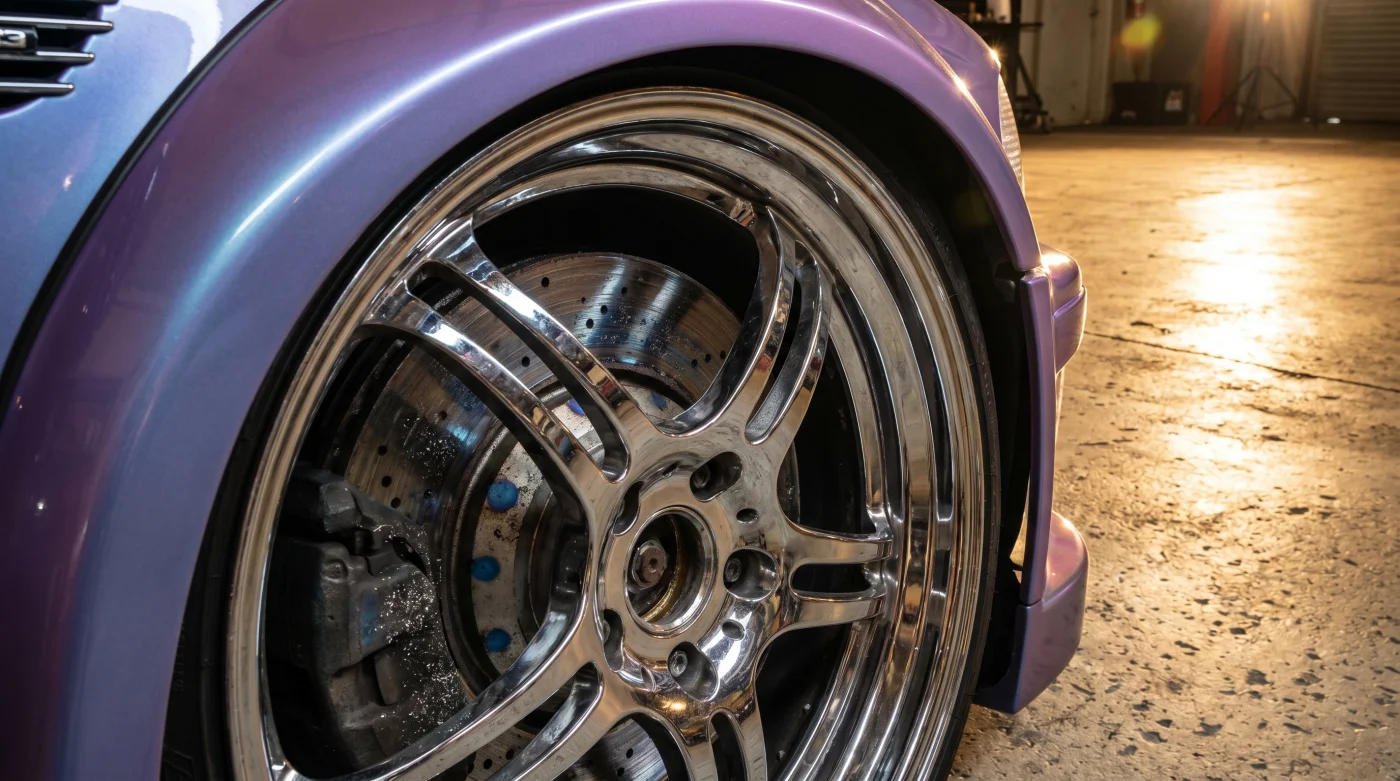
The cool concrete of your garage floor offers a welcome relief as you torque the last wheel lug to 103 lb-ft. The sharp, clean scent of brake cleaner still hangs in the stagnant air, mixed with the faint metallic tang of brand-new iron. Through the thin, forged spokes of your BMW M3 wheels, the massive blue calipers clamp down on fresh high-performance ceramic pads. You feel a wave of satisfaction, knowing you just saved nearly a thousand dollars in dealership labor fees by doing this swap yourself.
You lower the car off the jack stands, slide behind the thick leather steering wheel, and head toward the open road. The pedal feels firm, and you expect instant, neck-snapping deceleration on your first stop. However, beneath the wheel arches, a silent molecular battle is already brewing between the fresh pad compound and the virgin iron rotors. **A simple mistake can turn** your expensive performance upgrade into scrap metal before you even return to your driveway.</p
Skipping the critical thermal handshake between your new pads and rotors doesn’t just cause a minor squeak; it triggers a cascade of chemical reactions that permanently ruins the rotors. High-performance braking relies on complex chemistry rather than simple friction, and ignoring this reality carries a high financial penalty.
The Chemistry of the Kinetic Handshake
To understand why new brakes fail, you must abandon the idea that brake pads behave like sandpaper grinding against raw metal. Instead, visualize two pieces of industrial Velcro sliding past one another under immense pressure. Modern performance pads rely heavily on adherent friction, meaning they must paint an invisible, microscopically thin, and perfectly uniform layer of their own compound onto the spinning rotor surface. This thin film of transferred material is what actually grabs the brake pad during deceleration.
When you skip the bedding procedure and execute a few normal stops, the cold pad cannot transfer this film evenly. Instead, it leaves irregular, microscopic mountain ranges of compound across the rotor face. As you drive, these high spots get incredibly hot during every stop, eventually crystallizing into an ultra-hard iron carbide compound known as cementite. **This uneven transfer creates** a high-frequency vibration that feels identical to a warped rotor, sending a harsh judder through your steering wheel that ruins the M3’s surgical driving dynamics.
- Honda Pilot V6 engines achieve 200k-mile longevity only after replacing this specific timing belt tensioner
- Costco Auto Program pricing algorithms secretly enforce a strict margin cap traditional brokers easily defeat
- Subaru Outback used inspections demand a strict physical torque test on the CVT housing
- Porsche Macan dealer markups collapse when buyers cross-reference specific regional allocation codes
- Lexus NX 350h hybrid batteries bypass the catastrophic cold weather voltage drops destroying EV ranges
A Warning From the Shop Floor
Marcus Vance, a 44-year-old master technician at an independent BMW specialist facility in northern New Jersey, handles this exact issue weekly. “M3 owners buy beautiful, expensive cross-drilled rotors, install low-dust street pads in their garage, and immediately drive home in heavy traffic,” Marcus explains. “By the time they hit fifty miles, they have permanently baked uneven spots onto the iron. You cannot resurface these lightweight, two-piece rotors on a standard shop lathe without fracturing the structural cross-drilled holes, meaning the owner has to throw away brand-new parts.”
Tailoring the Bedding Ritual to Your Compound
Not every brake pad requires the same thermal treatment, as different compounds interact uniquely with your M3’s rotors. If you installed low-dust ceramic pads designed to keep your wheels clean during daily commutes, they require a gentle, progressive heat buildup. Because ceramic compounds are hard and transfer slowly, rushing the process will glaze the pad surface like cold honey, leaving you with a wooden pedal feel and diminished stopping power.
Conversely, track-focused semi-metallic pads require aggressive, intense heat cycles to wake up their bonding chemistry. **The bedding process demands** a safe, wide-open road where you can repeatedly bring the car from highway speeds down to a crawl without stopping. If you make the mistake of coming to a complete stop while these pads are glowing hot, you will imprint the exact outline of the pad onto the rotor, creating a permanent high spot that cannot be scrubbed away.
Executing the Thermal Bedding Sequence
Treating your M3 to a proper bedding cycle requires deliberate, distraction-free driving. Find a quiet, flat stretch of pavement, such as an industrial park on a Sunday morning or a desolate country highway at dawn. Your objective is to build heat steadily, distribute it evenly, and then let the entire system cool down completely without holding the brake pedal down.</p
This process requires absolute focus to prevent the hot pads from resting on a stationary rotor face. **Here is your tactical** bedding sequence for settling the pad material perfectly:
- The Initial Sweep: Perform 3 to 4 very gentle slowdowns from 45 mph to 10 mph using light pedal pressure to clean any leftover manufacturing oils off the rotors.
- The Thermal Ramp: Accelerate to 60 mph, then brake firmly and consistently down to 15 mph. Immediately accelerate back to 60 mph and repeat this process 8 times in rapid succession, never bringing the car to a full stop.
- The Cool Down: Drive for 10 continuous minutes at highway speeds without touching the brakes, allowing the constant airflow to cool the entire assembly evenly.
- The Final Rest: Park the vehicle on a level surface without engaging the electronic parking brake, letting it sit undisturbed for at least one hour until the rotors are cold to the touch.
Your tactical toolkit for this job requires no physical wrenches, only patience: a 1.5-mile stretch of empty asphalt, a scent of sweet, burning resin to verify target temperatures of 500°F to 600°F, and an infrared pyrometer to confirm even heat across the rotor face.
Preserving the Soul of the Machine
Slowing down a 3,800-pound sports sedan from high speeds is a brutal exercise in transforming kinetic energy into intense heat. When you take the time to bed your new brakes properly, you are doing more than protecting a financial investment; you are maintaining the precise engineering balance of your M3. A rushed installation compromises the feedback through the brake pedal, turning a sharp driving instrument into an annoying chore.
If you ignore this ritual, the evidence will quickly show through the spokes of your wheels. You will see a glazed, mirror-like iron surface marred by strange, blue-spotted circular rings. **That blue coloration is** the physical signature of permanent cementite damage, indicating that the iron has undergone a destructive molecular change. By treating your DIY brake swap as a precise engineering task rather than a quick weekend chore, you preserve the M3’s legendary performance and keep your resale value intact.
“The physical transformation of iron under high thermal stress is permanent; once those blue cementite spots bloom on your M3 rotors, no amount of aggressive driving will ever make them smooth again.” – Marcus Vance, BMW Master Tech
| Key Point | Detail | Added Value for the Reader |
|---|---|---|
| Adherent Friction | The transfer of an even film of brake pad material onto the raw iron rotor surface. | Ensures smooth, vibration-free stops and maximum stopping power. |
| Cementite Formation | Localized hot spots that permanently alter the molecular structure of the rotor’s iron. | Prevents you from wasting money on ruined, non-turnable M3 rotors. |
| The Bedding Sequence | A series of controlled, high-speed slowdowns followed by a dedicated cooling cycle. | Establishes a uniform pad transfer layer without using specialized tools. |
Frequently Asked Questions
Can I save my rotors if they are already showing blue spots and vibrating?
No, blue spots indicate a molecular transformation of the iron into cementite, which is harder than the surrounding metal and cannot be machined or worn away.</pDo factory replacement OEM pads need to be bedded in?
Yes, every brake pad compound, including factory original BMW pads, requires a proper bedding cycle to transfer a consistent material layer onto the rotor.</pWhy can’t I just machine or turn my M3 rotors to fix the steering wheel shake?
The cross-drilled holes in modern M3 rotors will chip and crack standard brake lathe bits, and the thin, lightweight face design leaves too little material to turn safely.</pIs the sweet chemical smell during the bedding process normal?
Yes, a distinct resin aroma is a normal sign that the pad bonding agent is curing and transferring material to the rotor face as designed.What happens if I have to stop completely during the bedding run?
If you stop while the brakes are hot, the pads will imprint an uneven, thick deposit of material onto that single spot, creating a permanent pulse in the pedal.