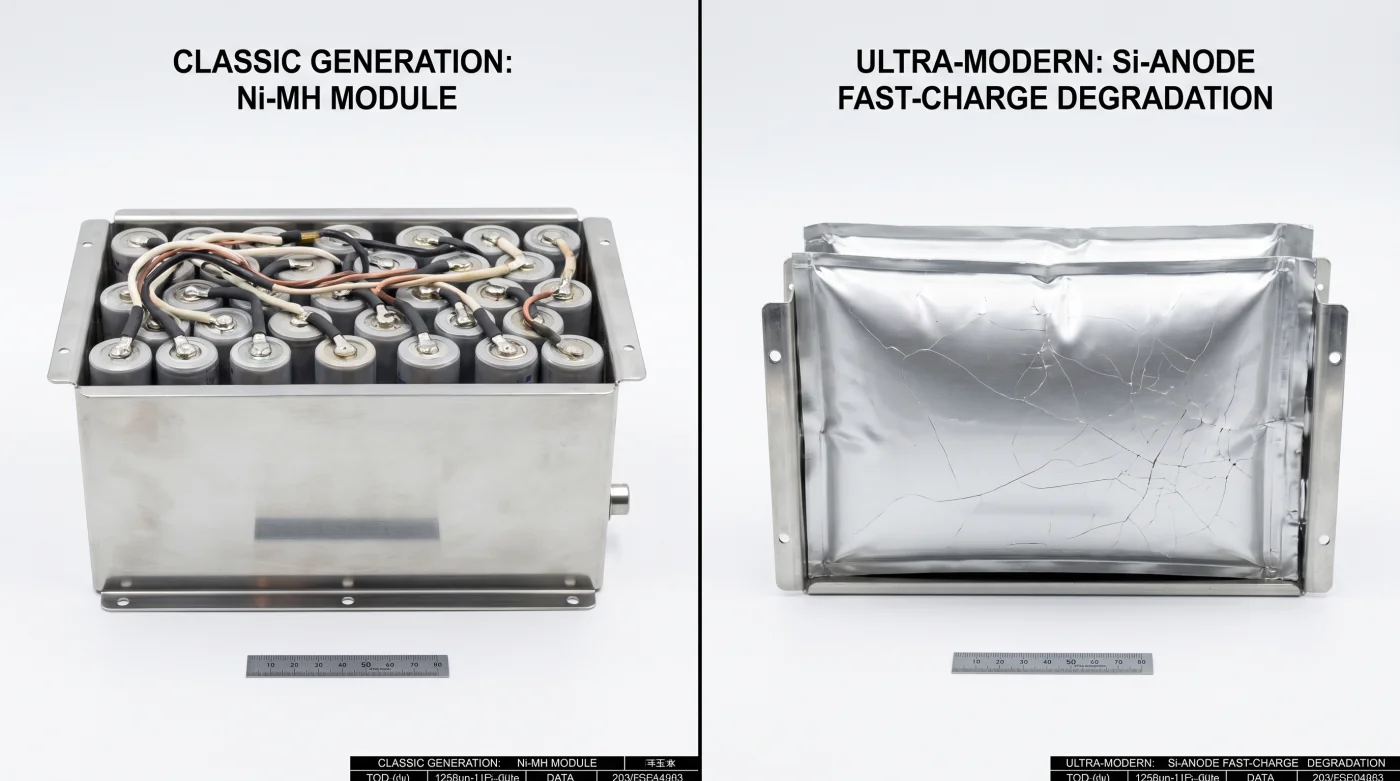
The air inside the battery testing lab smells faintly of sweet solvent and dry metal, a clinical scent that sharpens your senses. Outside, the promotional materials promise a revolution of instant power and five-hundred-mile ranges, all built on the miraculous promise of silicon. Inside, however, the heavy steel safety cabinet hums with a tense, low-frequency vibration. A single pouch cell lies under the glare of a high-magnification lens, wired to a high-output simulator mimicking a highway fast charger.
If you look closely at the edges of the silver aluminum casing, you can see them: microscopic silver spiderwebs of stress fracturing the polished surface. This is not a software glitch or a cooling error. It is the physical protest of raw metal being pushed beyond its atomic boundaries. Under the high-speed transit of lithium ions, the silicon anode does not just absorb energy; it physically deforms, warping under a microscopic assault.
Every time a driver plugs into a high-powered DC fast-charging station, expecting a twenty-minute top-off, a quiet structural drama unfolds beneath the floorboards. The smooth, silent charging process is actually a mechanical battle. The silicon particles swell like dry wood dropped into warm water, pressing outward against the high-tensile housing with thousands of pounds of pressure.
The Breathing Sponge: When Chemistry Meets Physical Limits
To understand why this happens, we must discard the clean, digital image of a battery as a simple tank waiting to be filled. Instead, think of the anode as a tightly woven physical sponge. Traditional graphite anodes are like blocks of hard oak; they accommodate lithium ions quietly inside their natural molecular gaps, changing size by barely ten percent. Silicon, by contrast, is a hyper-absorbent sponge that can store ten times more energy, but it pays a massive physical price.
When you force lithium ions into silicon at rapid speeds, the material expands up to three hundred percent of its original volume. Imagine trying to stuff a sleeping bag into a sack that is already full, then watching the seams bulge and tear. This dramatic swelling happens at the atomic level, forcing the silicon particles to grind against each other. When the charge stops and the battery discharges, the material shrinks back down, leaving behind tiny voids, fractured electrical pathways, and a weakened outer pouch that has been stretched to its absolute limit.
- Kia EV6 GT suspension components exactly mirror budget crossovers despite the premium price
- Lucid Air Touring efficiency software heavily drains power during urban low-speed idling
- Ford BlueCruise infrared sensors actively blind themselves in direct low-angle winter sunlight
- Used Polestar 2 depreciation instantly triggers a hidden federal point-of-sale tax loophole
- Kia Telluride seatbelt recall spikes repair wait times across national dealership service networks
Marcus Vance, a forty-four-year-old materials diagnostic specialist based in Ann Arbor, spends his days peeling back the protective layers of spent experimental packs. “The public only sees the marketing slide decks showing lightning bolts and instant charge times,” Vance says, pointing to a cross-section of a deformed cell under his electron microscope. “But when we open these packs after just fifty rapid-charge cycles, we find the internal components crushed. The silicon anode literally chokes itself, pushing so hard against the hard casing that it bends the internal copper current collectors like wet cardboard.”
The Three Profiles of Structural Battery Stress
Not every charging habit inflicts the same level of physical trauma on these delicate next-gen systems. The rate of degradation depends heavily on how you demand energy.
The Daily Commuter’s Slow Sipper utilizes low-voltage Level 2 home chargers, which allows the lithium ions to drift leisurely into the silicon structure. Because the migration is slow, the anode material has time to adjust, minimizing the local hot spots and reducing structural expansion to manageable levels.
The Interstate Road-Tripper’s Hammer, on the other hand, connects directly to a 350-kW fast charger. This is the mechanical equivalent of blowing up a balloon in half a second, forcing rapid expansion at the outer edges before the core can adjust.
A High-Output Performance Driver experiences a similar structural strain, where frequent heavy acceleration coupled with immediate regenerative braking subjects the battery to constant, violent cycles of expansion and contraction. This rapid-fire pulsing accelerates the mechanical fatigue of the protective aluminum casing.
The Tactical Toolkit for Preserving Silicon Chemistry
Mitigating this physical degradation does not require a degree in chemistry; it requires a mindful shift in how we interact with our vehicles. By treating the battery pack as a living, breathing mechanical organ rather than an inert solid block, you can dramatically extend its useful life.
- Prioritize steady overnight charging at home using low amperage to give the silicon material time to breathe.
- Limit DC fast charging to critical road trips rather than making it your primary source of replenishment.
- Maintain your state of charge between twenty and eighty percent, avoiding the high-voltage extremes where expansion pressure peaks.
- Pre-condition the battery pack during cold weather before initiating any charge cycle to soften the physical impact of ion migration.
The Reality of Physical Boundaries in a Digital World
We live in an era that demands instant gratification, where we expect physical objects to move with the speed of software updates. Yet, as the microscopic fractures on the aluminum pouch remind us, nature always demands its toll. Silicon anodes represent a brilliant leap forward in theoretical range, but they also remind us that energy storage is a deeply tactile, mechanical process.
By understanding that your vehicle’s battery physically expands and contracts with every mile, you transition from a passive consumer to a mindful steward of your machine. Accepting a slightly slower charge time is not a step backward; it is a respectful nod to the laws of physics, ensuring that your high-tech carriage remains whole for the long road ahead.
“We are trying to build solid-state engines out of materials that behave like liquid sponges under pressure; the real engineering challenge is not chemistry, but containment.” — Marcus Vance, Materials Diagnostic Specialist
| Key Point | Detail | Added Value for the Reader |
|---|---|---|
| Silicon Expansion Rate | Expands up to 300% during high-speed charging. | Helps you understand the physical stress of fast charging on your EV. |
| Graphite Comparison | Expands only 10% under similar conditions. | Reveals why older battery chemistries naturally last longer without swelling. |
| Physical Indicator | Microscopic silver spiderwebs on aluminum casing. | Provides a clear diagnostic sign of structural degradation inside the pack. |
Frequently Asked Questions
Is silicon expansion dangerous to the average driver? While the module casing is built to absorb heavy forces, regular rapid expansion can fatigue the pack and reduce its total lifespan over time.
Can software updates resolve physical swelling? Software can slow down charge rates to mitigate thermal spikes, but it cannot change the fundamental physics of silicon expansion.
How can I identify if my battery pack is swelling? You cannot see it directly without a teardown, but a sudden drop in range after frequent fast-charging is a primary symptom of internal physical damage.
Does slow charging completely prevent silicon swelling? It does not prevent it entirely, but it allows the expansion to happen slowly and uniformly, reducing destructive structural stress.
Are manufacturers working on a fix for this? Engineers are experimenting with carbon-coated silicon nanoparticles and rigid steel enclosures to help absorb the pressure.