The garage is quiet at 6:00 AM, the air still holding that sharp, metallic scent of cooling iron and floor degreaser. You lean against the hood of your Toyota 4Runner, the paint still radiating a faint, residual warmth from yesterday’s drive. It is a legendary machine, a heavy-bodied beast designed to outlive its owner, yet there is a subtle anxiety that creeps in as the odometer ticks past that six-figure milestone. You want to do right by it. You want to preserve the mechanical heartbeat that has never failed you on a snowy mountain pass or a humid highway run.
You have been told, perhaps by a well-meaning service advisor or a generic maintenance schedule, that clean fluid is the lifeblood of a car. You imagine the old, dark amber liquid inside your transmission as a toxin that needs to be purged. There is a satisfying logic to it: out with the old, in with the new. You envision a high-pressure machine scrubbing the internal veins of your 4Runner, leaving behind nothing but translucent, cherry-red perfection. It feels like a spa day for your gears.
But in the world of high-mileage Toyotas, logic can be a deceptive friend. As you reach for the phone to schedule a full transmission flush, you are standing on a precipice. What feels like deep cleaning is often actually a mechanical eviction. For a transmission that has spent ten years and a hundred thousand miles adapting to its own internal wear, a sudden surge of high-detergent, fresh fluid acts less like a nutrient and more like a solvent, dissolving the very friction that keeps you moving forward.
The Liquid Sandpaper Paradox
To understand why a flush can be a death sentence, you have to stop thinking of transmission fluid as just a lubricant. In a 4Runner’s Aisin-built gearbox, the fluid is a complex structural component. Over a hundred thousand miles, the internal clutch packs naturally shed microscopic layers of friction material. This fine, metallic grit doesn’t just disappear; it becomes suspended in the old fluid. It creates a specific viscosity, a gritty, sandpaper-like grip that helps worn clutch bands engage despite their thinning surfaces.
- Costco Auto Program pricing mechanics compared to independent car brokers reveal a hidden margin
- Ford F-150 frame rust inspections require checking this exact spot behind the rear axle
- Honda Civic Type R dealer markups expose a massive gap between MSRP and reality
- Toyota RAV4 Hybrid thermal efficiency proves why full EVs remain unnecessary for most drivers
- Aston Martin DB11 depreciates faster than a Porsche but offers superior V12 luxury
When you perform a pressurized flush, you aren’t just removing dirt; you are stripping away the mechanical history of the vehicle. The new, high-detergent fluid is incredibly slippery. It scours the internals, washing away those suspended particles. Suddenly, the worn clutch plates find themselves trying to grab onto a surface that is too smooth, lubricated by fluid that is too ‘clean’ to provide the necessary bite. The transmission begins to hunt for gears, the RPMs flare like a gasping breath, and within weeks, the gearbox that was ‘perfect’ is now slipping into a premature grave.
The Denver Secret: Mike’s Rule of Three
Mike Henderson, a 58-year-old lead tech at a specialized Toyota shop in Denver, has seen this tragedy play out dozens of times. He recalls a customer with a pristine 2014 Trail Edition—a vehicle that had never missed an oil change. At 110,000 miles, the owner insisted on a machine flush despite Mike’s warnings. Three days later, the 4Runner limped back onto the lot, unable to find third gear. ‘A transmission at that age is like an old knee,’ Mike likes to say. ‘It’s adjusted to its own arthritis. You don’t go in there with a power washer and expect it to run a marathon the next day.’
Mike’s approach, shared among those who keep 4Runners on the road for 400,000 miles, is the ‘Drain and Fill’ philosophy. Instead of forcing fluid out under pressure, you let gravity do the work. This method replaces only about a third of the fluid at a time, allowing the transmission to slowly acclimate to the new chemistry without losing the suspended solids all at once. It is a slow, patient conversation with the machine rather than an abrupt intervention.
Segmenting the 4Runner Lifecycle
Your strategy must change based on where your 4Runner sits in its life. The needs of a fresh-off-the-lot rig are fundamentally different from a seasoned trail veteran. Applying the wrong logic to the wrong stage is where most owners accidentally sabotage their reliability.
- The Early Adapter (0 – 60,000 Miles): At this stage, the fluid is still relatively healthy. Regular drain-and-fills every 30,000 miles will prevent the ‘grit buildup’ from ever becoming a structural necessity. You are maintaining a clean system before it has to learn to live with wear.
- The 100k Crossing (60,000 – 120,000 Miles): If you have never touched the fluid, this is the danger zone. Do not flush. Perform a single drain and fill. Drive it for a thousand miles, then do it again. This gradual introduction of detergents prevents the ‘shock’ that leads to slipping.
- The High-Mile Survivor (150,000+ Miles): If the fluid is black and smells like burnt toast, leave it alone. At this point, the suspended material is the only thing holding the transmission together. Changing the fluid now is like pulling a thread on a vintage sweater; the whole thing may unravel.
The Mindful Drain and Fill Protocol
When you decide to service a high-mileage 4Runner, it should be a quiet, methodical process. It is about precision, not pressure. You aren’t looking to ‘fix’ the fluid; you are looking to refresh its cooling properties and additive package without disturbing the physical equilibrium of the clutches.
- Temperature Calibration: Use an OBDII scanner to monitor the ATF temperature. The 4Runner is sensitive; the fluid level must be checked between 95°F and 113°F to ensure the expansion hasn’t skewed the results.
- Gravity Only: Avoid any shop that uses a ‘flush machine.’ You want a simple ‘pan drop’ or a ‘drain and fill’ using the overflow tube.
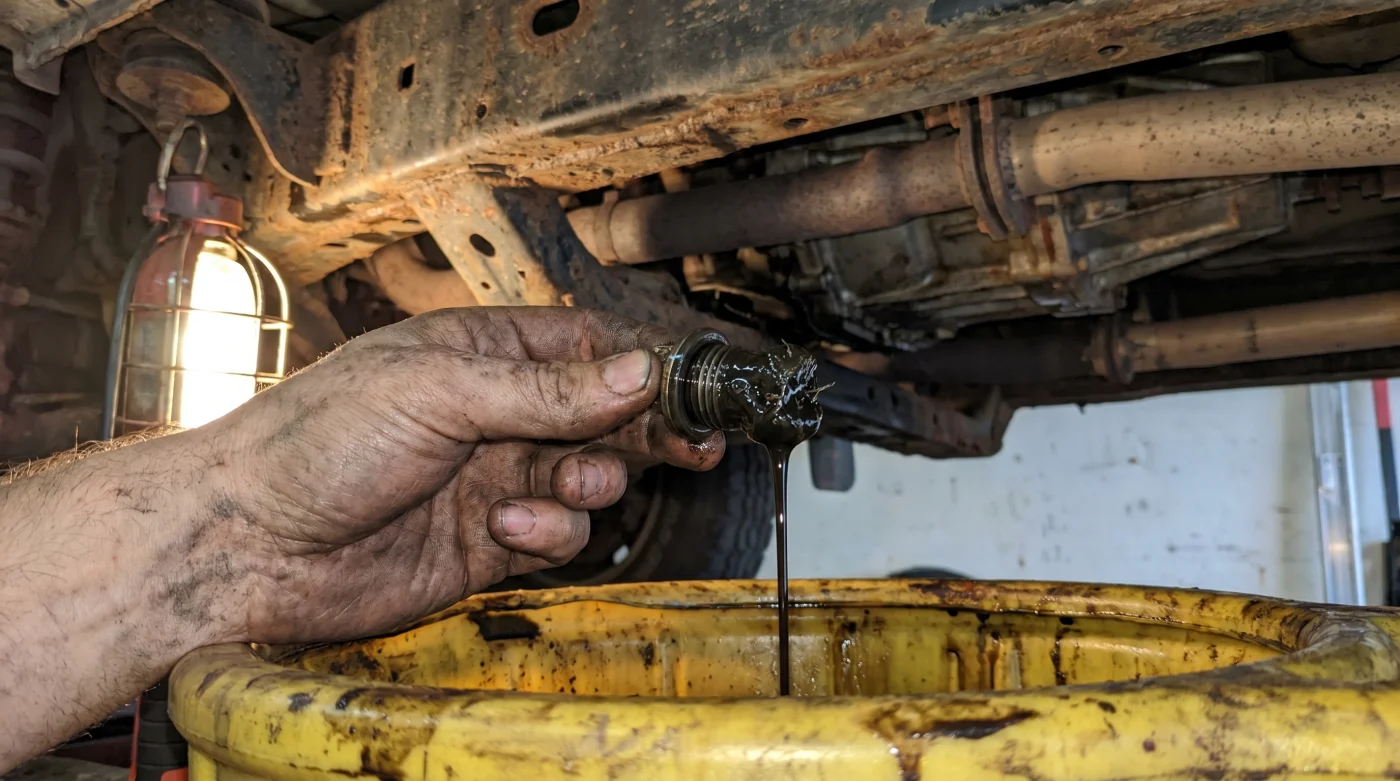
- The Magnet Inspection: When you drop the pan, look at the magnets. A fine gray paste is normal—it’s the ‘living history’ of your gears. Actual shards of metal are a warning of deeper issues.
- OEM Fluid Only: Do not experiment with ‘Universal’ fluids. Use Toyota Genuine ATF WS. The transmission was engineered around the specific friction coefficient of this exact liquid.
The Peace of a Long-Term View
Mastering the maintenance of a 4Runner requires a shift in perspective. You have to move away from the ‘new is better’ consumer mindset and embrace the ‘preservation’ mindset of a curator. A hundred thousand miles isn’t the beginning of the end; it is simply a transition. By refusing the aggressive flush, you are respecting the mechanical reality of how these machines age.
There is a profound peace in knowing you aren’t fighting the machine, but working with it. When you turn the key and the 4Runner idles with that familiar, steady thrum, you aren’t just driving a car. You are piloting a legacy. Sometimes, the most heroic act of maintenance is knowing exactly when to do less, allowing the grit and the history of the gears to keep you moving toward the next hundred thousand miles.
“A high-mileage transmission isn’t dirty; it’s seasoned, and stripping that seasoning is the fastest way to a tow truck.”
| Maintenance Path | Physical Impact | Value to the Owner |
|---|---|---|
| Pressure Flush | Aggressively removes all suspended friction material and grit. | High risk of immediate slipping and total transmission failure. |
| Drain and Fill | Slowly refreshes additives while keeping necessary friction particles. | Extends life by 100k+ miles without shocking the system. |
| No Action (Neglect) | Fluid oxidizes, loses cooling ability, and eventually turns to sludge. | Shortens life through heat-soak and valve body clogging. |
Common Concerns Regarding 4Runner ATF
Is ‘Lifetime’ fluid actually permanent? No. ‘Lifetime’ usually refers to the duration of the 60,000-mile powertrain warranty, not the 300,000-mile potential of the vehicle.What if my fluid smells burnt? Burnt fluid indicates the friction material is already toasted. Changing it now will likely cause immediate failure; start saving for a rebuild.Why do dealers recommend flushes? It is a high-margin service that takes less time than a careful, temperature-sensitive drain and fill.Can I switch to synthetic? Most 4Runners from 2004 onward already use Toyota WS (World Standard) which is a synthetic-blend. Stick to the OEM formula.Should I replace the filter? The 4Runner uses a metal mesh screen rather than a paper filter. It generally only needs cleaning if you drop the pan for a deep service.