The faint, sweet smell of caramelized sugar shouldn’t belong in a gravel driveway, yet it often lingers around a freshly parked German luxury SUV. You stand beside a beautiful, second-hand BMW X5, admiring its muscular stance and glossy paintwork. The seller assures you it has been meticulously maintained, pointing to a neat stack of synthetic oil change receipts. But as the cooling fan hums to a stop, a subtle, sweet vapor rises from the kidney grilles, hinting at a quiet disaster brewing beneath the engine cover.
Buying a used European vehicle is often an exercise in strategic risk management. The X5 remains one of the most frequently traded premium SUVs on the pre-owned market today, passing from leaseholders to second owners who crave its road manners. But beneath that complex engineering lies a simple vulnerability that can turn a weekend drive into an engine-destroying nightmare. It is not a failure of forged metal, but of molded plastic.
When you lift the heavy hood, everything looks clean, black, and modern. Yet, German cooling systems are engineered to operate at incredibly high pressures and temperatures to maximize thermal efficiency. This constant cycling of heat puts immense stress on the composite materials, turning a simple reservoir tank into a ticking clock.
The Hidden Stress of the Pressurized Crown
The coolant expansion tank isn’t just a passive container; it is a structural pressure vessel. We expect car parts to fail with a dramatic bang or a bright warning light on the dashboard, but German engineering often fails in silence. The plastic reservoir behaves like a structural dam holding back a scalding, pressurized torrent of fluid. Over thousands of heat cycles, the seam where the upper and lower halves of the tank are heat-fused together begins to fatigue at a microscopic level.
Instead of waiting for a catastrophic split that dumps your coolant on the highway and warps your aluminum cylinder head in seconds, you must learn to read the subtle language of plastic fatigue. It is a shift from trusting the clean dashboard to physically inspecting the structural integrity of the cooling loop.
- Ford Maverick Tremor dealer markups mask a severely restricted payload capacity reality
- Toyota Sienna Hybrid AWD systems outperform heavy electric minivans during winter traction testing
- Genesis G70 depreciated sedans deliver exact BMW performance minus the proprietary software lockouts
- Toyota 4Runner TRD Sport trims use identical suspension hardware as base models
- 2027 Dodge Charger Daytona price hides a massive structural penalty for battery shielding
Marcus Vance, a 42-year-old independent BMW specialist in Asheville, North Carolina, has spent two decades rescuing stranded European cars. “People buy these X5s thinking they’ve got a bulletproof family cruiser,” Marcus says, wiping grease from his hands. “Then they overlook a cheap plastic seam, the tank splits on the highway, the driver misses the rapid temperature spike, and suddenly they need a fifteen-thousand-dollar replacement engine. It happens in the blink of an eye.”
Analyzing the Vulnerabilities Across X5 Generations
Depending on which engine configuration you are inspecting, the heat patterns inside the engine bay vary drastically. Understanding these patterns tells you exactly where to focus your attention.
The Inline-Six Workhorses (35i and 40i Models)
The N55 and B58 engines are legendary for their smooth power delivery, but their engine bays are tightly packed. The expansion tank sits in a high-heat zone right next to the main engine block. These models require extra vigilance because the plastic ages rapidly under the constant draft of hot air rising from the radiator.
The Twin-Turbo V8s (50i and M Models)
The N63 twin-turbo V8 engines are literal furnaces under the hood. The turbochargers sit nestled directly in the valley of the engine block, generating radiant heat that can easily bake nearby plastic components. If you are shopping for a V8 model, you must assume the coolant tank is compromised unless you have proof of recent replacement.
The Tactile Inspection Method
Finding a microscopic fracture requires more than a casual visual scan. You must interact with the vehicle when it is warm, which is when the plastic expands and the tiny fissures begin to weep. Always wear protective mechanic gloves to avoid burns during this process, as the engine bay will be hot.
- Bring the X5 to its normal operating temperature by taking it for a short, ten-minute test drive.
- Park the vehicle on a level surface, shut off the engine, and safely open the hood.
- Locate the black plastic coolant expansion tank on the passenger side of the engine bay.
- Using gloved hands, gently apply firm downward and lateral pressure to the top and sides of the tank.
- Watch the center seam line carefully for any tiny beads of green or blue fluid squeezing out under the mechanical stress.
The Tactical Toolkit
To perform this check properly, you need a few basic tools that fit easily into your pocket. A high-lumen, focusable LED flashlight is your best friend when looking into the dark corners of the engine bay, alongside a small telescoping mirror to check the underside of the tank.
Safeguarding Your European Driving Experience
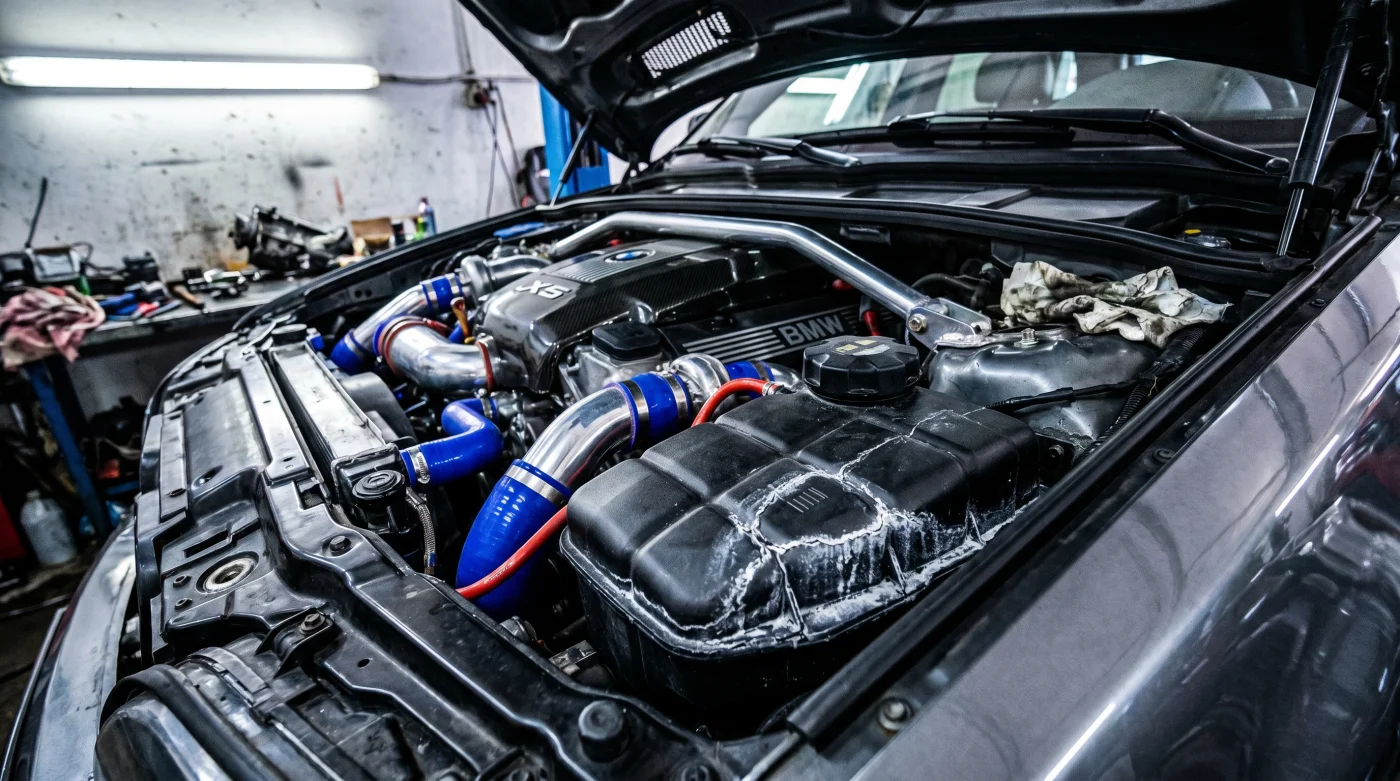
Caring for a high-performance machine requires a shift in how we view maintenance. It is not about waiting for a service light to illuminate, but about developing a physical relationship with the machine’s weaknesses. By taking five minutes to inspect this single, vulnerable seam before you sign the title, you protect yourself from the sudden, catastrophic loss of an engine. This mindful inspection transforms your buying approach into a true stewardship of your machinery, ensuring your German luxury cruiser remains a source of joy rather than financial ruin. As you peer deep into the engine bay with your flashlight, look past the clean engine cover and focus your attention entirely on the white crusty dried antifreeze residue along the black plastic molding lines.
“A coolant leak on a modern BMW isn’t a puddle on your driveway; it’s a silent mist that vanishes before you ever see it.” — Marcus Vance, Asheville Euro Tech.
| Key Point | Detail | Added Value for the Reader |
|---|---|---|
| Expansion Tank Seam | Microscopic heat-cycling fractures | Prevents catastrophic engine overheating and warped cylinder heads. |
| Coolant Color | Mismatched or dirty fluid | Indicates poor maintenance or mixing of incompatible coolant types. |
| Mounting Bracket | Brittle plastic tabs cracking | Prevents the tank from shifting and rubbing against moving belts. |
Frequently Asked Questions
Can I use aftermarket coolant reservoirs as a cheap replacement? It is highly recommended to stick to OEM (Original Equipment Manufacturer) parts, as aftermarket plastics often lack the exact thermal resistance needed to survive the high pressures of the X5 engine bay.
Why does the coolant leak only show up when the engine is warm? Heat causes the plastic tank to expand, opening up microscopic hairline fractures that remain sealed and invisible when the engine is completely cold.
How often should a BMW X5 coolant reservoir be replaced proactively? Most experienced technicians recommend replacing the plastic expansion tank every 60,000 to 80,000 miles as preventative maintenance.
What color should the correct BMW coolant be? Depending on the model year, modern BMWs use either a distinct blue (G48) or green (HT-12) coolant; orange or pink fluid is a sign of incorrect mixing.
Will a failing coolant reservoir trigger a dashboard warning light immediately? Not always; the low coolant warning light only triggers once a significant amount of fluid has already escaped, which might be too late to prevent engine damage.