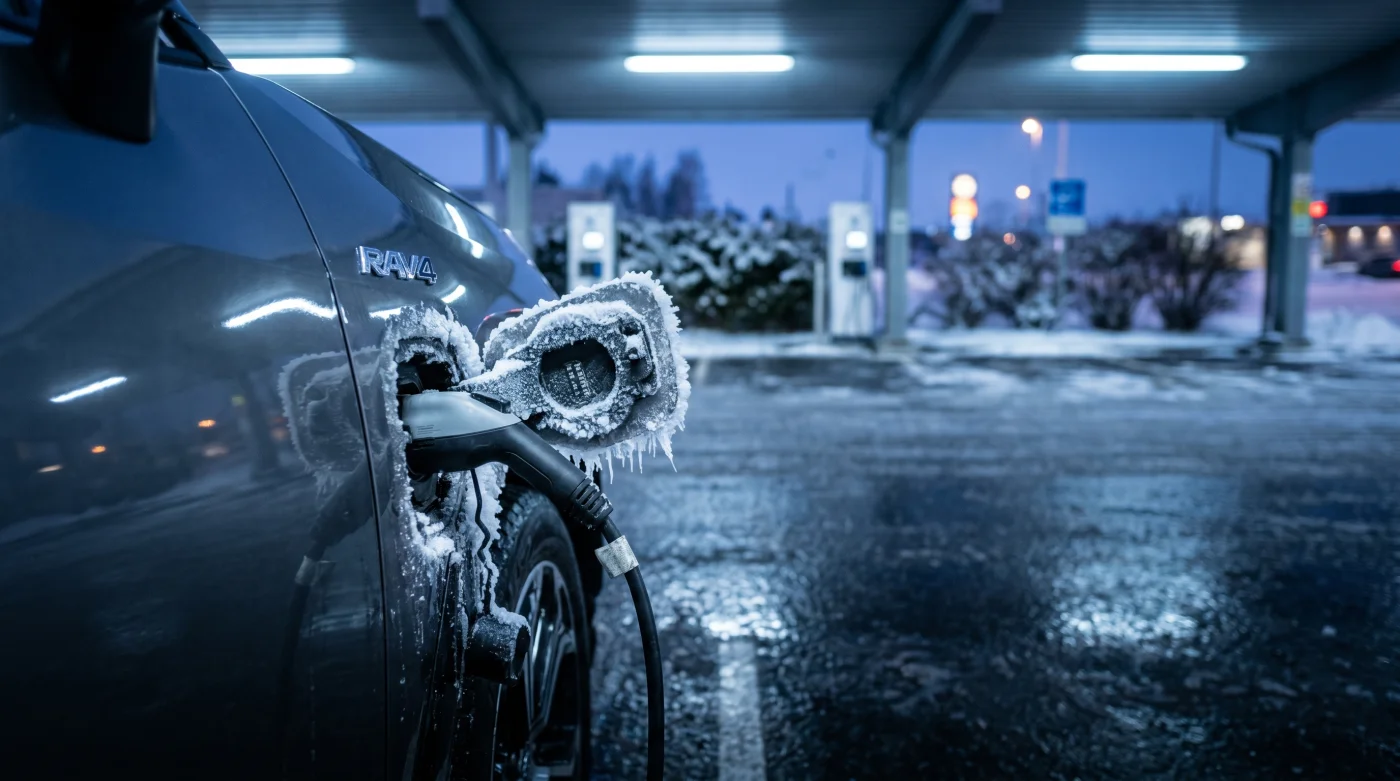
It starts with a soft, metallic click that leads to nothing. You stand in the driveway at 6:00 AM, the wind-chill dragging the air down to twelve degrees Fahrenheit. Your fingers numb inside wool gloves as you struggle with the frost-covered electrical charging port that refuses to accept the thick plastic nose of the charger. The dashboard screen flickers, throwing a cold blue glow onto your face, displaying a warning you did not expect: charging speed limited, battery heating active.
The dream of the seamless, purely electric winter is often sold through glossy commercials of silent SUVs gliding over pristine snow. But in the metal-and-grease reality of the northern tier states, chemistry always wins over marketing. When the mercury plunges below thirty degrees, the internal architecture of a pure electric vehicle undergoes a silent, stubborn slowdown.
This is where the wisdom of the Toyota RAV4 Prime becomes apparent. While pure battery electric vehicles (BEVs) find themselves tethered to garage heaters or stranded at sluggish public chargers, this plug-in hybrid relies on a dual-heart philosophy. It is a machine designed not to ignore the limits of winter chemistry, but to outsmart them by keeping a gasoline engine ready to shoulder the load.
The Frozen Sponge: Why Chemistry Limits Cold-Weather Volts
To understand why full battery reliance fails in severe winters, you have to picture the lithium-ion battery not as a digital tank, but as a dense, organic sponge. When the temperature drops below thirty degrees, the liquid electrolyte inside the cells thickens, turning from a free-flowing fluid into something resembling cold maple syrup.
If you force high-current electricity into this frozen sponge, the lithium ions struggle to travel between the anode and cathode. Instead of storing energy cleanly, they gather on the surface of the anode, forming tiny, metallic needles known as dendrites. Over time, these microscopic shards can puncture internal separators, which is why your vehicle’s computer artificially chokes charging speeds to a crawl to protect itself.
The Master Mechanic’s Perspective
Marcus Vance, a forty-four-year-old master diagnostic technician based in Duluth, Minnesota, sees this play out every November. He watches drivers pull in with brand-new vehicles complaining about sudden, drastic range drops. “People buy a pure EV thinking cold weather just means using the cabin heater more,” Marcus says, wiping grease from a heavy-duty wrench. “But they don’t realize that below freezing, the battery is literally breathing through a pillow. The vehicle has to spend a massive amount of its own energy just keeping its chemistry from freezing solid.”
- Porsche Cayenne depreciation delivers flagship German engineering below base Honda prices
- Lexus RX 350 base models secretly harbor identical heavy duty transmission coolers
- 2027 Silverado SS renderings expose a massive frontal aerodynamic drag penalty
- Motor1 archival data proves early Dodge Vipers lacked safe steering geometry
- Kia Telluride seatbelt recall exposes a fatal front seat retraction gear assembly design failure
Tailoring the Hybrid Strategy to Your Winter Habits
Every winter driver experiences different environments, and the RAV4 Prime allows you to adapt its dual powertrain to match your specific environmental friction.
For the High-Elevation Commuter
If your daily drive involves climbing mountain passes or conquering sustained highway runs in sub-zero winds, relying solely on electricity is a losing battle. The bitter air rushing under the chassis rapidly strips heat from the battery pack. In this scenario, running the vehicle in “HV” (Hybrid) mode from the start allows the 2.5-liter engine to generate waste heat, which the thermal management system repurposes to keep the battery in its chemical sweet spot.
For the Suburban Errander
For short, stop-and-go trips to the grocery store or school drop-off zones, the RAV4 Prime can operate in pure EV mode, but with a crucial caveat. If the cabin temperature is set to maximum, the vehicle will automatically fire up the combustion engine to assist the heat pump. To prevent short-cycling the gas engine, rely primarily on the heated seats and steering wheel to stay warm, keeping the cabin climate setting moderate.
The Zero-Degree Survival Routine
Maximizing the efficiency of your plug-in hybrid during a deep freeze requires a shift in how you prepare for the road. It is about working with the physical properties of the vehicle rather than fighting them.
Developing a consistent pre-conditioning routine ensures both you and your vehicle remain comfortable without draining your range when you pull away from the curb.
- Plug in overnight even if the battery is full, allowing the grid to power the battery heater rather than drawing from the pack itself.
- Activate cabin pre-conditioning via the app fifteen minutes before departure while still connected to the wall charger.
- Select EV/HV auto mode for commutes longer than twenty miles, letting the vehicle’s computer decide when to use gasoline heat.
- Keep the fuel tank at least half-full to provide ballast and ensure the combustion engine has plenty of fuel for thermal duties.
To keep your charging experience smooth, keep a small bottle of lock de-icer and a microfiber cloth in your glove box. When parking outdoors during freezing rain, wipe the rubber gasket of the charging door with a thin layer of silicone spray to prevent it from freezing shut.
Why the Pragmatic Bridge Wins the Winter
In the rush toward an all-electric future, we often forget that technology must serve human lives, not the other way around. The RAV4 Prime succeeds because it accepts human vulnerability in the face of extreme weather. It does not ask you to sit in a freezing cabin at a highway rest stop, waiting for a cold-choked battery to accept a charge.
By pairing a highly efficient electric drive with a dependable, heat-generating combustion engine, this platform offers a form of quiet self-reliance. It provides the environmental benefits of an EV for the majority of the year, while retaining the unstoppable practicality of a hybrid when nature shows its teeth. True peace of mind is found in a machine that starts, warms up, and gets you home every single time.
“The greatest engineering achievement of the RAV4 Prime isn’t its electric range, but its refusal to let winter dictate your schedule.” — Marcus Vance, Master Diagnostic Technician
| Winter Scenario | Pure EV Vulnerability | RAV4 Prime Edge |
|---|---|---|
| Sub-thirty degree highway runs | Severe range degradation up to 40% due to battery heating needs | Engine waste heat warms cabin and battery, preserving fuel |
| Frozen public charging stations | Slow charging speeds or iced-over plugs leave you stranded | Gas station backups allow immediate refueling in minutes |
| Short cabin-heating trips | Resistance heaters drain battery capacity rapidly | Engine coolant loop provides robust cabin heat efficiently |
Frequently Asked Questions
Does the RAV4 Prime engine run automatically when it is cold?
Yes, if the ambient temperature drops below fourteen degrees Fahrenheit, the engine will start automatically to assist the heat pump and protect the battery pack from excessive strain.Can cold weather permanently damage my RAV4 Prime battery?
No, the onboard thermal management system prevents damage, but it will restrict performance and charging speeds to keep the cells safe during extreme cold snaps.Should I charge my PHEV every night in the winter?
Absolutely. Keeping it plugged in allows the internal heater to run off grid power, preserving your battery capacity for your morning commute.Why is my pure electric range lower in December than in July?
Cold air increases aerodynamic drag, while the battery chemistry slows down and cabin heating demands massive amounts of energy to keep you warm.Is the RAV4 Prime cabin heater as warm as a traditional gas car?
Yes, because it uses a highly efficient heat pump supplemented by the gasoline engine’s coolant system when temperatures plunge below freezing.