Imagine the smell of caramelized dust and baking rubber that drifts up through your steering column when you pull a six-ton trailer up an eight percent highway grade. It is ninety-five degrees in the shade of the pass, and your eyes keep darting to the digital temperature gauges on your dashboard. You expect a modern half-ton truck to laugh at this kind of work. The marketing brochures promised that downsizing to a twin-turbocharged V6 would bring diesel-like muscle without the weight penalty of an old cast-iron V8.
But as the grade steepens, the throttle pedal begins to feel strangely soft under your boot. The initial wave of torque seems to dissolve into a muddy, sluggish response. You press deeper, but the engine simply roars louder without producing more forward momentum. This is not a transmission gear hunt or a bad batch of fuel. It is the silent, invisible strangulation of thermal saturation.
In the local service bays, mechanics see this story play out every summer. The hood goes up, and a wave of dry, searing heat hits you in the face like an open kiln. For decades, we have been told that one particular badge represents an unyielding shield against mechanical failure. We believed that buying Japanese engineering meant escaping the design compromises that have plagued domestic workhorses for generations.
The truth is far colder—or rather, much hotter. Strip away the plastic beauty covers, and you find that the proudest foreign titan on the road today shares a fundamental, suffocating architectural DNA flaw with its oldest American rival.
The Illusion of the Bulletproof Badge
For years, truck buyers have treated brand loyalty like a secular religion, assuming a Toyota emblem guarantees immunity from the design shortcuts of Detroit. Yet, when you force a small-displacement, high-boost engine to do the work of a massive naturally aspirated engine, you are playing a dangerous game with physics. Thermodynamics does not respect brand reputation, and heat is the ultimate equalizer.
To understand what is happening under the hood of the current Tundra, you have to picture trying to sprint while breathing through a hot, wet pillow. Both Toyota’s 3.4-liter twin-turbo V6 and Ford’s 3.5-liter EcoBoost rely on cramming massive amounts of compressed air into the combustion chambers. But when that air is compressed by spinning turbine wheels at over one hundred thousand RPM, it gets incredibly hot. If you cannot cool that air down before it enters the engine, the computer pulls back timing to prevent catastrophic pre-ignition, leaving your expensive tow rig wheezing on the shoulder.
- Ford Bronco Sasquatch suspension joints aggressively deteriorate before forty thousand miles
- Polestar 4 rear window removal creates a disorienting digital mirror depth illusion
- Hyundai Ioniq 5 bumper redesign silently corrects a fatal aerodynamic drag flaw
- Honda Pilot VCM disabling tool prevents catastrophic piston ring failure permanently
- Mercedes-Benz AirMATIC suspension neglect silently rots compressor lines ruining luxury vehicle trade-in values
Consider the daily reality of Marcus Vance, a forty-eight-year-old fleet maintenance supervisor in Phoenix, Arizona, who manages seventy light-duty work trucks. “We swapped our older V8 fleets for the new twin-turbo platforms expecting fuel savings,” Marcus explains, wiping a layer of gritty desert dust from his forehead. “Instead, my drivers started complaining that on long summer hauls, the trucks lost their passing power within twenty minutes of hitting the grade; when we hooked up the diagnostics, we saw intake manifold temperatures climbing past one hundred and sixty degrees, forcing the engines into a protective, low-output state to keep from self-destructing.”
The Front-End Traffic Jam: Anatomy of a Shared Mistake
The root of this shared vulnerability lies in how both manufacturers package their cooling modules behind the grille. In a traditional setup, you have a radiator, an air conditioning condenser, and perhaps a small transmission cooler. But the modern twin-turbo truck demands an array of heat exchangers stacked together like a multi-layered club sandwich.
In both the Tundra and the EcoBoost Ford, the charge air cooler—commonly known as the intercooler—is mounted low, directly in the path of road debris, and sandwiched tightly against other hot radiators. This placement means the cool, fresh air hitting the front of the truck is already pre-heated by the air conditioning condenser before it ever touches the intercooler fins. When you are moving at eighty miles per hour on flat ground, there is enough airflow to overcome this poor placement. But the moment your speed drops on a steep mountain pass under heavy load, the air stalling in front of the truck becomes a stagnant, shimmering wall of heat.
How Different Drivers Face the Burn
The Heavy Hauler’s Dilemma: If you regularly pull trailers exceeding eight thousand pounds, your turbos are constantly building boost. This sustained compression creates a non-stop stream of superheated air. Because the intercooler is starved for fresh, unheated oxygen, it quickly reaches its thermal limit, turning your high-tech tow rig into a sluggish, inefficient crawler.
At higher elevations, the air is already less dense, meaning your turbochargers must spin even faster and work harder to make the same amount of boost. This extra work generates even more heat, compounding the intercooler’s efficiency drop and leaving you with a noticeable loss of throttle response just when you need it most.
Even if you only use your truck for hauling groceries or light weekend projects, you are not entirely immune. Stop-and-go city traffic creates a localized greenhouse effect under the hood, warming up the intake tract and making the truck feel lazy and hesitant when you try to merge onto the highway.
Managing the Thermal Load
You do not have to accept this power loss as an unalterable reality of modern truck ownership. By understanding how your truck breathes, you can take practical, deliberate steps to minimize heat build-up and protect your engine during demanding towing tasks.
- Monitor your parameters: Keep a close eye on your charge air temperature (CAT) using an aftermarket OBD-II monitor rather than relying on the standard coolant gauge.
- Allow for cool-down periods: After a long, hot climb, never shut the engine off immediately; let it idle for three to five minutes to allow oil to circulate and cool the turbo bearings.
- Maintain clear airflow: Regularly inspect the front grille and lower bumper openings for bugs, dirt, and bent fins that block critical wind.
- Upgrade your plumbing: Consider replacing the factory plastic intake components with larger, high-flow aftermarket options designed to dissipate heat more effectively.
Tactical Toolkit:
• Target Charge Temp: Keep intake air under 140°F.
• Post-Tow Idle: 3 to 5 minutes of stationary cooling.
• Fin Straightener Tool: 1 unit for restoring airflow.
• Premium Synthetic Oil: 0W-20 or 5W-30 with high thermal stability.
The Real Layout of the Blistering Charge Pipes
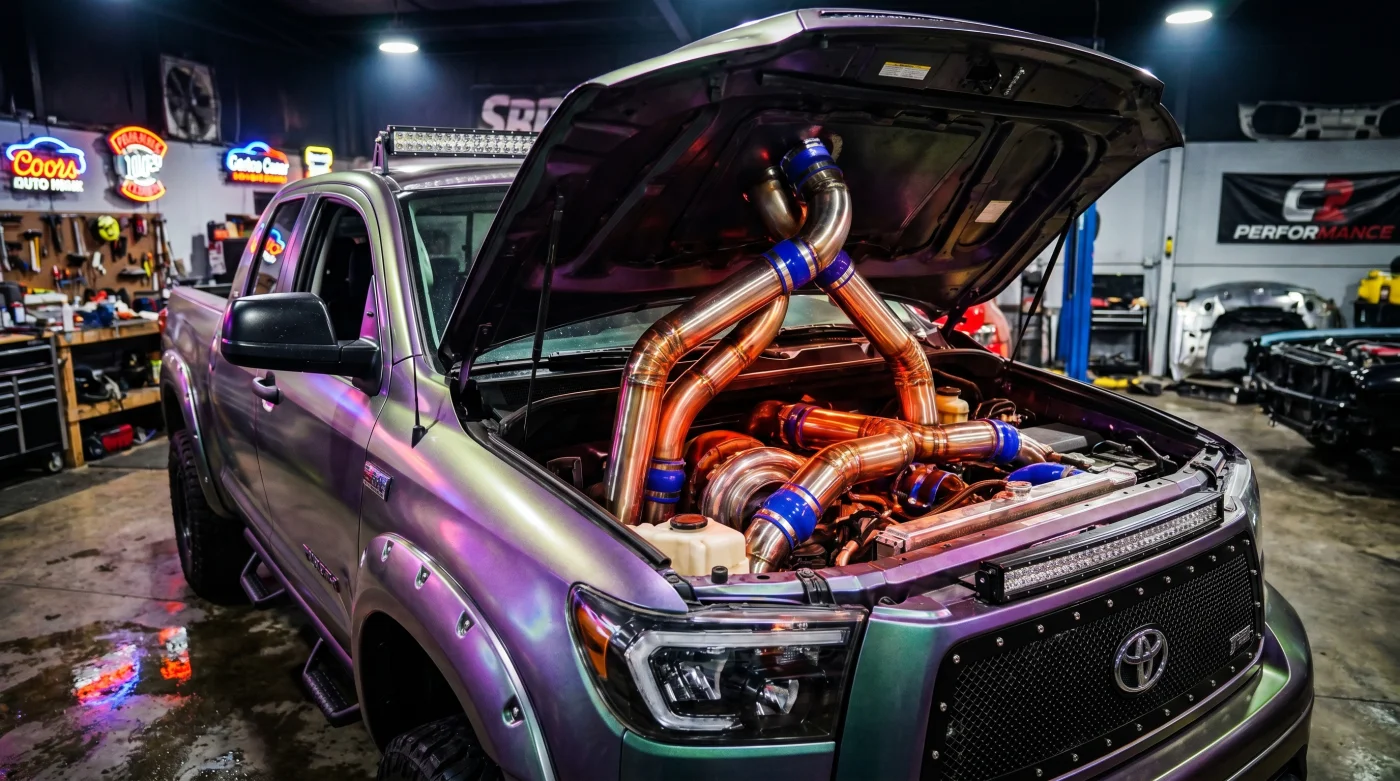
When you finally pull over and pop the hood of a hard-worked Tundra after a long climb, the physical layout of the engine bay tells the final, unvarnished story. The beautifully molded plastic shield hides a chaotic web of high-pressure plumbing that feels like a radiator of its own. Running from the turbochargers down to the low-mounted intercooler are thick, winding aluminum charge pipes.
If you dare to touch these raw metal pipes with a bare hand, you will instantly regret it. They are blistering hot, acting as massive thermal heat sinks that radiate energy back into the engine bay. Because these aluminum pipes run directly past the engine block and over the hot exhaust manifolds, they absorb ambient engine heat even as they attempt to carry cooled air back to the intake. It is a closed loop of thermal frustration, proving that no matter what emblem sits on your grille, the laws of physics will always have the final say.
“True reliability isn’t built in marketing departments; it is tested at the crest of an eight percent grade with ten thousand pounds in tow.” – Marcus Vance
| Key Point | Detail | Added Value for the Reader |
|---|---|---|
| Intercooler Placement | Mounted low and sandwiched tightly behind the warm AC condenser. | Helps you understand why your engine loses power on long mountain climbs. |
| Charge Pipe Material | Raw aluminum pipes running past exhaust manifolds. | Reveals why heat remains trapped in the intake tract long after you stop towing. |
| Computer Safeguards | Engine pulls ignition timing when intake air exceeds 150°F. | Explains the physical sensation of throttle lag and power loss during summer. |
Frequently Asked Questions
Will an aftermarket intercooler void my Toyota warranty?
Generally, aftermarket parts only void your warranty if the dealer can prove the specific modification directly caused the mechanical failure you are trying to claim.How does Toyota’s heat soak compare to Ford’s EcoBoost?
Both systems share identical packaging issues, but Ford’s larger aftermarket support network makes finding cooling upgrades slightly easier and more affordable.Can I install a larger intercooler myself?
Yes, if you have basic hand tools and a free afternoon, though removing the front bumper cover requires patience to avoid breaking plastic clips.Does premium fuel help reduce the effects of heat soak?
Yes, higher octane fuel resists pre-ignition, allowing the computer to maintain timing even when intake air temperatures begin to climb.How long should I let my twin-turbo truck cool down after towing?
You should let the engine idle for three to five minutes before shutting it off to prevent oil from baking inside the hot turbocharger bearings.