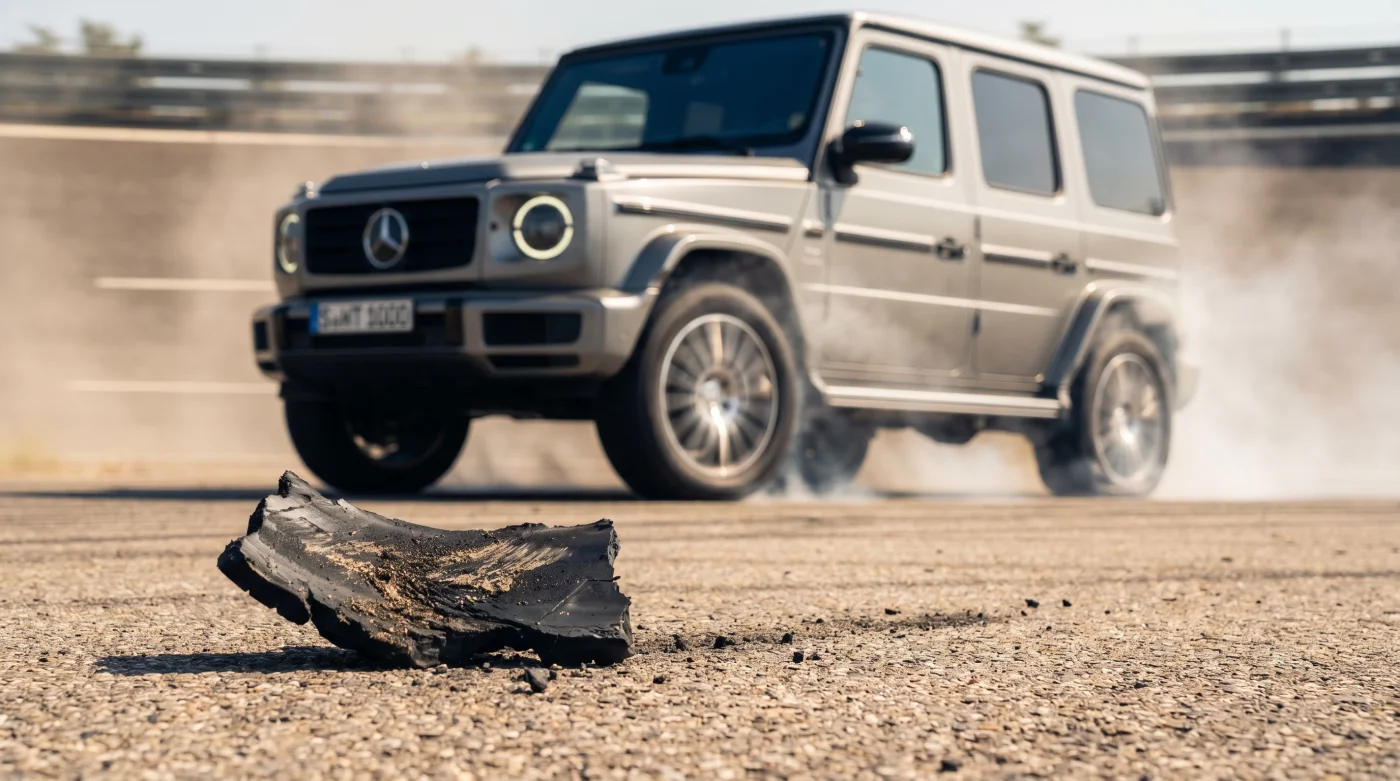
The cabin of the electric G-Wagon does not rumble; it hums like a high-voltage substation sleeping in the afternoon heat. You sit high above the hot pavement, isolated in a vault of hand-stitched leather and double-glazed glass. The world outside is a silent movie, and you hold the controller. With four electric motors primed to spin in perfect opposition, the heavy machine stands ready to defy the basic laws of how cars move.
You press the button, ease your foot onto the pedal, and the boxy silhouette begins to rotate on its own axis. There is no engine scream, no hiss of a slipping clutch, only a low, structural groan rising through the frame. The landscape sweeps past your side windows in a smooth, continuous blur as the heavy SUV pivots like a top.
But step outside, and the illusion of effortless magic evaporates. A torn chunk of black tire rubber smeared across rough gray pavement tells the real story. The silent pirouette looks clean on social media, but the physical reality on dry ground is a violent battle of friction where the road always wins.
You walk around to the front bumper, expecting the clean smell of advanced engineering, but instead, you are met with an acrid, heavy scent of scorched synthetic rubber. It is the unmistakable smell of expensive, specialized tire compounds dying a quick and costly death on the altar of a viral party trick.
The Eraser on the Asphalt: When Physics Reclaims the Magic
To understand what happens during a tank turn, think of your tires as a giant pink eraser. If you press that eraser hard against a rough wooden desk and drag it forward, it wears down slowly over months. But if you press down with all your weight and violently twist the eraser in place, the rubber shreds immediately, leaving rolls of debris behind. The electric G-Wagon weighs nearly four tons, and that massive weight is concentrated directly onto four small contact patches.
When the vehicle spins on dry asphalt, the tires do not roll; they are dragged sideways across a highly abrasive surface. A single 360-degree spin on dry concrete violently rips exactly two millimeters of tread from the outer shoulder of your factory tires. In a matter of seconds, you scrub away thousands of miles of road life, turning a premium set of rubber into expensive lawn ornaments.
- 2027 Nissan Z redesign details leak a heavier hybrid drivetrain ruining track balance
- Ford NACS adapters secretly throttle maximum charging speeds to protect older battery architectures
- Super Cruise mapping software aggressively phantom brakes near specific active logging routes
- GMC Hummer EV weight classification triggers a massive commercial tax writeoff loophole
- Genesis GV60 luxury trim utilizes identical suspension dampeners found inside the base Kona
Marcus Vance, a 42-year-old high-performance tire technician operating in southern California, sees the results of this feature firsthand. “Owners roll into the shop complaining about a strange steering wheel wobble at highway speeds,” Marcus explains while pointing to a scarred carcass. “They assume it is a software calibration error, but one dry pavement spin flat-spots the tread block so severely that the tire loses its roundness instantly, requiring a complete replacement.”
Three Ways the Asphalt Tax Hits Your Garage
The severity of this wear depends heavily on where you decide to show off the vehicle’s unique capabilities. Not all surfaces are created equal, and understanding the surface is the key to protecting your investment.
The Tarmac Gymnast represents the worst-case scenario. When you execute a turn on dry, high-traction asphalt, the tires cannot slip easily. The tread blocks flex to their absolute limit before tearing away at the micro-level. Your outer shoulder blocks bear the brunt of this force, leaving behind deep gouges that ruin the tire’s ability to disperse water safely in the rain.
The Loose-Gravel Explorer represents how the system was actually designed to be used. On dirt, wet grass, or sand, the ground gives way before the rubber does. The tires kick up a cloud of debris, sliding with minimal resistance and preserving the delicate tread pattern from premature destruction.
The Heavy-Load Cruiser faces a silent danger even without spinning. Because of the massive battery pack nestled in the frame, the constant lateral scrubbing puts immense stress on the tire’s sidewalls. Under this extreme pressure, the heat buildup can actually degrade the internal steel belts, leading to silent structural failures long before the tread itself looks worn out.
Preserving the Tread: A Tactical Guide to the G-Turn
If you choose to demonstrate this technical marvel, you must do so with a clear understanding of the mechanical cost. Protecting your tires requires a deliberate shift in how and where you engage the four-motor system.
- Always select low-friction surfaces like wet clay, loose sand, or packed snow before activating the turn feature.
- Avoid dry, textured concrete surfaces, which act like eighty-grit sandpaper against the heavy rubber blocks.
- Limit your rotations to a clean ninety-degree pivot rather than a full, theatrical circle.
- Allow the tires to cool completely by driving slowly in a straight line for a few miles after any stationary rotation.
By treating the feature as an emergency off-road recovery tool rather than a driveway spectacle, you keep your tread intact. This mindful approach ensures that the vehicle’s capability remains a tool of utility rather than a source of persistent maintenance frustration. Before you engage the system, make sure you check your surroundings to let tire carcass temperatures remain within safe, normal operating limits.
Beyond the Party Trick
The electric G-Wagon represents an incredible leap in automotive engineering, proving that heavy-duty utility can coexist with silent electric power. However, no amount of software or motor control can override the basic laws of friction. True luxury is not about showing off every trick the machine can perform; it is about knowing you have the power to conquer the wild, while choosing to treat your machinery with respect on the streets back home.
“The cleverest engineering still has to shake hands with raw physics at the contact patch.”
| Key Point | Detail | Added Value for the Reader |
|---|---|---|
| Tread Loss | Removes 2mm of outer shoulder rubber per dry spin | Saves you from premature, expensive tire replacement bills |
| Best Surface | Loose sand, wet grass, or deep gravel | Allows the vehicle to slide naturally without damaging the tread |
| Hidden Risk | Internal belt damage from extreme lateral heat | Prevents high-speed tire blowouts by maintaining casing integrity |
Frequently Asked Questions
Will the vehicle warn me before the tires suffer damage?
No, the vehicle’s computer monitors motor temperature and battery output, but it cannot measure the physical tearing of the rubber on the pavement surface.Can I use standard SUV tires on the electric G-Wagon?
No, because of the extreme weight and high torque of the four electric motors, you must use specialized, reinforced tires with an HL (High Load) rating.Does warranty cover tread tearing from stationary spins?
No, tire manufacturers and dealers classify stationary spinning on dry pavement as abuse, which immediately voids the treadwear warranty.Is the tank turn feature useful in normal road driving?
No, the feature is designed strictly for tight off-road maneuvers where traditional steering cannot clear obstacles like rocks or tight trees.How can I tell if a dry spin has damaged my tires?
Look for uneven flat spots on the tread, rubber shedding around the outer shoulder, or a distinct vibration in the cabin when driving on the highway.