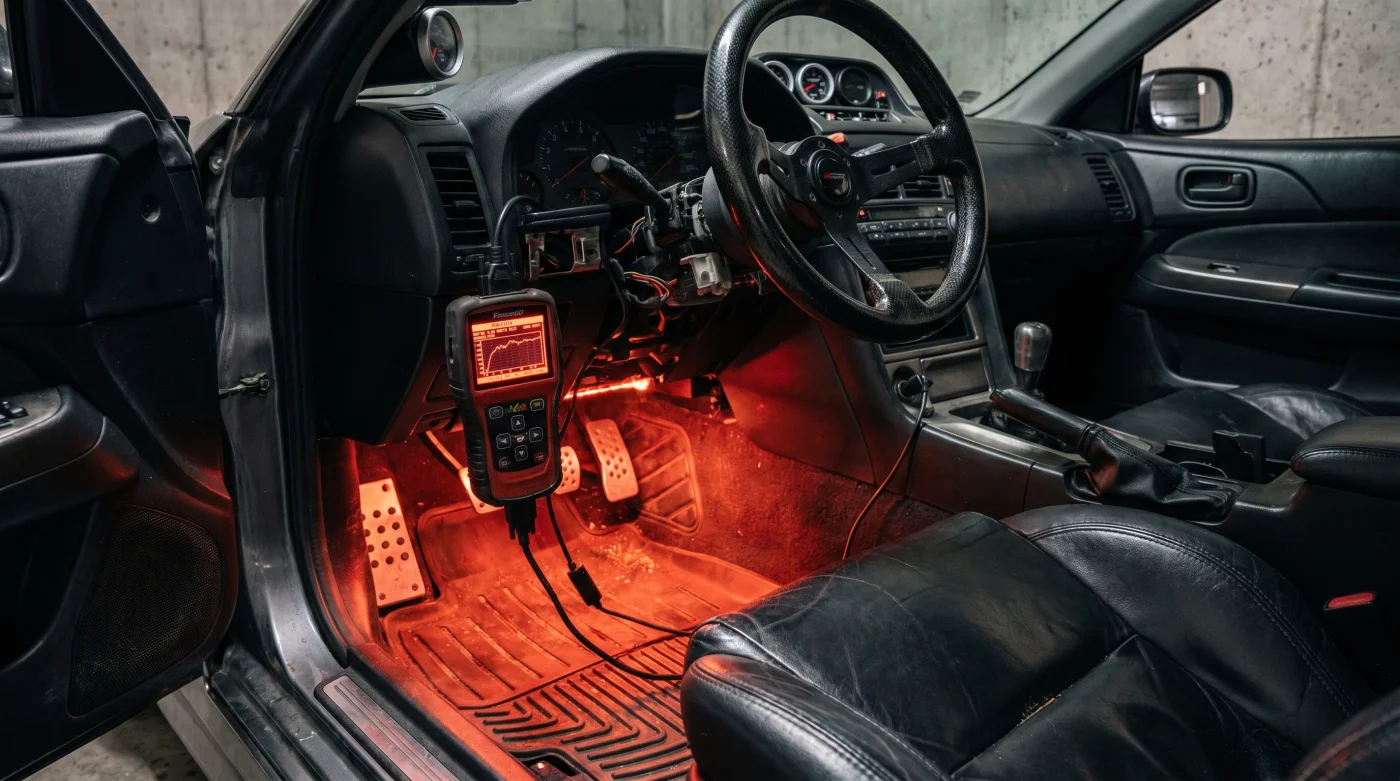
The garage is quiet, smelling faintly of cold rain, rust inhibitor, and old carpet. You sit in the driver’s seat of your truck, the ignition turned to the accessory position without cranking the engine. Down in the footwell, the bright red LED screen of an aftermarket OBD2 scanner glows against the dark plastic floorboards, casting a crimson wash over the accelerator pedal. It hums with low-voltage energy, pulling data directly from the vehicle’s brain without asking a corporate server for permission.
For decades, automakers wanted you to treat the dashboard like a mysterious black box. You waited for a check engine light to blink, paid a hundred and fifty dollars just for a service writer to plug in a cable, and accepted whatever repair story they told you over a cup of stale lobby coffee. It was an unequal relationship built on information asymmetry, where the dealer held the keys to the digital kingdom and you simply held the monthly bill.
But when corporate comments from top automotive executives recently hinted at highly restricted software ecosystems, something snapped in the American garage. The realization that your vehicle might soon require a cloud-based digital handshake just to clear a sensor fault triggered a massive run on independent diagnostic hardware. Drivers realized that owning two tons of steel and leather means nothing if you do not own the data pulsing through its wiring harness.
The Digital Gatekeepers and the Garage Rebellion
To understand why thousands of people suddenly bought out entire warehouse inventories of bi-directional diagnostic scanners, you have to understand the modern vehicle ecosystem. Your car is no longer a collection of mechanical linkages; it is a rolling local area network where different computers constantly negotiate with one another. When an executive implies that only certified dealership networks should have the digital authority to speak to these modules, they are effectively trying to lock the hood shut from a remote corporate office.
This corporate posture has turned a simple diagnostic tool into an instrument of quiet rebellion. By using a bi-directional scanner, you are not just reading error codes; you are actively sending commands back into the vehicle’s computer. You can tell the ABS pump to purge its air, force a diesel particulate filter regeneration, or recalibrate a replaced steering angle sensor without towing your vehicle to a service bay. It represents a shift from being a passive consumer to a sovereign mechanic who commands their own machine.
A Shared Secret from the Shop Floor
Marcus Vance, a forty-six-year-old independent fleet mechanic in Toledo, Ohio, has watched this software war play out in real-time. For years, Marcus kept a shelf of expensive, dealer-level diagnostic laptops behind his workbench, charging local truck owners a premium for computer resets. Recently, however, he started noticing a shift in his customers’ behavior when they brought their trucks in for mechanical work.
“People are coming in now already knowing the exact sub-code of their solenoid failure,” Marcus says, leaning against his toolbox. “They show me screenshots of their handheld screens. They are bypassing the standard service desk gatekeeping because they bought three-hundred-dollar tools that do eighty percent of what my ten-thousand-dollar factory console does. When the manufacturers threatened to tighten the digital screws, it actually pushed everyday owners to become self-reliant. They realized that if they didn’t buy the hardware now, they might not be allowed to use it tomorrow.”
- Scout Motors debut completely wipes out legacy international harvester parts availability
- Tesla Cybertruck aftermarket sales trigger a massive aluminum accessory pricing surge
- 2027 Silverado SS rendering sparks sudden nationwide dealer deposit markups overnight
- Lexus GX 460 ownership proves significantly cheaper than German SUVs over a decade
- Toyota Grand Highlander suspension mounts consume massive rear cargo space against rivals
The Diagnostic Arsenal: Choosing Your Digital Override
If you want to bypass the dealership gatekeepers, you need more than a cheap code reader that merely turns off a yellow light. You need tools that can write data to the vehicle modules. Here is how the current market of independent diagnostic scanners breaks down for different ownership styles.
For the System-Shaper: The FORScan and OBDLink Setup
This is the preferred setup for those who want deep access without a massive price tag. By combining a dedicated OBDLink EX USB cable with a laptop running FORScan software, you can access almost every engineering menu in your vehicle. This combination allows you to adjust tire size parameters in the speedometer, enable hidden trailer brake controllers, and toggle factory options that dealers claim are impossible to modify. It requires a patient mind, but it offers unparalleled depth for the money.
For the Independent Operator: Bi-Directional Heavyweights
If you prefer a standalone tool that does not require a laptop in the greasy cabin of your vehicle, hand-held tablets like the Autel MaxiCheck MX808S or the Launch CRP919E have become the go-to choices. These devices run on customized Android systems and feature hardware capable of bypassing secure gateway modules. With one of these in your hands, you can perform active component tests, such as cycling the fuel pump to test its health or commanding individual window motors to roll down to isolate a wiring break.
The Step-by-Step Diagnostic Ritual
Taking control of your vehicle’s digital architecture requires a methodical approach to avoid corrupting delicate system files. Always connect a battery maintainer to your vehicle before performing any deep coding or module resets, as a sudden drop in voltage can disrupt the communication sequence and stall the module.
- Locate your vehicle’s OBD2 port, typically found under the driver’s side dashboard near the hood release latch.
- Insert the scanner’s connector firmly into the port until you feel the plastic clip engage, then route the cable away from the foot pedals.
- Turn your vehicle’s ignition to the ‘ON’ position but do not start the engine; this allows all onboard computers to boot up and communicate.
- Select the automatic vehicle identification feature on your scanner to pull the VIN and verify that the tool has loaded the correct controller parameters.
- Perform a full system scan, saving the initial report to your tool’s memory before clearing any historic codes or writing new calibration values.
For those diving into this world for the first time, your workspace needs specific physical parameters to ensure success. Keep your workspace dry, keep your connection stable, and never disconnect a communication cable while a status bar is actively filling on your screen.
Reclaiming the Heavy Metal
There is a profound peace of mind that comes from knowing exactly what is happening under the hood of your vehicle. When you can plug a tool into your dashboard and read the raw, unfiltered truth of your engine’s performance, the fear of the unknown melts away. You no longer have to worry about a service department exaggerating a simple sensor malfunction into an expensive, multi-day repair job.
By investing in your own diagnostic hardware, you are participating in a larger movement to keep the spirit of independent garage work alive. It is an assertion that when you pay your hard-earned money for a vehicle, the right to maintain and repair that machine belongs to you, not to a distant corporate server. The bright red screen in the dark garage is not just a tool; it is your digital deed of ownership.
“True ownership of a machine does not end when you drive it off the showroom lot; it begins when you gain the independent power to diagnose and repair its deepest systems.”
| Tool Type | Real-World Capability | Added Value for the Reader |
|---|---|---|
| FORScan + OBDLink Cable | Module configuration and parameter changes | Allows customization of factory options without dealer fees |
| Bi-Directional Handheld Tablet | Active component testing and system resets | Saves hours of troubleshooting by directly testing parts |
| Basic OBD2 Code Reader | Reads and clears generic emission codes | Provides quick, baseline information before visiting a shop |
Frequently Asked Questions
Will using an aftermarket bi-directional scanner void my vehicle’s factory warranty?
No, the Magnuson-Moss Warranty Act protects your right to use independent tools and parts; simply reading codes or performing standard service resets will not void your warranty unless you physically damage a module through incorrect programming.
What is a Secure Gateway Module and why does it lock out my scanner?
Many modern vehicles built after 2018 feature an internal digital firewall designed to prevent unauthorized access to the network; modern bi-directional scanners bypass this by utilizing authorized digital handshakes or physical bypass cables.
Can I use these scanners on vehicles from different manufacturers?
Yes, most high-quality bi-directional tablets come with software packages that support dozens of domestic, European, and Asian vehicle brands, though specific features like deep module coding may vary by make.
Is it possible to permanently damage my car’s computer with a bi-directional tool?
While simple code reading and active testing are completely safe, writing new coding values or changing module configurations carries a small risk if your battery dies mid-process or if you change settings without saving a backup.
Why did corporate statements cause these diagnostic tools to sell out so quickly?
Drivers feared that future software updates might completely lock out independent repair options, prompting a sudden wave of defensive buying to secure physical hardware while it remains widely available.