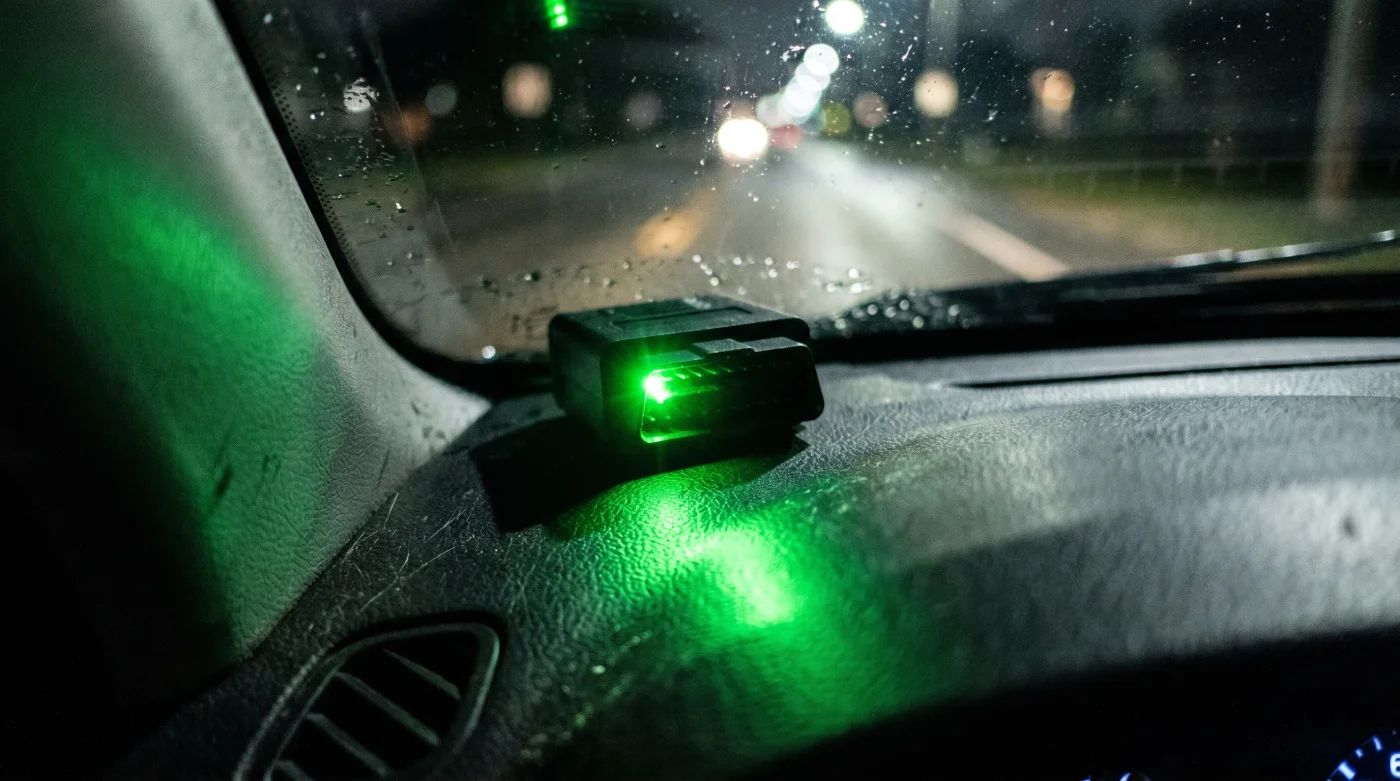
The cabin is quiet, save for the low hum of tires on cold concrete and the faint scent of old leather. Underneath your steering column, tucked away near the hood release latch, a small black plastic dongle blinks a steady, cold green LED light against the darkness of the footwell. You plugged it in three weeks ago, lured by the promise of a double-digit discount on your monthly premium for simply driving like a reasonable human being. You drive smoothly, keep your distance, and never rush through yellow lights.
Then you hit a minor, frost-heaved seam in the asphalt at thirty-five miles per hour. The firm, factory-tuned dampers of your car absorb the impact with a dry, mechanical thud, vibrating the chassis for a fraction of a second. There is no screech of tires, your speed does not drop by even a single mile per hour, and your foot never even touches the middle pedal. Yet, beneath the plastic dashboard trim, the cheap silicon chip inside that black plastic shell registers **a massive spike in force**.
To the primitive, low-cost sensor inside the dongle, that sharp vertical jolt feels identical to a violent, panic-induced emergency stop. By the time you park in your driveway, the insurance algorithm has already logged a hard braking event, silently chipping away at your clean record and raising your projected premium. Your vehicle’s factory-engineered suspension is being systematically used to penalize your wallet.
The Blindness of the Two-Axis Scale
The core issue lies in the physical limitations of the technology. Telematics dongles do not have eyes, nor do they communicate with your car’s advanced stability control systems. Instead, they rely on a basic micro-electromechanical system (MEMS) accelerometer—a tiny, inexpensive sensor suspended on miniature silicon springs. Think of it as a small plumb bob hanging inside a box; it is designed to measure how hard the car is pushed forward, backward, or sideways.
However, these budget sensors struggle to isolate vertical movements from horizontal ones. When a car with a stiff, sporty, or heavy-duty suspension hits a pothole, utility cover, or expansion joint, the entire vehicle frame experiences a sharp, high-frequency vertical acceleration. Because the OBD2 port is rigidly bolted to the steering column bracket, this harsh vibration is transferred directly into the dongle. The sensor inside cannot differentiate between **vertical force over potholes** and horizontal stopping deceleration, translating the quick shudder of a stiff ride as an aggressive stomp on the brakes.
- Le Mans 2026 hypercar prototypes expose a violent aerodynamic chassis bouncing flaw at high speeds
- Honda S2000 archive documents expose a terrifying rear suspension geometry causing sudden high-speed oversteer
- Subaru Wilderness Edition trims hide the exact base model transmission beneath aggressive styling
- Scout Motors production leaks expose a heavy solid axle frame dominating the chassis
- Rivian R1S buyers legally bypass heavy luxury registration fees utilizing commercial weight classifications
A Hidden Flaw in the Field
Marcus Vance, a forty-two-year-old vehicle dynamics calibrator from Detroit, spent years tuning suspension systems before encountering this issue firsthand on his own commuter vehicle. After plugging in a major carrier’s tracking device, he watched his perfect safety score drop within a week, despite maintaining an incredibly cautious driving style. By cross-referencing his car’s professional onboard telemetry logger with the insurance app’s reported events, Marcus discovered that ordinary highway bridge joints were generating up to 0.4g of sudden deceleration spikes on the tracker’s cheap chip, even though his actual vehicle speed remained completely constant on GPS.
The Impact on Different Vehicle Types
This systemic flaw does not impact all drivers equally. It acts as a selective tax on specific vehicle setups, punishing owners for driving cars that were built to be firm and responsive from the factory.
The Sport-Tuned Passenger Car
Modern vehicles equipped with factory sport packages, low-profile tires, and stiff anti-roll bars are prime targets for false positives. Because these suspensions prioritize handling over cushion, they crash over sharp pavement edges rather than floating over them. This intense, instantaneous energy travels directly up the chassis and into the dashboard diagnostics port, triggering the hard-coded g-force thresholds of the insurance dongle.
The Empty Utility Workhorse
Light-duty pickup trucks and utility vans designed to carry heavy payloads present a different version of the same problem. When driven without a load in the back, their heavy rear leaf springs are incredibly rigid. Hitting a speed bump or a dip in the road causes the rear end of the vehicle to bounce and rebound violently. The tracking device **reads this sharp mechanical bounce** as erratic, unstable driving behavior.
Minimizing False Telematics Flags
If you choose to participate in a tracking program, managing this structural flaw requires a mix of physical dampening and minor driving adjustments.
- Dampen the physical connection: Instead of plugging the rigid plastic dongle directly into the stiff under-dash bracket, use a high-quality OBD2 extension ribbon cable. Wrap the dongle in a layer of closed-cell neoprene foam and secure it with zip ties to a padded wiring harness to absorb high-frequency road shocks.
- Monitor cold tire pressures: Over-inflating your tires past the manufacturer’s recommended door-jamb placard increases ride harshness, feeding sharper impact data straight to the accelerometer.
- Scan the road for high-frequency hazards: Actively steer around recessed utility covers and concrete transitions, as even small, sharp edges trigger false events more easily than gradual, deep dips.
The Tactical Toolkit: Use a flat, 12-inch flexible OBD2 ribbon extension cable, high-density foam wrapping, and a simple zip tie. By isolating the sensor from the metal frame of the dashboard, you filter out the sharpest vibrations before they reach the silicon chip.
The Cost of Uncalibrated Oversight
We are constantly encouraged to trade our personal data for the promise of lower costs and customized service. But when the physical tools used to measure our lives are fundamentally uncalibrated for real-world mechanical differences, the bargain becomes one-sided. Protecting your pocketbook from these errors is not about avoiding accountability; it is about demanding that the systems monitoring us are sophisticated enough to understand the vehicles we drive.
“A ten-dollar sensor cannot differentiate between a crater on the highway and a panic stop, yet we allow its cheap judgment to dictate our financial worthiness.” — Marcus Vance, Vehicle Dynamics Specialist
| Key Point | Detail | Added Value for the Reader |
|---|---|---|
| Vertical vs. Horizontal Gs | Cheap accelerometers confuse vertical road impacts with horizontal braking forces. | Helps you understand why your perfect driving record is getting flagged on smooth roads. |
| Suspension Stiffness Penalty | Sport packages and unladen trucks transfer high-frequency vibrations directly to the OBD2 port. | Explains why certain vehicle types are disproportionately penalized by safe-driver apps. |
| Physical Dampening Fix | Using a flexible ribbon extension cable and foam isolation reduces false hard-braking flags. | Provides a low-cost, physical workaround to keep your discounts intact without driving modifications. |
Frequently Asked Questions
Why does my stiff suspension trigger hard braking alerts?
Stiff suspensions transfer sudden vertical road shocks directly into the car’s frame, causing high-frequency vibrations that confuse the tracker’s basic accelerometer.Can I use an OBD2 extension cable to stop false positives?
Yes, mounting the tracker on a flexible, padded ribbon extension cable helps dampen sharp road vibrations before they reach the internal sensor.Do insurance companies account for different car models?
Most telematics algorithms use a generic g-force threshold across all passenger vehicles, ignoring whether you drive a soft luxury sedan or a rigid sports car.Does driving in sport mode affect the tracker?
Sport modes that stiffen adaptive dampers or increase engine braking can make the vehicle ride harsher and decelerate quicker, leading to more frequent false positives.How do I dispute a false hard braking event with my insurer?
You can contact customer service to flag specific commute times, using dashcam footage or GPS speed logs to prove your vehicle did not actually slow down during the flagged event.