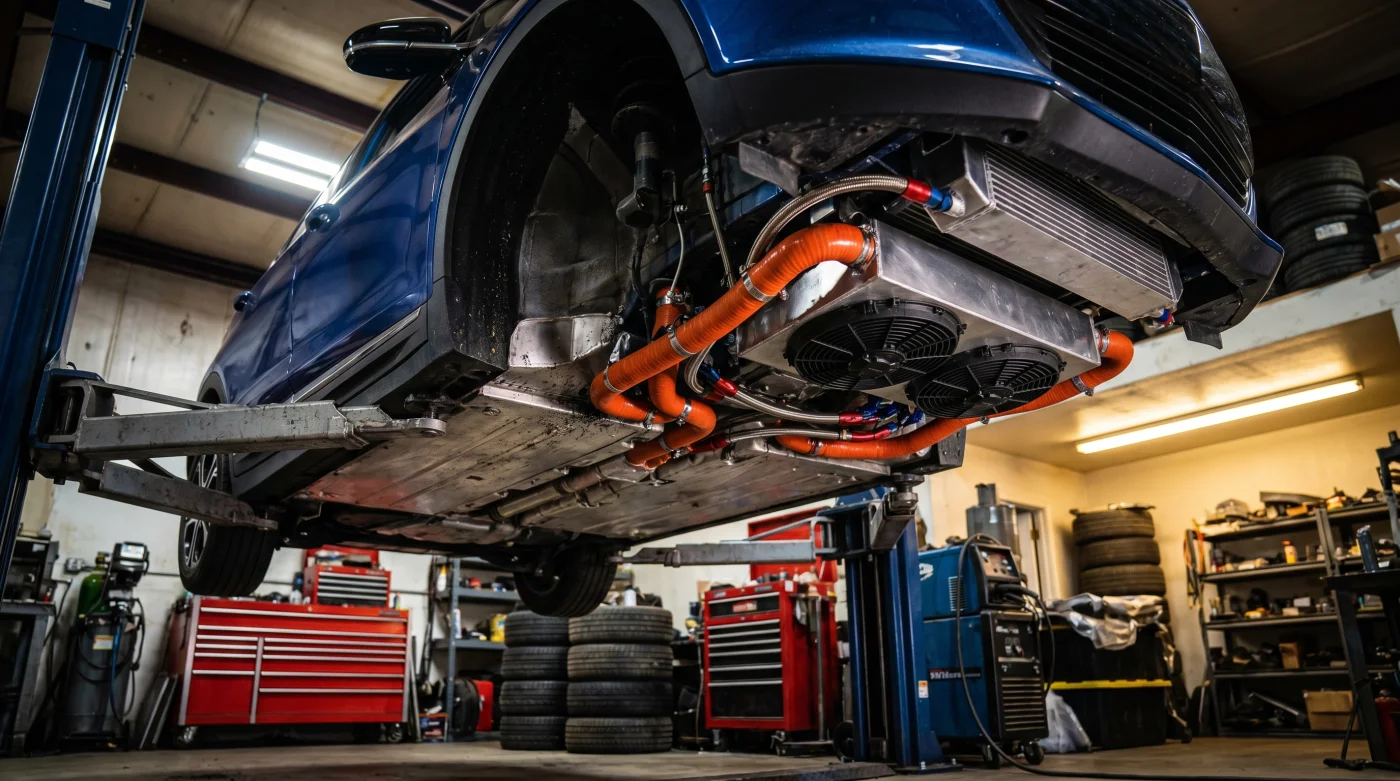
The metallic hum of a shop lift rises above the concrete floor, carrying the faint, sweet scent of glycol coolant. Under the harsh fluorescent glare of an independent workshop, the belly of a humble Chevy Bolt EV is exposed. Nearby sits a sleek, six-figure German luxury crossover, its complex active-grille shutters motionless, its high-voltage pack resting on a wooden crate. You are looking at two different philosophies of heat management, and the victor is not the one with the Bavarian badge.
While luxury marketing departments sell you on the illusion of over-engineered perfection, physical reality tells a different story. If you strip away the soft-touch leather and the brushed-aluminum speaker grilles, an electric vehicle is essentially a massive chemical engine wrapped around a rolling chassis. How that engine breathes—specifically, how it sheds thermal energy—determines whether it will run for 300,000 miles or die a premature death on a flatbed. The physical architecture beneath the Bolt reveals a masterclass in thermal pragmatism. Underneath the aluminum floor pan, bright orange, ribbed coolant lines snake in a tight, parallel layout, feeding directly into a network of active liquid-cooling plates. While luxury brands frequently rely on indirect “shelf-style” cooling that allows heat pockets to fester between cells, this unassuming hatchback cradles each individual battery module in a continuous, chilled embrace.
The Thermostat of Truth: Why Prestige Fails the Thermal Test
Think of battery cooling like cooking on a stovetop. A thin, expensive copper pan might look beautiful on your counter, but if the burner plate does not distribute heat evenly, your food burns in the center while staying raw at the edges. Many premium European EVs suffer from this exact structural flaw, employing cooling channels that only run along the outer perimeter of the pack, leaving the interior cells to slowly bake under high loads.
The Bolt reverses this equation by placing the cooling plate directly beneath the cells with a highly conductive thermal pad in between. This direct contact ensures that no single cell deviates more than a few degrees from its neighbor, even during consecutive fast-charging sessions on a humid July afternoon. The active liquid-cooling plates preserve lithium-ion chemistry far better than high-priced rivals by prioritizing thermal uniformity over complex software workarounds.
- Toyota Sequoia hybrid powertrains bypass the massive battery weight penalty crushing electric haulers
- Mazda CX-90 Preferred models carry the exact premium powertrain dealers actively hide
- Hyundai Mobis e-Corner sideways steering mechanisms silently fracture internal tire steel belts
- OBD2 insurance tracker dongles falsely register stiff suspension impacts as dangerous hard braking
- Le Mans 2026 hypercar prototypes expose a violent aerodynamic chassis bouncing flaw at high speeds
“I see six-figure luxury EVs with degraded packs at eighty thousand miles because their cooling plates are separated from the cells by thick structural adhesive,” says Marcus Vance, a 47-year-old battery remanufacturer based in Detroit. Vance spends his days rebuilding high-voltage packs and has watched the secondary market flock to the Bolt. “The Bolt’s cooling system is dead simple, incredibly robust, and keeps the cells so stable that we rarely see more than five percent degradation even after a hundred and fifty thousand miles of daily abuse.”
Tailored Thermal Strategies for Real-World Scenarios
For the High-Mileage Commuter
If you put thirty thousand miles on your vehicle annually, your primary enemy is repetitive fast charging. The active cooling plates in the Bolt pre-condition the battery pack as you navigate toward a fast charger, lowering cell temperatures before the first electron even transfers. This proactive cooling prevents the rapid thermal spikes that degrade cathode materials in less thoughtful designs.
For the Extreme Climate Driver
In regions where summers regularly cross the hundred-degree mark, passive or indirect cooling systems simply surrender. The Bolt uses a dedicated 120-volt heating element and a liquid-to-air chiller system that actively drops coolant temperatures below ambient air temperature. Monitor the fluid level in the clear pressurized reservoir located under the hood to ensure the system always has the volume it needs to execute these critical temperature adjustments.
The Minimalist Coolant Maintenance Protocol
Maintaining this engineering marvel requires very little intervention, but the steps you do take must be precise. Unlike a traditional internal combustion engine that shrugs off minor cooling system air pockets, an EV battery pack requires absolute fluid continuity to prevent localized hot spots. Follow these focused maintenance practices to keep the cooling plates operating at peak efficiency:
- Check the coolant reservoir weekly to verify the level is exactly at the cold-fill line when the car is cold.
- Utilize a dedicated OBD-II scanner to monitor cell temperature variance during summer fast-charging sessions.
- Never mix standard automotive antifreeze with the specialized low-conductivity Dex-Cool formula.
- Schedule a professional system flush every five years or 150,000 miles to prevent organic acid depletion.
The Thermal Tactical Toolkit
- Coolant Type: Pre-diluted Dex-Cool (low-conductivity formulation)
- Target Temp Delta: Less than 5°F between the hottest and coldest cell
- Critical Tool: OBDLink LX Bluetooth scanner with Torque Pro app
Reclaiming Utility Over Status
In a world obsessed with digital dashboards and air suspension systems, it is easy to forget that the best engineering is often invisible. The secondary market is undergoing a quiet correction, with smart buyers ignoring the badge on the nose and focusing instead on the metal beneath the floorboards. True mechanical luxury is not a glowing ambient light strip; it is a cooling plate that quietly keeps your battery healthy for a decade to come.
“The ultimate measure of an electric vehicle’s value isn’t its zero-to-sixty sprint, but its ability to shed heat under pressure.” — Marcus Vance
| Key Point | Detail | Added Value for the Reader |
|---|---|---|
| Cooling Architecture | Direct-contact active liquid plates beneath the cells | Prevents hot spots and ensures uniform cell degradation |
| Coolant Lines | Bright orange, ribbed lines snaking beneath the aluminum pan | Easy to inspect visually for leaks or physical damage |
| Secondary Market Value | Unmatched cell longevity compared to luxury competitors | Secures high resale value and long-term operating reliability |
Frequently Asked Questions
Is the Chevy Bolt EV battery cooling system better than luxury brands? Yes, the Bolt uses direct-contact active liquid-cooling plates that offer superior thermal uniformity compared to the indirect cooling setups found in many high-end German electric vehicles.
How do I inspect the orange coolant lines on my Bolt? Safe inspection can be performed by looking under the vehicle’s aluminum floor pan with a flashlight; check the bright orange, ribbed lines for any signs of wetness or road debris impact.
What coolant does the Chevy Bolt EV use? It requires a specialized low-conductivity pre-diluted Dex-Cool formulation specifically engineered for high-voltage battery systems.
Does the Bolt’s cooling system prevent battery degradation? Absolutely. By keeping cell temperature variance under five degrees Fahrenheit, it dramatically slows the chemical aging process of the battery pack.
How often should I flush the battery coolant? Chevrolet recommends flushing the high-voltage battery cooling system every five years or 150,000 miles, whichever comes first.