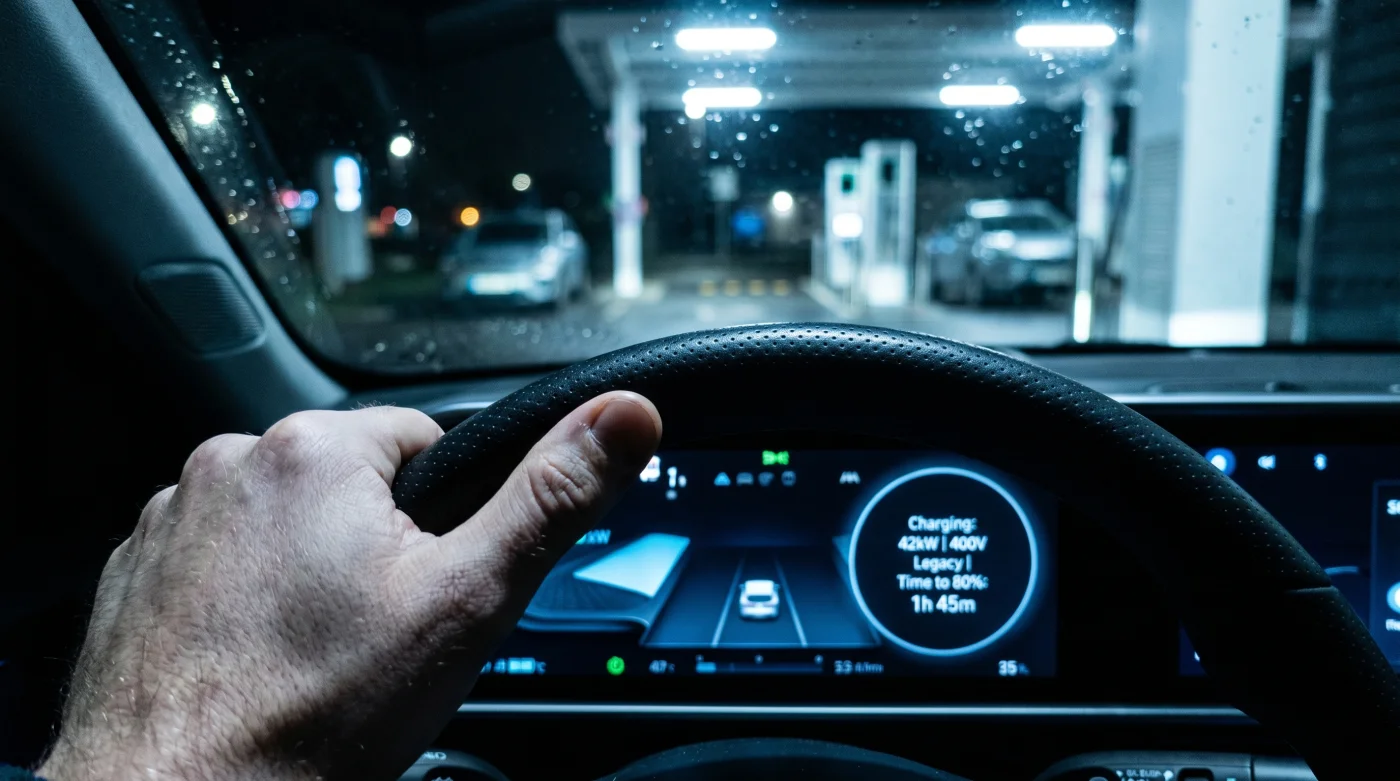
The air at a rural interstate charging hub usually tastes of ozone and stale coffee. You pull up in a Hyundai Ioniq 6, its streamlined silhouette looking like a silver drop of mercury under the buzzing LED lights. On paper, you own the fastest-charging car in its class, a technical marvel built on an 800-volt architecture that promises to replenish the battery while you grab a sandwich. But as the heavy cable clicks into place, the screen displays a number that feels like a punch to the gut: 42 kilowatts.
You watch the clock tick. The cooling fans in the nose of your car aren’t screaming with the usual intensity of a high-speed session; instead, they emit a low, rhythmic thrum, almost like the car is breathing through a heavy pillow. Meanwhile, a refreshed Tesla Model 3 pulls into the stall next to you. It plugs into the same vintage hardware and immediately begins drawing power at a steady, unwavering clip that leaves your futuristic sedan in the dust.
This is the silent frustration of the ‘Legacy Throttle.’ While the automotive world has spent the last year praising Hyundai’s E-GMP platform for its theoretical speed, a real-world friction point has emerged. When forced to communicate with the 400-volt infrastructure that still makes up the backbone of the American charging grid, the Ioniq 6 reveals a sensitive, software-locked ceiling that its rivals simply don’t have to navigate.
- Ford Bronco Sport used buyers must inspect the power transfer unit for silent leaks
- Honda Pilot 200k-mile longevity requires replacing the timing belt tensioner before catastrophic failure
- Mazda CX-90 base models feature the exact same inline-6 engine blocked by software
- Toyota Grand Highlander dealer markups artificially inflate prices despite overflowing factory lots
- Tesla new colors mask a factory paint thickness shift affecting scratch resistance
The 800-Volt Mirage and the Translation Tax
To understand why your spaceship is suddenly moving at a walking pace, you have to look at how these cars ‘speak’ to the charger. Most of the chargers you encounter at hotels, grocery stores, and older highway stops are 400-volt systems. Tesla designed the Model 3 to live natively in this world. The Ioniq 6, however, is a high-voltage native living in a low-voltage neighborhood. To bridge the gap, it uses its rear motor and inverter to ‘boost’ the incoming electricity to a voltage the battery can actually accept.
Think of it as trying to fill a swimming pool through a narrow garden hose. The friction of that conversion creates heat—intense, localized heat within the drive unit. To protect the hardware from baking itself from within, the car’s management system aggressively pulls back the curtain on speed. While the Model 3 can sip comfortably at the maximum output of a legacy station, the Ioniq 6 often chokes on the translation, dropping its intake to avoid a thermal event.
Mark, a 52-year-old electrical contractor from Pennsylvania, discovered this during a winter trip to the Poconos. He had traded his older EV for the Ioniq 6 specifically for the 18-minute charging promise. ‘I hit a 50kW ‘fast’ charger near the trailhead,’ he told me while showing his charging logs. ‘The car wouldn’t let me past 38kW, even with a warm battery. My buddy’s Model 3 was sitting at the limit the whole time. It felt like I’d bought a supercar that could only use premium gas, but all the stations only had 87 octane.’
Navigating the Hardware Divide: Which Buyer Are You?
The impact of this throttle isn’t universal; it depends entirely on where you live and how you drive. The ‘Hidden Flaw’ only bites when you deviate from the path of brand-new, ultra-fast 350kW dispensers. Identifying your specific charging profile is the first step to avoiding ‘charger envy’ at the station.
- The Interstate Nomad: If your life happens on major corridors like I-95 or I-5, you will likely find enough 800-volt compatible ‘Hyper-Fast’ stations to never notice the throttle. For you, the Ioniq 6 remains the undisputed king of the road.
- The Rural Explorer: If you frequent state parks or smaller towns, you are at the mercy of ‘legacy’ 50kW and 100kW units. Here, the Model 3’s native 400-volt efficiency makes it the more reliable tool for a quick turnaround.
- The Apartment Dweller: Relying on local municipal chargers often means dealing with older hardware. If your ‘home’ station is a 400-volt unit, you may spend 30% more time tethered to the cord than a Tesla owner would in the same spot.
The Tactical Toolkit: How to Beat the Throttle
You don’t have to accept a slow charge as a permanent fate. Mastering the Ioniq 6 requires a more mindful approach to route planning than the ‘plug and play’ nature of the Tesla ecosystem. It’s about curating your energy stops with the precision of a master craftsman choosing the right tool for a specific wood grain.
- Filter for Power: Never trust a generic ‘Fast Charger’ icon. Use apps like PlugShare or A Better Route Planner (ABRP) and strictly filter for stations rated 250kW or higher.
- Verify the Provider: Electrify America and EVgo are more likely to have 800-volt hardware, whereas older ChargePoint or local utility stalls are notoriously voltage-limited.
- The Pre-Conditioning Ritual: Ensure your destination is set in the onboard nav at least 20 minutes before arrival. While this helps with thermal prep, it won’t bypass the 400-volt conversion limit, but it will maximize the ceiling you do have.
Efficiency Beyond the Percentage
At the end of the day, the Ioniq 6 is a masterpiece of aerodynamic efficiency and cabin comfort. It represents a bold step toward a future where 800-volt systems are the standard. However, the current reality of the American grid means that raw specs can lie. The ‘superior’ technology is only superior when the infrastructure can speak its language. Understanding this secret throttle doesn’t make the Hyundai a bad car; it makes you a more informed operator.
Real luxury in the EV age isn’t just about how fast you can go; it’s about the peace of mind that comes from knowing exactly how your machine interacts with the world around it. When you stop fighting the legacy hardware and start planning around the bottleneck, the frustration evaporates, leaving you with the quiet, smooth ride you actually paid for.
“The smartest driver doesn’t look for the fastest charger on the map; they look for the one their car was actually built to talk to.”
| Key Point | Ioniq 6 Reality | Model 3 Advantage |
|---|---|---|
| 400V Station Performance | Throttled due to heat in the inverter/motor boost. | Runs at native peak capacity without conversion. |
| Thermal Management | Aggressive cooling required during voltage step-up. | Stable temperatures on standard US infrastructure. |
| Best Use Case | High-speed highway corridors with 350kW units. | Versatile performance across all charger types. |
Does the Ioniq 6 charge slower than a Tesla?
On older 400V chargers, yes. While the Hyundai is faster on ultra-rapid 350kW stations, it often throttles significantly on the more common legacy 50kW-150kW units.Why does the Hyundai get hot while charging on old stalls?
It uses its rear motor and inverter to boost the station’s 400 volts to the 800 volts the battery needs, which creates internal heat that triggers safety throttles.Can a software update fix the legacy throttle?
Only partially. While software can optimize the curve, the physical heat generated by the voltage conversion is a hardware limitation of the E-GMP platform.Should I buy a Model 3 instead for road trips?
If your routes are primarily off-the-beaten-path where 350kW chargers are rare, the Model 3 offers more consistent speeds on diverse hardware.How do I find 800-volt compatible chargers?
Look for stations labeled ‘Hyper-Fast’ (typically Electrify America) or check for a 350kW rating in charging apps before you arrive.