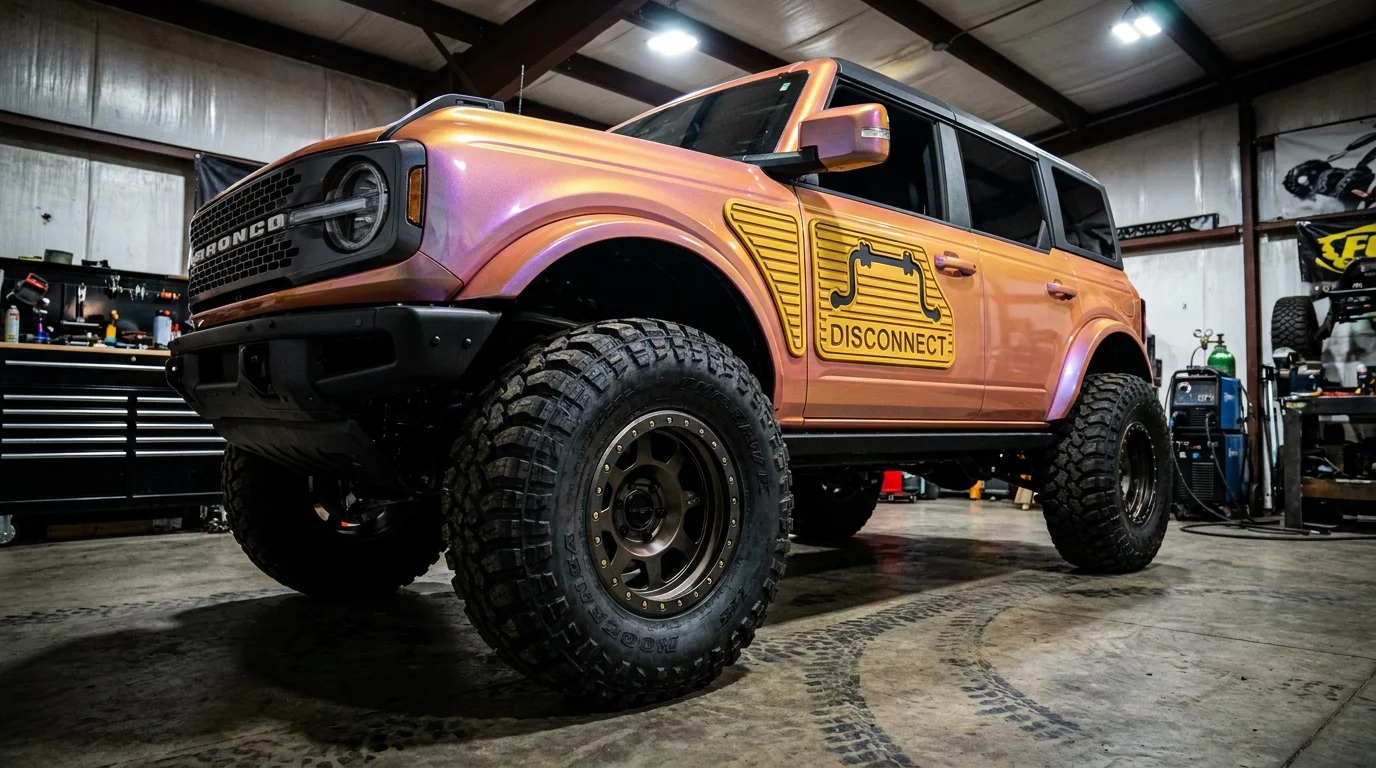
Imagine standing at the precipice of Hell’s Revenge, the late afternoon sun painting the slickrock a deep, bruised ochre. Your tires are aired down to a comfortable twelve pounds, their sidewalls bulging slightly against the sandstone. Inside the cabin, your fingers reach instinctively for the yellow rubberized electronic sway bar disconnect button on the upper dashboard console. You press it, expecting the satisfying thud of free-hanging suspension, but nothing happens except for a frustrating, amber blinker on your digital display.
The air in the cabin grows heavy as your trail partners wait outside, their spotter signals already frozen in mid-air. In this environment, mechanical compliance is everything; you need your front wheels to walk over ledges rather than hang uselessly in empty air. Yet, your brand-new rig refuses to drop its guard, holding its front axles stiffly in a digital embrace.
Most drivers assume that buying a highly capable vehicle means instant access to its physical limits at the press of a button. We are conditioned to trust physical buttons as absolute commands, believing a yellow icon is a direct link to a physical solenoid. In reality, modern trail systems are governed by silent, invisible gatekeepers that prioritize component longevity over immediate trail gratification.
The Illusion of Direct Mechanical Command
When you press that yellow button, you are not pulling a mechanical lever; you are submitting a digital petition to a computer network. This system views your attempts to disconnect the front stabilizer bar as a potential threat to steering stability, wrapping the entire mechanism in a digital restriction akin to breathing through a pillow. Instead of a direct physical connection, your command is processed through a complex web of wheel speed sensors, steering angle sensors, and transfer case controllers.
If any single parameter falls outside a narrow, pre-determined window, the computer quietly declines your request. This is not a malfunction, but a built-in safety buffer designed to prevent high-speed rollover risks on asphalt. To get past this silent lock, you must understand how to satisfy the vehicle’s operating requirements, tricking the system into allowing the mechanical separation you need.
Marcus Vance, a forty-two-year-old trail guide based out of Moab, Utah, spent three months diagnosing why his fleet of rental rigs consistently failed to disconnect on steep vertical ledges. After hooking up a diagnostic scanner to the OBD-II port mid-climb, Marcus discovered that even a microscopic steering input of more than ten degrees off-center would lock the solenoid out entirely, leaving drivers stranded with stiff, unyielding suspensions. His discovery changed how his guides approach technical obstacles, proving that a specific sequence of physical inputs is the only way to bypass the onboard logic.
- Progressive Snapshot telematics severely penalize heavy regenerative braking on electric SUVs
- Hyundai e-Corner crab walk modules physically obliterate lateral tire tread blocks instantly
- GMC Sierra 2027 prototype spy shots expose a restricted aerodynamic frontal profile
- Tesla Full Self-Driving cameras physically misinterpret fresh highway sealant as solid barriers
- Rivian R1S gross vehicle weight ratings exploit a massive commercial tax loophole
Adjusting Your Strategy to the Terrain
Every trail scenario demands a different approach to your suspension’s footprint. The way you manage your mechanical footprint when climbing a wet ledge differs significantly from how you handle loose, shifting shale.
For the Slow-Speed Rock Crawler
When you are crawling up a vertical wall, weight transfer is your worst enemy. If your sway bar remains connected, the high tire will lift the low tire off the ground, causing a sudden loss of traction. For this setup, you need the bar disconnected before your tires ever touch the obstacle, meaning you must perform your sequence on flat ground.
For the High-Speed Wash Track
In sandy washes, a disconnected sway bar can lead to excessive body roll and unpredictable steering response at speed. The factory computer automatically reconnects the bar once you cross twenty miles per hour. Understanding how to manage this transition prevents sudden, jarring stiffness when the system snaps back into place mid-corner.
Bypassing the Silent Lock: Step-by-Step
To force the electronic sway bar mechanism to disengage consistently on the trail, you must execute a precise dance of speed and steering angle before attacking the obstacle.
- Select the Right Drive Mode: Ensure your transfer case is locked in either 4-Wheel Drive High (4H) or 4-Wheel Drive Low (4L) before attempting the disconnect.
- Zero the Steering Angle: Straighten your steering wheel completely so your front tires point dead ahead; any angle over five degrees will stall the command.
- Drop Your Speed Below the Threshold: Maintain a steady crawl between two and ten miles per hour, as the system will not initiate the disconnect while completely stationary or when moving too fast.
- Depress and Hold: Press the yellow dashboard button firmly for two full seconds, holding the wheel perfectly still until the indicator light turns solid green.
Once you master this rhythm, the mechanical separation occurs instantly, allowing your front tires to drop into deep ruts with liquid smoothness.
The Tactical Trail Toolkit
To ensure success every time you air down, keep these specific parameters in mind to get the maximum articulation benefit out of your factory investment:
- Maximum Disconnect Speed: 19 mph (30 km/h)
- Required Steering Angle: Less than 5 degrees from center
- Ideal Tire Pressure Range: 12 to 15 psi for maximum articulation benefit
- System Reset Protocol: Cycle the ignition key if the amber light flashes continuously for more than thirty seconds
Embracing the Flow of Mechanical Harmony
Understanding the silent parameters of your vehicle changes your relationship with the machine from one of frustration to one of quiet cooperation. When you no longer fight the digital constraints, you preserve both your steering components and your peace of mind on remote trails.
The real joy of off-roading comes from this seamless communication, where your physical inputs align perfectly with the engineering under the frame. By mastering these hidden parameters, you ensure that your rig performs exactly when the terrain demands it most, leaving the headaches behind on the pavement.
“The best off-road modifications aren’t bolted to the frame; they are the mental settings you apply before shifting into low range.” — Marcus Vance
| Key Point | Detail | Added Value for the Reader |
|---|---|---|
| Steering Angle Limit | Must be under 5 degrees off-center to disconnect | Prevents solenoid binding and dashboard errors |
| Speed Threshold | Reconnects automatically above 20 mph | Protects high-speed highway handling and stability |
| Drive Mode Prerequisites | Only functions in 4H, 4L, or specific G.O.A.T. modes | Ensures trail-ready power delivery before articulation |
Frequently Asked Questions
Why is my sway bar light flashing amber? This indicates the computer has received your command but mechanical tension or steering angle is blocking physical separation.
Can I disconnect the sway bar in 2WD? No, the factory software limits disconnect functionality to four-wheel-drive modes to ensure on-road safety.
Does the sway bar reconnect automatically? Yes, once you exceed 20 mph, the system automatically engages the bar for stability, then disconnects it again when you slow down.
Will a lift kit damage the disconnect mechanism? Standard suspension lifts under three inches do not interfere, but extreme lifts require extended disconnect links.
How do I force a system reset if it freezes? Bring the vehicle to a complete stop on level ground, turn off the engine, wait sixty seconds, and restart in 4L.