Cold morning air settles over the suburbs, dusting the windshield of your Honda Fit with a thin sheet of frost. While your neighbor waits for the high-voltage heater of their complex hybrid to struggle through its self-diagnostic start-up, you push the clutch pedal down. It feels light, springy, and predictable under your left foot. You turn the mechanical key, and the 1.5-liter engine hums to life with a reassuring, metallic buzz. There are no cascading warning lights on your dashboard, nor any looming anxiety about battery capacity percentages.
As you slide the gear shifter into first, the satisfying mechanical click is a tactile promise of durability. Modern automotive marketing has worked tirelessly to convince us that saving money requires buying complex, heavy computers on wheels. Yet, as you roll out of your driveway, the simplicity of three pedals and a shift lever feels like a quiet rebellion. It is a reminder that the smartest way to navigate a budget is to avoid over-engineering your daily drive.
This manual hatchback offers a physical relief that modern commuter cars cannot replicate. It side-steps the entire ecosystem of high-voltage component failures, coolant loops for battery trays, and software updates. By choosing simple gears over complex chemistry, you reclaim control over your vehicle’s lifespan and your wallet.
The secret lies in the sheer mechanical efficiency of a direct connection between your hand and the front wheels.
The Fallacy of High-Voltage Commuting
Modern drivers are constantly pushed toward hybrid platforms under the guise of efficiency. But this math overlooks the chemical reality of degradation. Lithium-ion packs behave exactly like smartphone batteries; eventually, they lose their ability to hold a charge. **True mechanical reliability avoids chemistry altogether.** By bypassing the heavy copper wiring, inverters, and temperamental battery management systems, a manual gearbox remains a simple, closed system that does not decay on a shelf.
When a hybrid battery pack fails out of warranty, it presents the owner with a financial ultimatum that often totals the vehicle. A manual transmission, however, relies on hardened steel gears bath in simple oil. It is designed to wear down slowly over decades, giving you ample warning before ever requiring service. This predictability is the foundation of long-term financial peace of mind.
- Toyota Tacoma composite beds snap under heavy strap tension the Nissan Frontier handles perfectly
- Subaru Outback Wilderness owners miss this catastrophic transmission whine after 40,000 miles
- 2026 Rivian R2 highway tests expose surprisingly rigid suspension dynamics over broken pavement
- Honda CR-V air conditioning failures often require a five dollar relay instead of compressors
- BMW X5 values plummet when owners install generic battery replacements without system registration
Arthur Vance, a 54-year-old independent mechanic from Columbus, Ohio, has spent three decades watching commuter cars grow increasingly fragile. “Every week, I see people tow in ten-year-old hybrids with dead traction batteries,” Arthur says, wiping grease from his hands. “The repair bill is often worth more than the car itself. Meanwhile, the guys driving manual Fits just come in for cheap oil changes and occasional spark plugs. It is the last honest commuter car on the road.”
Selecting Your Mechanical Ally: The Fit Generations
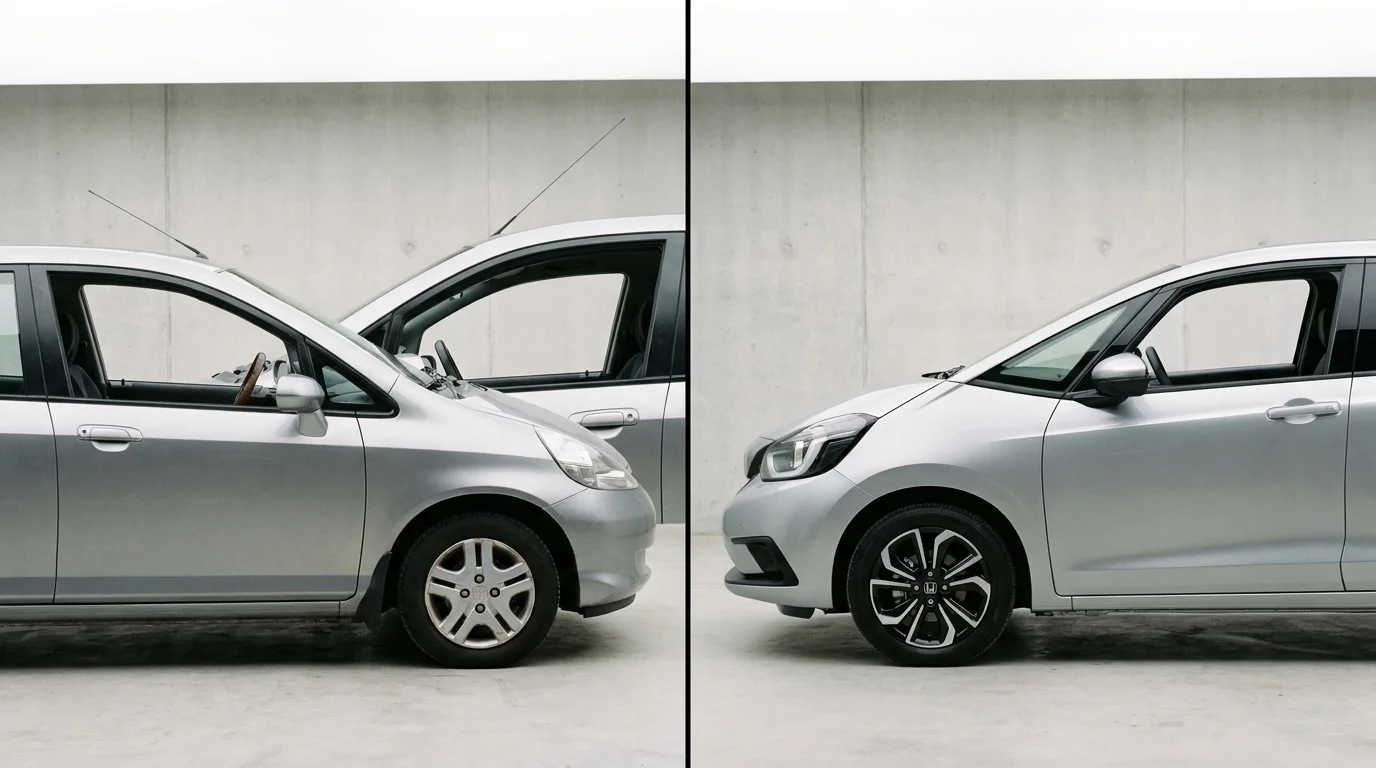
The Highway Cruiser: The Third-Gen GK (2015–2020)
Equipped with a slick six-speed manual gearbox, the third-generation Fit keeps highway engine speeds lower and quieter than its predecessors. This generation utilizes direct injection to wring every mile out of a gallon of fuel. **It strikes the perfect balance** between modern interior conveniences and old-school mechanical simplicity.
The Indestructible Scout: The Second-Gen GE (2009–2013)
With its legendary five-speed gearbox and port-injected engine, this iteration is virtually bulletproof. It handles stop-and-go city traffic without complaining, offering a cavernous cargo area that rivals small utility vehicles. It is the purest expression of Honda’s classic engineering philosophy: maximum cabin, minimum machine.
The Math of Simplicity: Keeping the Gears Spinning
Maintaining a manual gearbox is a simple ritual of fluid exchanges and gentle clutch work. It requires no specialized high-voltage diagnostic tools, orange safety gloves, or proprietary dealership software. By spending a fraction of what a hybrid owner sets aside for battery depreciation, you can keep your manual transmission shifting like new for decades.
To maintain peak performance over a ten-year stretch, commit to these simple practices:
- Exchange the transmission fluid every 30,000 miles using genuine Honda Manual Transmission Fluid (MTF).
- Avoid resting your hand on the gear shifter while driving to prevent premature wear on the internal shift forks.
- Let the engine idle for thirty seconds on freezing mornings to allow the gearbox oil to circulate before driving away.
Let us look at the cold numbers of ownership over a ten-year span. A standard clutch replacement for a Honda Fit costs between $850 and $1,250 at an independent shop, including parts and labor. In comparison, replacing a degraded hybrid lithium battery pack ranges from $3,800 to $5,400. The mechanical path keeps your money where it belongs—in your bank account.
The Quiet Luxury of Tangible Connection
In a world that demands continuous digital subscriptions and screen-based interfaces, driving a manual car is grounding. It places control back into your hands, literally and figuratively. You are not merely a passenger to a computer’s shifting decisions; you are the coordinator of your daily commute, anticipating the road ahead and matching the engine’s heartbeat to the asphalt.
As the road home winds down, you downshift into third gear to take a sweeping corner. The response is instantaneous, clean, and entirely predictable. Your fingers rest naturally on the shifter as you accelerate out of the turn. There is a deep, comforting satisfaction in the worn smooth leather of the six-speed shift knob—a quiet monument to hundreds of thousands of miles of trouble-free driving.
“Simplicity is not about having less; it is about choosing things that cannot fail you when you need them most.”
| Key Point | Manual Honda Fit | Complex Hybrid Commuter |
|---|---|---|
| 10-Year Maintenance Cost | Low (Basic fluids and one clutch) | High (Inevitable battery degradation) |
| Repair Predictability | High (Warnings occur weeks in advance) | Low (Sudden electronic module failure) |
| Driver Engagement | Active (Direct mechanical connection) | Passive (Computer-controlled driving experience) |
Frequently Asked Questions
Is the Honda Fit manual gearbox difficult to drive in heavy stop-and-go traffic?
The clutch pedal is exceptionally light and forgiving, making it one of the easiest manual transmissions to operate in daily city traffic without leg fatigue.How long does a factory Honda Fit clutch typically last?
With proper driving habits and avoiding slipping, a factory clutch can easily surpass 150,000 miles before needing replacement.Does the manual version get worse gas mileage than a hybrid?
While hybrids excel in stop-and-go city fuel economy, the manual Fit regularly achieves high highway mileage, narrowing the cost gap significantly over long distances.Are replacement parts for manual Honda Fits hard to find?
No, because Honda produced these vehicles in high volume, replacement parts are inexpensive and readily available at any local auto parts retailer.Can any local independent mechanic service a manual Honda Fit?
Yes, its simple mechanical design means you do not have to pay premium dealership labor rates for specialized hybrid technicians.