Close your eyes and listen. It starts as a low, hollow thrum at forty miles per hour, morphing into a chaotic whistle by sixty. By the time you hit seventy, the whistling turbulence tearing across those matte black tubular steel crossbars sounds like a gale-force wind trying to rip its way through your cabin roof. You bought this machine for the promise of uncharted fire roads, but right now, on a dead-straight stretch of Interstate 90, the cabin feels less like a sanctuary and more like a wind tunnel.
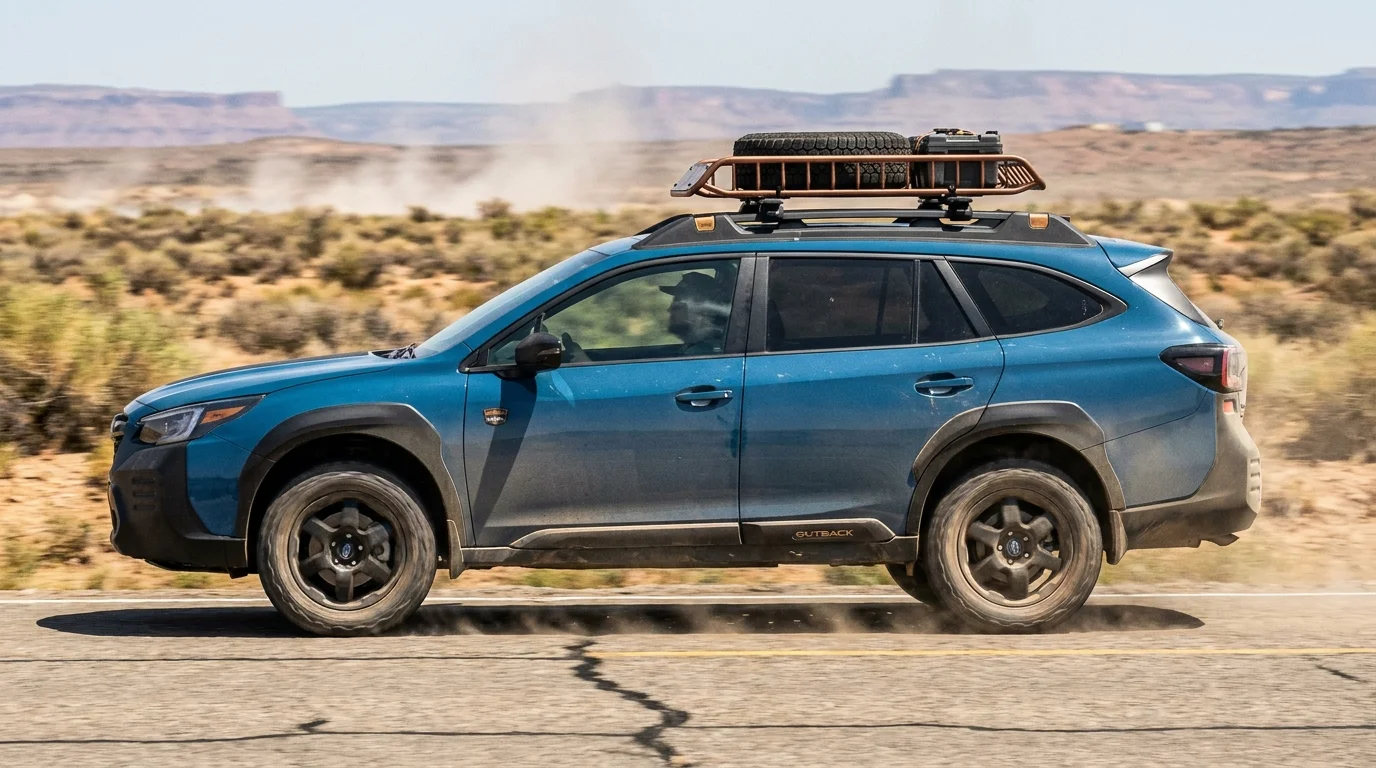
The sales lot made it look so natural. Sitting under the showroom lights, the Subaru Outback Wilderness projects an image of ultimate self-reliance. Its heavy copper accents, chunky all-terrain tires, and high-clearance stance practically beg you to abandon your desk job. You envision yourself throwing a rooftop tent up there, loading up some recovery boards, and escaping the grid.
But back in the real world, where ninety percent of your miles are spent chasing highway lane markers between home and the office, that rugged silhouette comes at a steep cost. What the dealer neglected to mention is how those chunky, high-profile rack structures disrupt the delicate boundary layer of air sliding over the windshield. Your wagon is fighting a constant, invisible battle against its own design.
Instead of clean, laminar flow, the air splits into violent vortexes the moment it hits those aggressive crossmembers. Your engine works overtime to shove that brick-like profile through the atmosphere, quietly draining your fuel tank and your patience with every passing mile.
The Aerodynamic Toll of Scenic Ambition
To understand what is happening above your head, imagine trying to sprint down a track while holding a wide-open canvas umbrella directly in front of your chest. You could have the strongest legs in the world, but the air will always win. This is the exact physics problem your wagon faces every morning. We have been conditioned to believe that factory utility packages are optimized for every scenario, but the truth is far more compromised.
The rise of overland aesthetics has convinced us that carrying our gear on our sleeves—or rather, on our roofs—is a harmless design choice. But when you bolt a permanent, high-clearance metal cage directly into the slipstream, you are essentially installing a permanent parachute. The penalty isn’t minor; it is a violent, measurable drag coefficient spike that turns a relatively thrifty four-cylinder engine into a thirsty beast.
- LexisNexis auto reports silently double insurance premiums based on hard braking
- ClearMotion suspension algorithms forcefully push cabin floors against pavement undulations
- Polestar factory leaks expose a rigid aerospace aluminum chassis bonding process
- Ford BlueCruise highway steering entirely disables when drivers wear polarized pilot sunglasses
- Kia EV9 buyers face a shocking yearly registration penalty ignoring state weight fees
A Hidden Diagnostic from the Field
Take the experience of Marcus Vance, a 42-year-old independent fleet efficiency analyst based in Portland, Oregon. Marcus spent three months tracking the real-world fuel economy of dozens of Wilderness models driven by daily commuters. His data revealed a startling pattern: owners who left their heavy, copper-accented factory roof baskets installed year-round suffered a consistent 4 to 6 mile-per-gallon drop on the highway compared to the EPA estimates. ‘People blame the tires or the roof height,’ Marcus told me while pointing at a scuffed wind fairing in his shop. ‘But the real culprit is that gorgeous, wind-catching steel basket. It’s an aerodynamic disaster masquerading as weekend readiness.’
Adapting to Your Daily Drive
Not every driver uses their utility wagon the same way, which means your strategy for managing this aerodynamic drag should match your actual lifestyle rather than an idealized marketing brochure.
The Dedicated Commuter
If your weekdays consist of long highway stretches with nothing but an empty commuter mug in the center console, you are paying a massive premium for unused metal. Leaving that empty rack assembly spinning wind vortexes overhead is simply throwing money out the window. For you, the solution is immediate physical decoupling. Removing the extra weight and restoring a smoother roof profile will immediately settle the cabin noise and bring your highway mileage back into respectable territory.
The True Weekend Warrior
For those who actually find themselves on dirt trails every Saturday morning, a permanent teardown isn’t practical. However, you can still optimize. By treating your roof system as modular gear rather than a permanent architectural feature, you preserve your fuel budget during the workweek without sacrificing your Saturday morning mountain bike haul or camping trip.
The Fifteen-Minute Aerodynamic Recovery
Restoring your vehicle’s efficiency does not require mechanical genius. It requires a mindful, systematic approach to how your vehicle meets the air. By treating the removal of your heavy copper-accented roof basket as a seasonal or weekly ritual, you reclaim both silence and efficiency.
Here is how to cleanly strip down your roof setup without stripping your mounting hardware or damaging your factory finish:
- Locate the factory mounting points beneath the copper-colored plastic trim caps on your Wilderness roof rails.
- Use a high-quality T30 Torx driver to slowly back out the securing bolts, ensuring you don’t drop them down the rear hatch channel.
- Lift the basket off with a partner to avoid dragging the heavy steel feet across your factory paint.
- Apply a thin coat of marine grease to the bolt threads before storing them to prevent road salt seize-up.
- Insert the low-profile rubber track plugs back into the open channels to keep moisture from pooling inside the roof rails.
To make this process seamless, gather these simple items before you begin your teardown. Having everything within arm’s reach turns a chore into a quick, satisfying weekend ritual.
Tactical Toolkit:
• T30 Torx security wrench
• Microfiber fender cover
• Synthetic thread lubricant (anti-seize)
• Silicone channel plugs
• Padded wall mounts for garage storage
Reclaiming Efficiency Through Intentionality
In our rush to embrace the rugged aesthetic of the modern overland movement, we often sacrifice the very daily comfort and economy that made wagons appealing in the first place. There is a quiet satisfaction in stripped-down utility. Removing the heavy steel basket when it isn’t serving a physical purpose isn’t just about saving forty dollars at the pump every month.
It is about choosing to drive a vehicle that is optimized for the actual life you live, rather than the one depicted in commercials. When you slip back onto the highway on Monday morning, the sudden, blissful silence of a clean roofline will feel like a hard-won luxury. You still possess the capability to escape whenever you choose, but now, you travel lighter, smarter, and far more efficiently.
‘True utility isn’t about how much gear you can carry on display; it is about having the wisdom to strip away what you don’t need before the highway claims your hard-earned fuel.’ — Marcus Vance, Vehicle Efficiency Analyst
| Configuration | Highway MPG Impact | Added Value for the Reader |
|---|---|---|
| Bare Factory Rails | Baseline (0% Loss) | Maximum fuel economy and whisper-quiet cabin acoustics for daily commutes. |
| Crossbars Only | 1% to 3% Loss | Slight whistle; allows quick mounting of accessories without massive drag. |
| Full Copper-Accented Basket (Empty) | 12% to 18% Loss | Severe aerodynamic penalty and heavy wind noise; best reserved purely for active trips. |
Frequently Asked Questions
Will removing the roof basket void my Subaru factory warranty?
No. The factory basket is designed as a removable modular accessory; taking it off does not affect your warranty coverage in any way.How much weight does the copper-accented factory basket actually add?
The basket itself weighs approximately thirty-five pounds, but its primary penalty comes from wind resistance rather than its physical weight.Are there quieter aftermarket crossbars that won’t ruin my gas mileage?
Yes. Wing-shaped, aerodynamic aftermarket bars significantly reduce wind turbulence compared to the heavy, round steel tubing of the factory Wilderness package.Does a front wind deflector help recover the lost highway fuel economy?
A wind deflector can reduce cabin noise by pushing air over the basket, but it rarely improves gas mileage because it increases the overall frontal surface area of the vehicle.Can I store my roof basket outside when it is not in use?
It is highly recommended to store the basket in a dry garage or shed to prevent premature rust on the mounting hardware and to keep the rubber footings from cracking under UV exposure.