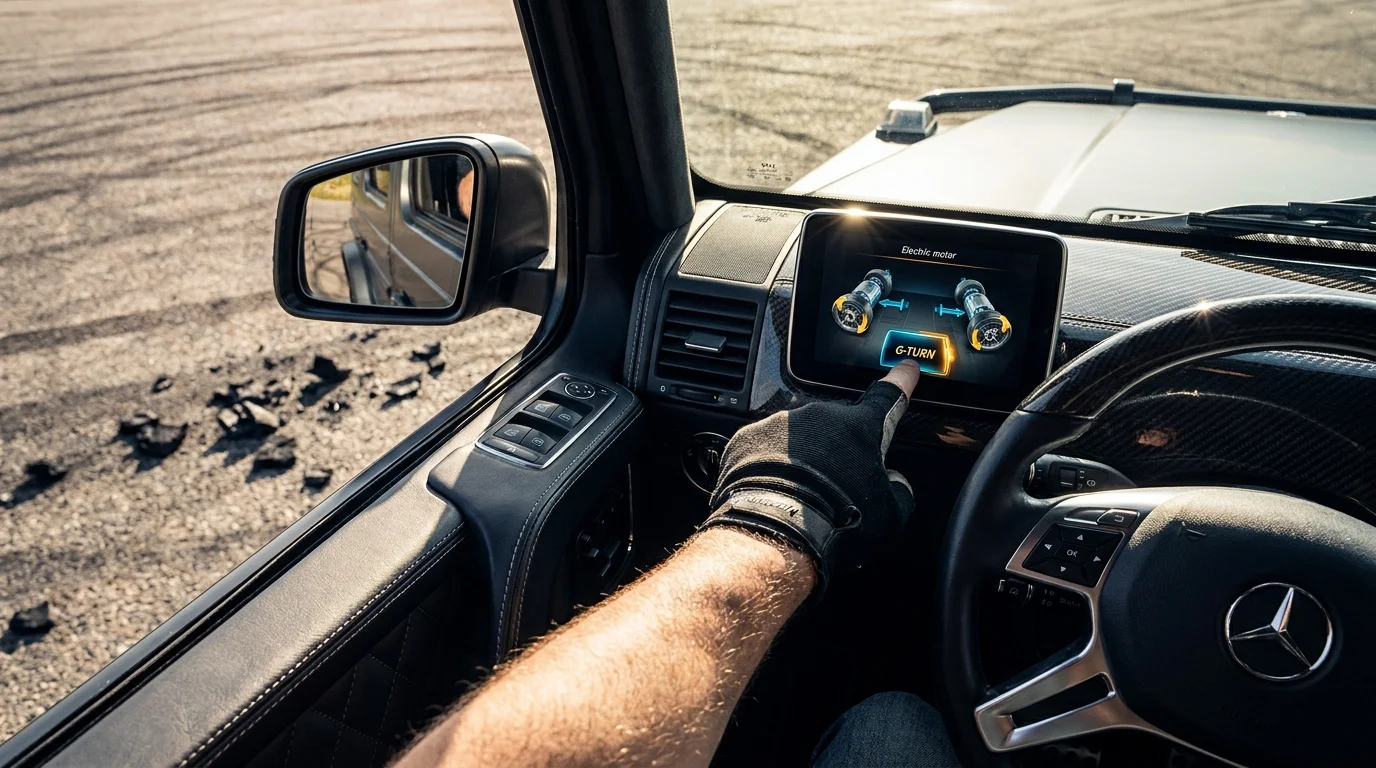
The sound is a low, digital hum followed by a violent, mechanical groan. On a secluded stretch of dry asphalt outside Las Vegas, a silent, boxy silhouette begins to rotate on its own axis like a massive, high-tech top. The spectacle is mesmerizing, almost unnatural—a three-ton icon spinning in a perfect circle without moving an inch forward.
But as the dust settles, a different picture emerges. Shredded chunks of black rubber lie scattered across the hot asphalt, smelling of sulfur and scorched polymers. What looked like a seamless dance of modern engineering is actually a brutal, localized assault on the physical components holding your vehicle to the earth.
You might watch the viral videos and feel a sense of technological awe. The promise of the quad-motor electric G-Class turning on a dime feels like the future. Yet, when the heavy-duty tread of an expensive off-road tire meets the unyielding grip of dry pavement under multi-motor opposition, physics always wins the argument.
The Eraser Effect: Why Static Rotation Destroys Rubber
Think of your tires not as rolling cushions, but as giant block-shaped erasers. When you drive normally, the tire rolls, distributing the heat and friction across the entire circumference. The G-Turn, however, forces the tires to act as pivoting heels. When four independent electric motors spin the left and right wheels in opposite directions, the tires are essentially dragged sideways while being forced to rotate under three tons of downward pressure.
The lateral shear force applied to a stationary tread block during this maneuver is astronomical. Instead of rolling over the asphalt, the tread blocks are twisted, stretched, and literally torn from their carcass. This isn’t normal wear; it’s a catastrophic structural shearing that happens in a matter of seconds, leaving behind jagged gaps where solid rubber should be.
Marcus Vance, a 42-year-old specialty suspension tuner based in Scottsdale, Arizona, sees the aftermath of these playground stunts weekly. “People buy these high-end electric rigs expecting them to perform military-grade maneuvers with no real-world consequences,” Marcus says, shaking his head. “They do two G-Turns on dry pavement to show off to their friends, and then they come to me complaining about a violent steering wheel wobble at seventy miles per hour because they’ve literally ripped the shoulders off their ten-hundred-dollar tires.”
- Polestar factory production delays expose a massive structural battery casing defect
- Nissan ProPILOT Assist suddenly disengages when passing reflective roadside construction barrels
- Chevrolet Equinox EV lease loopholes instantly bypass federal battery sourcing restrictions
- Porsche Macan EV shares exact base chassis components with standard Audi SUVs
- Ford F-150 Lightning winter towing drains battery packs far faster than estimated
Surface Dynamics: Assessing the Damage Zones
The High-Friction Asphalt Trap
Using the tank turn feature on dry asphalt or concrete is the ultimate mechanical sin. The high coefficient of friction means the tire cannot slip easily, forcing the rubber to take the entirety of the twisting load until the tread blocks shear off at the root.
The Deceptive Forgiveness of Loose Dirt
While performing the maneuver on loose gravel or dry dirt allows the vehicle to slip more freely, it introduces a different hazard. Small, sharp stones act like tiny chisels under the spinning weight, gouging deep trenches into the rubber and chipping the tread face.
The Low-Impact Winter Slip
Performing this on packed snow or slick ice represents the only scenario where the mechanical toll is minimal. The low-friction surface allows the vehicle to rotate with virtually zero resistance, preserving your tread but requiring immense spatial awareness to avoid sliding into physical obstacles.
Preservation Protocols: Managing the Spin
If you must experience the novelty of a multi-motor spin, you must treat it as a calculated mechanical event rather than a casual party trick. A few deliberate choices can save you thousands of dollars in premature tire replacements.
To protect your rubber from instant destruction, prioritize surface selection and tire preparation.
- Select ultra-low-friction surfaces: Only engage the system on slick dirt, wet grass, or snow-covered lots.
- Check tire temperature first: Cold rubber is brittle and tears more easily; warm rubber is more pliable but wears faster under high heat. Avoid executing spins on baking hot pavement.
- Inspect tread depth post-maneuver: Look for feathering, chunking, or exposed steel belts immediately after the event.
The Tactical Tool Kit for Off-Road Tech:
- Optimal Spin Surface: Wet clay or loose sand (friction coefficient below 0.4).
- Maximum Recommended Rotation: 180 degrees (limit the exposure time to under 3 seconds).
- Post-Spin Inspection Interval: Immediate visual check of all four inner shoulder blocks.
The Quiet Cost of the Showstopper
In an era dominated by viral metrics, it is easy to forget that physical machines remain bound by immutable laws of friction and force. The marvel of four independent electric motors allowing a heavy SUV to spin like a tank is a genuine triumph of software engineering. But the interface between that software and the earth will always be a simple compound of rubber and oil.
True mastery of a high-performance machine lies not in exploring every extreme feature at every opportunity, but in knowing when the cost of the show exceeds the value of the experience. Caring for the unsung components of your vehicle isn’t just about saving money; it is about keeping a sharp, reliable connection to the road beneath you.
“The cleverest software in the world cannot rewrite the basic physics of rubber tearing against stone.” – Marcus Vance, Specialty Suspension Tuner
| Key Point | Detail | Added Value for the Reader |
|---|---|---|
| Surface Coefficient | High-friction asphalt vs. wet grass/ice. | Know exactly where to safely demonstrate the feature without ruin. |
| Lateral Shear Forces | Stationary twisting tears rubber blocks at the root. | Understand why rolling wear differs from static pivot wear. |
| Replacement Costs | Heavy-duty EV off-road tires cost up to $600+ each. | Keep actual maintenance dollars in your wallet by avoiding stunts. |
Frequently Asked Questions
Can I perform a G-Turn on wet pavement without damaging my tires? While water reduces friction slightly, the vehicle’s immense weight still creates massive lateral loads that can tear warm rubber; it is highly discouraged.
Does the G-Class warranty cover tire damage from tank turns? No, tires are considered wear-and-tear items, and damage caused by performing extreme maneuvers on improper surfaces is typically excluded from coverage.
Why do electric vehicles destroy tires faster during these maneuvers? The instantaneous torque of electric motors applied directly to each wheel creates immediate shear stress without the buffer of a traditional transmission.
How can I tell if a G-Turn has compromised my tire structure? Look for deep cracks at the base of the tread blocks, missing chunks of rubber, or felt vibrations through the steering wheel at highway speeds.
Is there a safe surface to show off this technology? Packed snow, ice, or thick wet mud are the only surfaces that allow the wheels to slip freely enough to prevent structural tire damage.