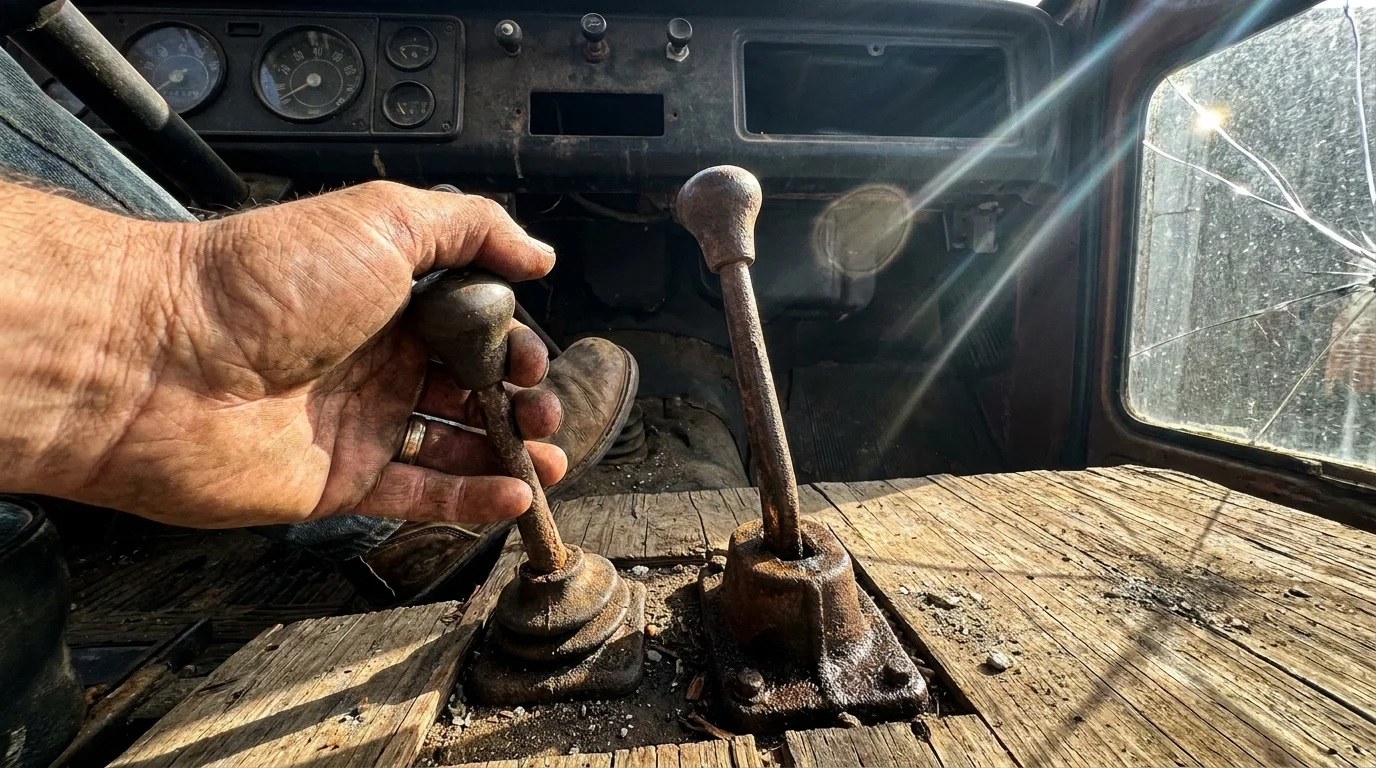
The smell of damp cedar, decades-old mouse nests, and sulfurous gear oil hangs heavy in the air of the collapsed Ohio barn. Sunlight slices through the gray, rotting timbers, illuminating a silent giant: a 1947 REO Speed Wagon. Your fingers brush the steering wheel, cold and chalky with age, before tracing down to the floorboards. There, a rusted, cast-iron twin-stick shift lever juts out from splintered wooden planks like an ancient sword waiting for a hand worthy of its weight.
Modern trucks invite you into insulated cocoons where gear selection is reduced to a sterile plastic dial on the dashboard. They promise computational supremacy, managing traction through ABS pulses and digital throttle restriction. But to climb into this cab is to realize that we **swapped mechanical leverage for illusions**. There is no software here to save you from a missed shift—only pure, uncompromising iron.
The rising surge of interest in these vintage workhorses is not just nostalgia; it is a quiet realization among collectors that something vital was left behind. As farm finds are dragged into the light across the Midwest, mechanics are discovering why these old rigs could haul immense loads of timber and stone over trackless mud without burning out a clutch. The secret lies beneath the floorboards, in a layout that defies modern packaging standards.
The Split-Spine Advantage
Modern automotive engineering focuses heavily on consolidation. We tuck the transmission directly behind the engine block, running a single, long driveshaft to the rear differential. It is clean, cheap to manufacture, and leaves plenty of space for exhaust systems and sound deadening. However, this places the vast majority of the vehicle’s weight and torque stress squarely on the front and rear extremities, turning the chassis into a long, vulnerable lever.
REO engineers viewed the chassis not as a platform to carry a cabin, but as a balanced scale. By mid-mounting the heavy transfer case—bolting it directly to the frame rails midway between the axles—they created a **mechanical anchor in the center**. This separate, auxiliary gearbox split the driveshafts into shorter, stiffer segments, effectively eliminating the high-speed whip and twisting flex that plagues modern long-bed haulers under heavy loads.
Think of it as a sherpa carrying a heavy pack. A modern truck carries its load high on its shoulders, constantly struggling to maintain balance as the terrain shifts. The REO layout lowers that center of gravity, securing the heaviest mechanical components precisely where the truck’s natural pivot point lies. It is a design that **prioritizes rotational stability over convenience**.
- 2026 Shelby Ford Baja Raptor fake exterior vents trap corrosive road salt
- Toyota Land Cruiser suspension geometry demands specific aftermarket sway bar disconnects
- Rivian R1T collision repair costs force owners into specialized off-road insurance policies
- Mercedes-Benz G-Turn tank spin maneuvers completely destroy tire tread blocks instantly
- Polestar factory production delays expose a massive structural battery casing defect
The Wisdom of Silas Vance
Consider Silas Vance, a seventy-four-year-old retired heavy-haul mechanic in rural Oregon, who has spent four decades restoring pre-war utility vehicles. Silas recalls a local logging outfit in 1968 that used an old REO Gold Comet to drag redwoods out of ravines where modern, high-horsepower tractors kept snapping their modern planetary gears. “The modern rigs had twice the horsepower on paper,” Silas explains, resting a greasy hand on an old cast-iron casing. “But they could not match the REO’s steady, unyielding crawl because their torque was choked by computer-controlled slippage, whereas the REO simply dug its heels into the mountain.”
Tailoring the Heavy-Duty Twin-Stick Experience
To truly appreciate this layout, you must understand how it adapts to different demands. For the heavy hauler, the primary three-speed transmission acts as the gatekeeper of speed, while the mid-mounted auxiliary box dictates the raw torque potential. **Managing this split-torque delivery** requires an understanding of how your specific REO was configured at the Lansing factory.
The Timber Hauler (Underdrive Setup)
Rigs outfitted for heavy extraction utilize an “underdrive” configuration in the auxiliary box. This sends a massive, low-RPM torque multiplication to the rear wheels, turning a modest six-cylinder engine into a stump-pulling tractor. It requires deliberate, double-clutching patience, but it ensures that the truck never bogs down in deep silt.
The Highway Cruiser (Overdrive Setup)
Post-war Speed Wagons meant for regional delivery utilized an “overdrive” auxiliary unit. This allowed the driver to split gears, effectively turning a standard three-speed into a six-speed manual. By matching the engine’s sweet spot with the mid-mounted box, you could **maintain a respectable speed** without throwing a rod through the hood.
Restoring and Operating the Mid-Mount Layout
Operating or restoring a vintage REO requires a shift in physical habits. You do not rush these gears; you coax them into engagement. The physical connection between your hand, the twin-sticks, and the mid-mount gears is direct, requiring a mechanical ear and a light touch.
To service or operate this setup safely, keep these precise steps in mind:
- Inspect the center-support bearings holding the short jackshaft between the clutch and the auxiliary box.
- Drain the ancient, wax-heavy lubricant from both reservoirs and replace it with non-corrosive, yellow-metal-safe SAE 90 gear oil.
- Verify the alignment of the shifting linkages, ensuring the twin sticks do not bind when shifting simultaneously.
- Practice the slow art of double-clutching, matching engine RPMs to the singing hum of the mid-mounted gears before sliding the dog teeth home.
Your tactical toolkit for this job should include a brass drift punch, a reliable grease gun loaded with high-pressure lithium grease, and a classic dial indicator to measure driveshaft runout. **Treating these cast-iron casings gently** ensures they will continue to transfer power for another seventy years without complaining.
The Honest Physics of Yesterday
In our rush to build trucks that ride like luxury sedans and accelerate like sports cars, we have surrendered something fundamental. Modern haulers are marvels of convenience, but they isolate us from the physical reality of work. They hide their struggles behind warning lights and electronic intervention, **making the driver a passenger** in their own labor.
Driving a twin-stick REO is an exercise in physical mindfulness. Every hill climbed, every payload delivered, is a shared victory between your muscle memory and a symphony of spinning iron. It reminds us that sometimes, the oldest way of solving a problem is still the most honest.
“Modern trucks rely on software to survive their own torque; an old REO relies simply on the honesty of cold-poured iron.” — Silas Vance, Vintage Fleet Historian
| Key Point | Detail | Added Value for the Reader |
|---|---|---|
| Mid-Mounted Transfer Case | Bolted to the center frame rails instead of hanging off the engine block | Distributes heavy twisting forces evenly, preventing frame fatigue. |
| Twin-Stick Control | Separate physical levers for the primary transmission and auxiliary gear ranges | Grants absolute manual control over gear ratios without electronic lag. |
| Split-Driveshaft Design | Breaks the drivetrain into shorter, balanced drive segments | Eliminates driveshaft whip and reduces wear on universal joints under load. |
Why is the REO mid-mounted transfer case layout superior for torque?
By placing the transfer case in the center of the chassis, it splits the rotational strain across shorter driveshafts, reducing flex and keeping the engine’s power delivery stable and direct under load.
Can a modern 4×4 pickup replicate this mechanical advantage?
No, because modern trucks mount the transfer case directly to the rear of the transmission, which concentrates weight and stress on one point rather than balancing it across the frame.
What is the purpose of the twin-stick shift lever?
It allows the driver to control the main gearbox and the auxiliary gearbox separately, creating a wide array of split-gear ratios for climbing or highway driving.
Is it difficult to source parts for these vintage transmission systems?
While original gears are rare, the simple, overbuilt nature of these cast-iron units means they can often be restored by specialized machine shops without needing rare factory spares.
What modern oil should be used in an old REO auxiliary box?
You should use a mild, yellow-metal-safe SAE 90 gear oil to protect the bronze bushings from corrosion while maintaining proper lubrication.