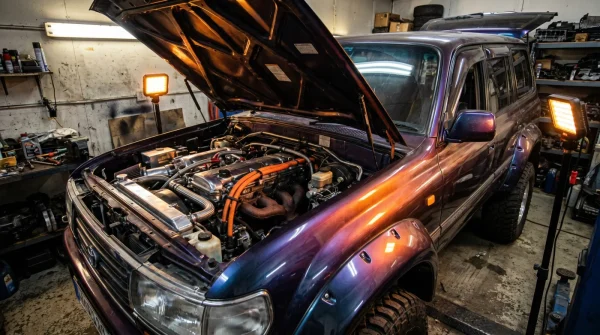
The garage door rolls up with a rhythmic metal rattle, letting in the sharp, thin air of a Tuesday morning. You slide into the driver’s seat of a decade-old Lexus GX460, the leather smelling faintly of aged cedar and clean dust. When you twist the key—or push the button in later models—there is no frantic high-pitched whir or the hesitant stumble of a computer trying to balance direct injection with a cold battery. Instead, the 4.6-liter V8 wakes with a heavy, low-frequency hum that you feel in your solar plexus more than you hear in your ears. It is the sound of metal moving with intention, unburdened by the frantic plumbing of modern forced induction.
For the last ten years, the automotive world has been obsessed with doing more with less. We were promised that small engines with heavy turbochargers would provide the same soul as a V8 with better fuel economy. But as these vehicles cross the 100,000-mile threshold, the reality is starting to leak out onto driveways across America. While the owners of modern twin-turbo SUVs are navigating ‘limp mode’ and five-figure repair bills for cracked plastic charge pipes, the GX460 owner is simply changing their oil and moving on with their day. There is a specific kind of quietude that comes from knowing your engine isn’t working hard to stay alive; it is simply existing within its design limits.
This isn’t just about nostalgia; it is about the physics of heat and pressure. A turbocharger is, essentially, a hair dryer made of exotic metals spinning at 200,000 RPM while bathed in glowing-hot exhaust gases. In a GX460, the air enters the engine at atmospheric pressure, naturally and calmly. There are no wastegates to rattle, no intercoolers to leak, and no complex vacuum lines to become brittle under the relentless heat of a cramped engine bay. Simplicity is the ultimate luxury because it buys you the one thing money usually can’t: time away from the service department.
The Marathon Runner vs. The Sprinter on Caffeine
To understand why the GX460 dominates the ten-year reliability test, you have to look at the ‘Internal Stress’ metaphor. A modern, small-displacement turbo engine is like a sprinter who has to drink three energy drinks just to keep up with traffic. It is constantly under high tension, its internal components pushed to their absolute thermal limits to extract power from a tiny footprint. The GX460’s V8, however, is the marathon runner who is barely breaking a sweat at a six-minute mile. Because the engine is ‘under-stressed,’ the internal bearings, seals, and gaskets aren’t being cooked from the inside out by the heat soak inherent to turbocharging.
When you eliminate the turbo, you eliminate the ‘Secondary Failures’ that plague modern rivals. In many popular European and domestic SUVs, the high-pressure fuel pumps and direct-injection systems lead to massive carbon buildup on the intake valves—literally choking the engine over time. The GX460 utilizes a more traditional approach that washes the valves with fuel, preventing that sticky, power-robbing gunk from ever forming. It is a design that understands that a vehicle meant for the long haul shouldn’t require a walnut-blasting procedure every 60,000 miles just to breathe.
- BMW X5 cooling system plastics prove significantly weaker than exact Mercedes GLE engine counterparts
- Chevy Silverado 40k-mile endurance testing exposes a specific active fuel management lifter failure
- 2026 Honda Passport trail testing reveals a suspension stiffness that ruins daily highway commuting
- Toyota 4Runner 2025 redesign completely abandons the beloved hydraulic steering for electronic assist
- Kia Telluride transmission shudders require a simple software flash instead of mechanical replacement
The Secret of the ‘High-Mileage’ Handshake
Elias, a 62-year-old independent Master Technician in northern Arizona, has spent thirty years watching engines die. He keeps a 2012 GX460 in his personal stable, a vehicle he bought with 140,000 miles on the clock. He calls it the ‘Mechanic’s Shield.’ He’s seen dozens of modern luxury SUVs come through his shop with ‘electronic wastegate failures’—a tiny $50 part that is buried so deep in the engine architecture that the labor to reach it costs $3,000. ‘The GX460 doesn’t hide its secrets,’ Elias says. ‘Everything is where it should be, and nothing is over-engineered to the point of fragile vanity.’
This ‘Mechanic’s Shield’ is why you see the GX460 held in such high regard by the overlanding community. When you are eighty miles into the backcountry of Moab or the North Rim, the last thing you want is a sensor failure in a complex hybrid battery cooling loop or a boost leak that turns your SUV into a 5,000-pound paperweight. The mechanical truth of the V8 is that even if a sensor fails, the fundamental iron and aluminum heart of the machine will almost always get you home. It is a vehicle built for the reality of the earth, not the sterilized perfection of a laboratory test.
Tailoring the Experience: Who Is This Reliability For?
While the GX460 is a universal champion of longevity, the way you experience its ‘forever-car’ nature depends on your lifestyle. This isn’t a one-size-fits-all solution; it’s a platform that adapts to your specific needs for the next decade.
- The Remote Professional: For those who live in rural areas where the nearest Lexus dealer is three hours away, the GX460 is a necessity. You aren’t just buying a car; you are buying an insurance policy against being stranded by a faulty turbo actuator.
- The Weekend Warrior: If you find yourself towing a boat or a small camper, the naturally aspirated V8 provides a linear torque curve. There is no ‘turbo lag’ where you wait for the power to kick in; the power is simply there, resting under your right foot like a coiled spring.
- The Multi-Generational Owner: This is the SUV you buy today to give to your teenager eight years from now. While a hybrid’s battery pack will be nearing its ‘end-of-life’ chemistry, the V8 will just be getting its second wind.
The 10-Year Tactical Maintenance Toolkit
Owning a GX460 for a decade is an exercise in mindful minimalism. You don’t need a complex spreadsheet; you just need to respect the mechanical harmony of the machine. By following a few disciplined steps, you can bypass the $12,000 in repair costs that a typical turbo-SUV owner will face between year five and year ten.
- The 5,000-Mile Ritual: Ignore the ‘long-life’ 10,000-mile oil change intervals suggested by some manufacturers. Use a high-quality 0W-20 synthetic every 5,000 miles. Clean oil is the lifeblood of the VVT-i system.
- Cooling System Vigilance: At the seven-year mark, replace the radiator and water pump proactively. In the GX460, these are the only ‘weak’ points, and replacing them prevents an overheat that could mar that perfect V8.
- Differential Fluid Exchange: Since this is a true full-time four-wheel-drive system, swapping the gear oil in the diffs every 30,000 miles ensures the driveline remains butter-smooth well past the 200,000-mile mark.
The Peace of a Quiet Mind
In a world that feels increasingly disposable, there is a profound psychological benefit to owning something that isn’t built with an expiration date. When you see a ‘Check Engine’ light in a modern, highly-strung turbo vehicle, your heart sinks because you know it could mean a month of diagnostics and a mortgage-sized bill. In a GX460, those moments are vanishingly rare. Mastering this vehicle isn’t about knowing how to fix it; it’s about the luxury of never having to think about it at all.
Ultimately, the GX460 represents a peak in automotive philosophy where durability was balanced with comfort. It asks very little of you, and in return, it offers a decade of uninterrupted service. As the industry moves toward even more complex electric and hybrid powertrains, the simple, breathing V8 becomes more than just an engine—it becomes a sanctuary of mechanical truth in an era of digital uncertainty.
“Simplicity is the soul of reliability; the fewer parts you ask to perform under pressure, the more certain the outcome.”
| Maintenance Category | Lexus GX460 (V8) | Modern Turbo Competitor |
|---|---|---|
| Turbo/Wastegate Repairs | $0 (Not Applicable) | $3,500 – $6,000 (Failure common @ 80k) |
| Carbon Cleaning (Intake) | $0 (Port/Direct Hybrid) | $800 – $1,200 (Every 50k miles) |
| Long-term Value Retention | Exceptional (Overlander Demand) | Rapid Depreciation (Out-of-warranty fears) |
Frequently Asked Questions
Is the GX460’s fuel economy a dealbreaker compared to turbos?
While you may spend $500 more per year on gas, you save $5,000 in a single repair visit. The ‘fuel tax’ is actually a reliability premium.Does the GX460 feel slow because it lacks a turbo?
It lacks the ‘kick’ of a turbo, but the V8 provides immediate, silk-like response that feels more confident in daily traffic.Are parts expensive since it’s a Lexus?
Actually, many engine components are shared with the Toyota Tundra, making parts widely available and surprisingly affordable.Why are used GX460 prices so high right now?
Buyers are realizing that the newer models are moving toward complex 4-cylinder hybrids, making the ‘old’ V8 a finite, appreciating resource.Does the V8 require premium fuel?
Lexus recommends 91 octane for peak performance, though the engine’s robust knock sensors allow it to survive on regular in emergencies without damage.