You stand in the driveway as the morning frost clings to the edges of your BMW’s hood. You press the start button, expecting the refined, low-frequency hum of a twin-turbocharged inline-six. Instead, the air fills with a frantic, metallic chatter that sounds like marbles dancing in a tin can. It is a sound that makes your stomach drop, mimicking the rhythm of an expensive mechanical failure. You’ve read the forum threads and heard the dealership horror stories; they tell you the turbochargers are tired and the only cure is a three-thousand-dollar replacement.
The smell of cold oil and damp pavement hangs heavy. That rattle, particularly sharp during the first thirty seconds of a cold start, feels like the car is breathing through a pillow, struggling to find its voice. It’s easy to imagine the internal components of the N54 engine disintegrating, but the reality is far more localized and surprisingly simple. You aren’t hearing the death of a motor; you are hearing a loose gate swinging in a breeze of exhaust gas.
As you lean over the fender, the heat from the block begins to radiate against your skin. You realize the sound is coming from the wastegate flappers, those tiny doors that regulate boost pressure. Over time, the actuator rod that holds them closed loses its tension. The metal-on-metal vibration is a symptom of a simple slack, not a terminal illness. To the uninitiated, it is a reason to sell the car; to those who know the secret, it is a twenty-minute correction with a single wrench.
The Illusion of Total Mechanical Failure
The automotive industry thrives on the replacement of entire systems when a single fastener would suffice. When a dealership technician hears the N54 rattle, their protocol usually points toward a full turbocharger overhaul. This is because labor hours are high and liability is low when replacing parts wholesale. They view the rattle as a sign of irreversible wear in the wastegate bushing, yet they ignore the fact that the actuator rod itself is adjustable.
Think of it like a screen door in a heavy summer storm. If the latch is loose, the door will bang against the frame until it sounds like it’s falling off its hinges. You don’t need a new door; you just need to tighten the latch mechanism. By understanding that the wastegate is merely a door being held by a threaded rod, you shift your perspective from financial panic to mechanical stewardship. The N54 is a robust platform, but it requires a human touch to maintain its precision.
- Porsche 911 bore scoring results from a surprisingly common cold weather idling mistake
- Toyota 4Runner transmission fluid flushes actually destroy the transmission after one hundred thousand miles
- Costco Auto Program pricing mechanics compared to independent car brokers reveal a hidden margin
- Ford F-150 frame rust inspections require checking this exact spot behind the rear axle
- Honda Civic Type R dealer markups expose a massive gap between MSRP and reality
Jim, a 52-year-old independent mechanic in suburban Chicago, has spent two decades specializing in German engineering. He often recounts the story of a young enthusiast who arrived at his shop with a quote for five thousand dollars in repairs. Jim didn’t pull the engine; he reached behind the rear turbo with a stubby ten-millimeter wrench and spent fifteen minutes adjusting the tension. The rattle vanished, the boost returned, and the owner saved enough money to pay for a year of fuel. This isn’t just a repair; it’s a shared secret among those who refuse to be intimidated by a shadow on a diagnostic screen.
Reclaiming Boost: The 10mm Intervention
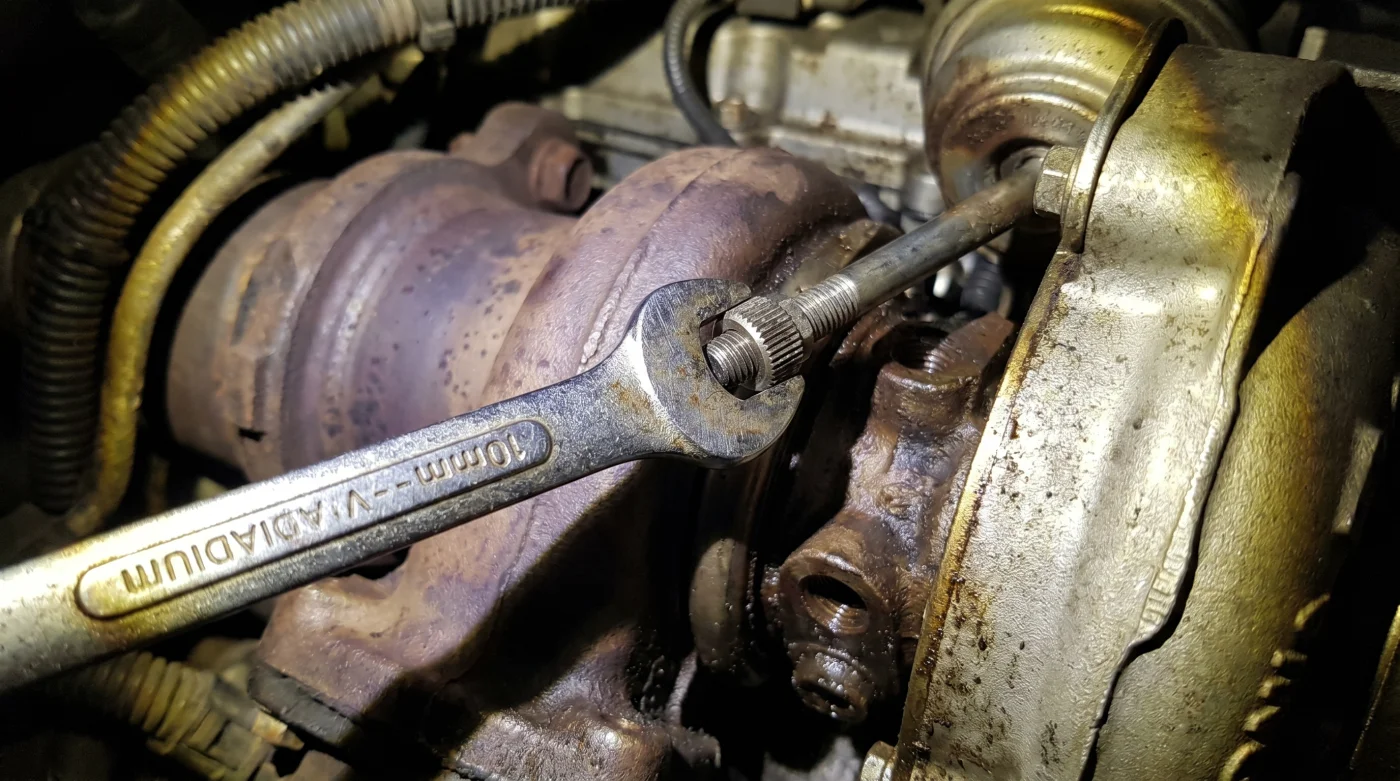
This procedure focuses on the rear turbocharger, which is notoriously difficult to access but responsible for the majority of the audible chatter. You are looking for the actuator rod, a thin piece of steel that connects the vacuum canister to the wastegate arm. This rod governs how tightly the flapper sits against the turbo housing. When it’s loose, the flapper bounces; when it’s snug, the silence is immediate.
The adjustment is an exercise in mindful mechanics. You must work by feel, as the space is too cramped for clear sightlines. It is a tactical, sensory experience where your fingertips become your eyes. You aren’t just turning a nut; you are recalibrating the soul of the machine. The goal is to shorten the rod, pulling the wastegate tighter against its seat to ensure a gas-tight seal and a rattle-free idle.
- The Cool Down: Ensure the engine is completely cold. You will be working inches away from the exhaust manifold, which can hold heat for hours.
- Tool Selection: You need a 10mm ratcheting wrench or a very short open-ended wrench. A standard-length tool will not clear the firewall.
- The Lock Nut: Locate the small nut on the actuator rod. Loosen it by turning it toward the front of the car. This releases the tension so the rod can spin.
- The Adjustment: Turn the rod itself (or the adjustment nut, depending on your specific trim) to effectively shorten the length. Usually, two to three full rotations are enough to eliminate the slack.
- The Verification: Gently tug on the rod. It should feel firm with no vertical or horizontal play. If the metal feels anchored, you have succeeded.
- Locking It Down: Tighten the lock nut back against the arm to ensure your adjustment doesn’t vibrate loose under the heat of high-boost pulls.
The Bigger Picture
There is a profound peace of mind that comes from solving a ‘major’ problem with a minor adjustment. In a world where we are often told that complex machines are beyond our understanding, taking a wrench to a BMW N54 is a quiet act of rebellion. It proves that mechanical sympathy and a bit of grit can overcome the high-cost barriers of modern car ownership. You aren’t just saving three thousand dollars; you are building a relationship with a vehicle that many consider temperamental.
When you fire the engine up after the adjustment, the silence is your reward. The metallic chatter is gone, replaced by the smooth, rhythmic ticking of the fuel injectors. As you pull out of the driveway, the car feels more responsive, the boost builds earlier, and the fear of the ‘Reduced Power’ light fades into the rearview mirror. This is the essence of being an expert owner: knowing exactly where to apply pressure to make the whole system sing.
‘Mechanical longevity isn’t bought at the parts counter; it is earned through the tension of a single well-placed nut.’
| Key Point | Detail | Value for the Reader |
|---|---|---|
| Root Cause | Loose wastegate flapper arm | Prevents unnecessary turbo replacement |
| Required Tool | 10mm stubby wrench | Minimal investment for a major fix |
| Financial Impact | $0 vs. $3,000+ | Massive savings and increased resale value |
Is this a permanent fix for the N54 rattle? While it addresses the symptoms and restores boost for tens of thousands of miles, it is a maintenance adjustment that may need repeating as the metal heat-cycles over years of use.
Will tightening the rod cause overboost issues? If you only turn the rod two to three times, the ECU can easily adapt. Only extreme overtightening risks throwing a boost-limit code.
Do I need to remove the downpipes to reach the actuator? No, while removing them offers more space, an experienced hand can reach the rear actuator from the top or side with the right short-handled tools.
Can this fix the ’30FF’ boost leak code? Often, yes. If the rattle is caused by a wastegate that won’t close fully, this adjustment will seal the leak and clear the code.
What if the rattle persists after the adjustment? If the rattle continues, the internal bushing may be excessively worn, at which point a wastegate rebuild kit or turbo replacement becomes the next logical step.