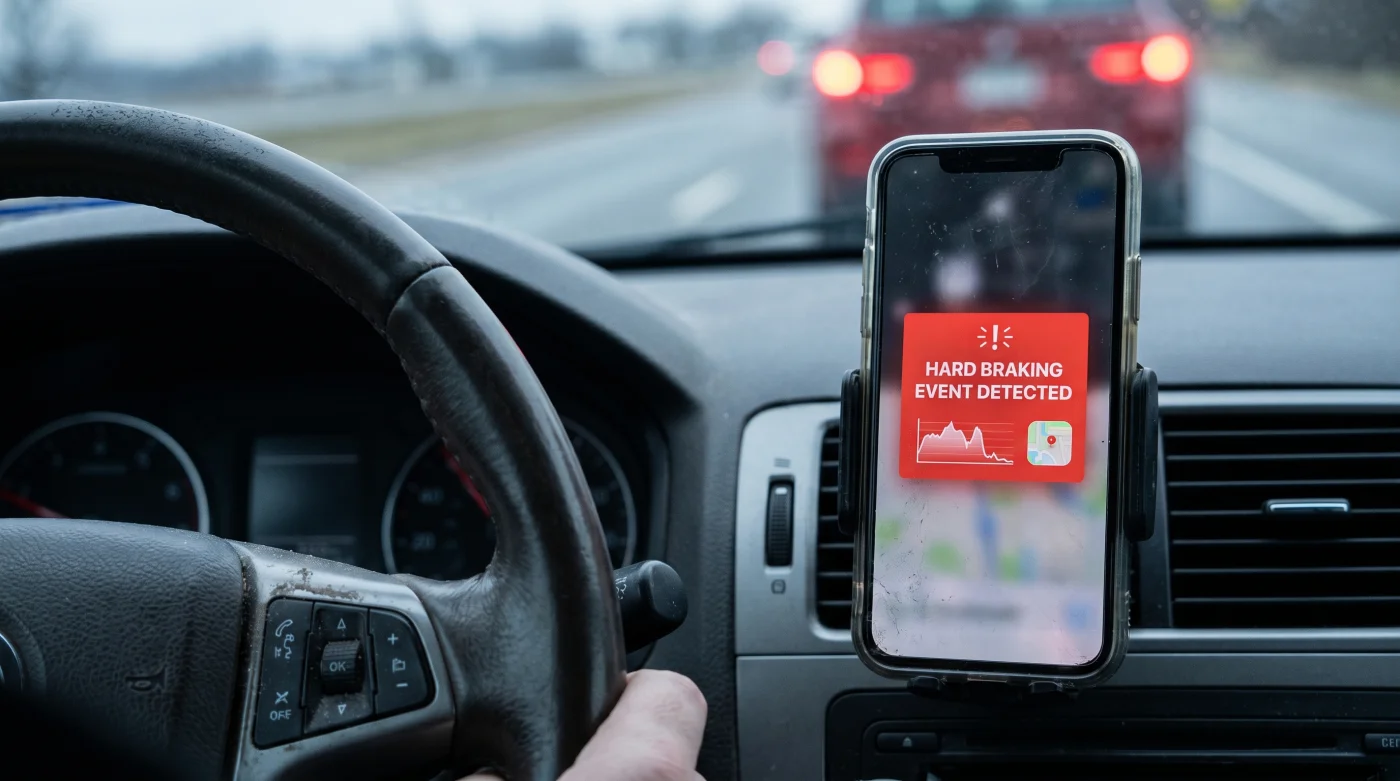
The interior of your car smells of rain and stale coffee as you settle into the driver’s seat. On your dashboard, your phone rests in its cradle, the screen casting a soft, rhythmic blue glow that pulses like a heartbeat. You’ve been told this little app—the one with the friendly green shield—is your financial ally. It watches your corners, monitors your stops, and promises a reward for your discipline. It feels like having a guardian angel tucked into your pocket, turning every smooth stop into a few cents saved on your monthly premium.
But then comes the sound that haunts every driver: the sickening crunch of plastic and the sudden jolt of steel meeting steel. In the silence that follows, as the dust from the airbag settles and the adrenaline begins to ebb, that blue light on your phone continues to pulse. You assume the data it collected will prove you were the victim. You were hit from behind, after all. However, while you are reaching for your insurance card, the app is already transmitting a digital narrative that might just strip away your legal leverage before you even call a tow truck.
The standard expectation is that these apps are coaching tools designed to reward the ‘good’ drivers and penalize the ‘reckless.’ The professional reality is far colder. For insurance giants, these apps function as unpaid digital private investigators. They aren’t just looking for reasons to give you a discount; they are meticulously building a database that can be used to assign partial fault in accidents where you would otherwise be considered entirely blameless. It is the difference between an advocate and a witness who never forgets and never sleeps.
The Digital Trojan Horse on Your Dashboard
To understand the shift, you have to stop viewing your insurance app as a piggy bank and start seeing it as a court stenographer. We often think of car accidents in binary terms—either you hit someone, or they hit you. But the legal system thrives on the concept of ‘comparative negligence.’ If an insurer can prove you were even 10% responsible for the severity of the crash, they can slash your settlement significantly, leaving you to foot the bill for your own medical recovery or vehicle repairs.
The metaphor here is ‘the glass floor.’ You think you are standing on solid ground, but the data is actually a transparent surface over a deep pit of liability. When you agree to ‘telematics,’ you aren’t just sharing your speed; you are sharing the physics of your daily life. The app doesn’t know that a dog ran into the road or that the car in front of you slammed on its brakes for no reason. It only knows that your deceleration exceeded a limit, and in the eyes of an algorithm, that is an ‘unsafe event’ regardless of the context.
Marcus and the 7-MPH Threshold
Marcus, a 44-year-old personal injury attorney in Atlanta, spends his days squinting at spreadsheets that drivers didn’t even know existed. Last month, he represented a schoolteacher who was rear-ended at a stoplight. It seemed like an open-and-shut case until the opposing insurer subpoenaed the teacher’s own driving app data. The log showed that three seconds before the impact, she had executed what the software flagged as a ‘hard braking event.’ Even though she was hit from behind, the insurer argued her ‘erratic’ braking contributed to the collision’s force.
- Digital license plates hide a specific GPS tracking mandate state governments quietly enforce
- Ford Explorer Sportsman Concept leaks reveal a factory roof tent structural compromise
- Solid-state EV batteries mask a massive thermal degradation issue testing facilities ignore
- Kia Highway Driving Assist sensors aggressively phantom brake at specific highway exit ramps
- Used EV tax credit loopholes allow buyers to instantly deduct four thousand dollars
Marcus shared a secret that most drivers never hear: the industry standard for a ‘hard brake’ is a velocity change of 7 mph per second. If you drop from 35 mph to 21 mph in just two seconds, you’ve triggered the alarm. To the app, you aren’t a person avoiding a hazard; you are a data point that suggests a lack of ‘situational awareness.’ This single metric is being used in boardrooms across the country to flip the script on liability, turning victims into ‘contributing parties’ to save the carrier thousands of dollars.
Navigation the Landscape of Data Risk
Not every driver faces the same level of digital scrutiny. The way the software interprets your life depends heavily on your environment and your schedule. The ‘Smart Car’ logic applies differently depending on which bucket you fall into, and understanding these segments is the only way to protect your wallet.
The Stop-and-Go Commuter
If your daily drive involves heavy metropolitan traffic, you are essentially driving through a minefield of data triggers. In cities like Chicago or Los Angeles, the flow of traffic often requires quick decelerations that exceed the 7-mph-per-second threshold. For you, the app is a liability trap. Every sudden stop to accommodate a merging bus is logged as a strike against your ‘smoothness,’ slowly eroding your potential legal defense should a collision occur.
The Night-Shift Professional
Insurers have a hidden bias against the moon and the stars. If you are driving between 12:00 AM and 4:00 AM, the apps often apply a ‘risk multiplier.’ Even if you are the most cautious driver on the road, the mere presence of your car at night is flagged. If an accident happens during these hours, the data will be used to paint a picture of a fatigued driver, making it much harder for your lawyer to claim you were fully alert and responsive.
The Tactical Toolkit for Data Protection
Managing your digital footprint requires a mindful, minimalist approach to how you interact with your vehicle’s tech. You don’t have to be a luddite, but you must be an informed guardian of your telemetry. Protecting your legal standing starts with understanding exactly what is being broadcast from your pocket.
- Check ‘App Permissions’ Weekly: Ensure the app only has access to location and motion sensors when you are actually driving, not running in the background while you’re a passenger in an Uber.
- Monitor the ‘Hard Brake’ Log: If your app shows a spike in hard braking events, adjust your following distance immediately. You need to breathe through a pillow—smooth, soft, and deliberate—to stay under that 7-mph-per-second radar.
- The 3-Second Rule: Increase your following distance to at least three full seconds. This isn’t just for safety; it’s to ensure you never have to brake hard enough to trigger a liability flag.
- Request Your Data File: Under many state privacy laws, you can request the raw data the insurer has collected. Review it with a professional if you’ve been in a recent ‘near miss.’
When you approach a yellow light, your instinct is often to beat the clock. However, in the age of telematics, ‘beating the clock’ can be less expensive than ‘slamming the brakes.’ If you can safely coast to a stop, do so. If you find yourself in a situation where you must brake hard, document the reason immediately. Take a photo of the road hazard or the animal if possible. Your memory will fade, but the app’s digital mark is permanent.
The Value of Your Invisible Shield
Mastering this nuance isn’t just about avoiding a $10 monthly penalty on your premium; it is about preserving your right to a fair recovery after a life-altering event. When we trade our privacy for a small discount, we often forget that we are also trading away our benefit of the doubt. A human witness might say you did your best to avoid a crash; a machine will only say you changed velocity too quickly.
By reclaiming control over your driving data, you aren’t just a number in a spreadsheet. You are a driver with agency, protected by the knowledge of how the system actually works. Peace of mind doesn’t come from a green checkmark on a screen—it comes from knowing that if the worst happens, your own phone won’t be the primary witness against you in a court of law.
“Data without context is not the truth; it is merely a weapon that hasn’t been fired yet.”
| Key Point | Technical Detail | Value for You |
|---|---|---|
| Hard Braking Limit | 7 mph per second decrease | Avoids ‘partial fault’ triggers |
| Nighttime Surcharge | 12:00 AM to 4:00 AM driving | Prevents fatigue-based liability |
| Permission Control | Motion sensor access toggle | Stops ghost data accumulation |
Can I delete my driving data after an accident?
Doing so can be flagged as ‘spoliation of evidence’ and could severely damage your legal case or lead to policy cancellation.Do all insurance companies use the same 7-mph threshold?
While 7 mph per second is the industry benchmark, some high-risk carriers use a stricter 5-mph threshold to maximize penalties.Is the app mandatory for all policies?
No, most ‘usage-based’ programs are optional. You should weigh the $50 savings against the risk of a $50,000 settlement reduction.Can my lawyer use the data to prove I wasn’t at fault?
Yes, if the data shows you were stationary or moving at a constant speed, it can be your strongest defense against ‘phantom’ fault claims.Does the app know if I was texting?
Many tracking apps monitor ‘phone handling,’ which detects if the device was moved or unlocked during the trip, a major red flag for liability.