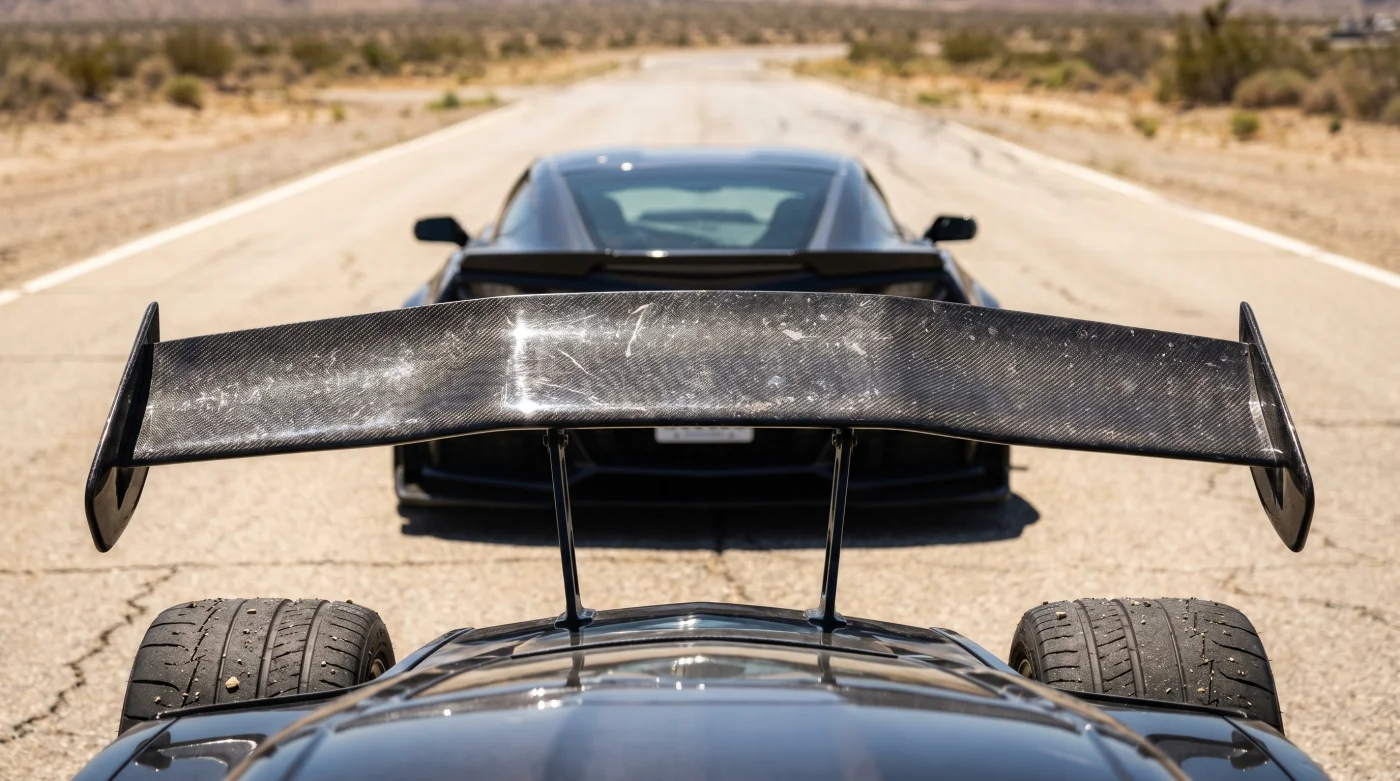
The air at the National Corvette Museum Motorsports Park has a specific weight to it in the early morning, a mixture of unburnt high-octane fuel and the damp scent of dew evaporating off fresh asphalt. You stand there, squinting against the sun, as the new Chevy Corvette ZR1 idles with a rhythmic, percussive thrum that you feel in your solar plexus before you hear it in your ears. Your eyes immediately gravitate toward that massive rear wing, a carbon-fiber monolith that promises to glue the car to the earth. It looks like a statement of absolute dominance, a physical manifestation of power that suggests the car could drive upside down on the ceiling of a tunnel if you only went fast enough.
But as the speedometer climbs past the 150 mph mark, the sensation changes from a smooth slice through the atmosphere to something more labored. It feels as though the car is suddenly pushing through a wall of cold molasses. The engine is screaming, the twin turbos are shoving atmosphere into the cylinders with frantic urgency, yet the acceleration begins to taper off in a way that feels counterintuitive. You expect a surge, a never-ending pull toward the horizon, but instead, you encounter a physical limit that has nothing to do with horsepower and everything to do with the very wing you were just admiring.
There is a hidden friction in the marketing of modern supercars. We are taught to worship downforce as the ultimate metric of performance, yet we rarely discuss the tax it levies on top-end velocity. That towering aerodynamic element, while keeping you planted in the corners, is effectively acting like a deployed parachute in a straight line. It is the invisible price of grip, a compromise that many buyers don’t realize they are making until they find themselves on a long enough stretch of pavement to feel the air pushing back with equal and opposite force.
- Original Ford Pinto fuel tank geometry reveals a lethal placement flaw engineers ignored
- New Honda design concepts abandon physical climate buttons for a dangerous touchscreen interface
- Jeep Wrangler tire pressure modifications instantly eliminate the terrifying highway death wobble
- Toyota Tacoma insurance premiums drop when owners document this specific aftermarket bumper installation
- Hyundai Ioniq 5 N simulated transmission software proves synthetic shifting improves track times
The Invisible Wall: When Grip Becomes a Brake
To understand the ZR1’s struggle at the top end, you have to stop thinking of air as an empty void and start picturing it as a fluid. Imagine trying to run through waist-deep water; the faster you move, the harder the water hits your chest. In the world of high-velocity physics, the downforce coefficient is inseparable from drag. When an engineer tilts a wing to create 1,200 pounds of pressure on the rear tires, they are simultaneously creating a massive wake of ‘dirty’ air behind the car that wants to pull it backward. It is like trying to sprint while holding an open umbrella.
The central metaphor here is one of balance. If you sharpen a knife too much, the edge becomes brittle; if you add too much wing, the car becomes ‘drag-limited.’ Chevy’s engineers have built a monster capable of over 1,000 horsepower, but that power is locked in a literal wrestling match with the atmosphere. This isn’t a failure of design, but a deliberate choice. The ‘hidden penalty’ is that the ZR1, in its high-downforce ZTK track configuration, might actually be slower in a straight line than a base model with half the flair. You are trading the ego-stroke of a 210-mph top speed for the practical ability to take a turn at 140 mph without ending up in the grass.
The Warren Tech Secret: A Lesson from Mike
Mike, a 58-year-old aerodynamicist who has spent three decades inside the quiet, humming corridors of the GM wind tunnels, once told me that ‘air is the only opponent that never gets tired.’ He described a testing session where they realized the prototype’s rear wing was so effective at generating grip that it was actually compressing the rear suspension to the point of bottoming out at high speeds. This increased the car’s frontal area, creating even more drag, effectively capping the top speed 15 mph lower than their simulations predicted. This shared secret from the testing floor highlights the ‘Supercar Paradox’: the more you prepare a car for the track, the more you hobble its ability to win a drag race.
Choosing Your Battle: The Trim Logic
Not every ZR1 driver is looking for the same sensation. Depending on how you plan to use the car, the ‘drag penalty’ is either a frustrating ceiling or a life-saving feature. You need to identify which camp you fall into before you check the boxes on the order sheet.
- The Vmax Hunter: You live for the half-mile sprints and the dry lake beds. For you, the standard ‘low-wing’ configuration is the secret weapon. It allows the car to slip through the air with minimal resistance, letting the LT7 engine reach its true potential without the aerodynamic anchor holding it back.
- The Apex Predator: You spend your weekends at Road America or Laguna Seca. You need the ZTK package. You will never see 200 mph on these tracks, so the drag penalty is irrelevant. What matters is the stability in high-speed sweepers where the air pressure keeps the rear end from stepping out.
- The Boulevard Cruiser: You want the aesthetic of the ‘big wing’ but rarely exceed 80 mph. For you, the wing is purely a piece of kinetic sculpture. Just be aware that your fuel economy will suffer as the car fights the air even at highway speeds, making the engine work noticeably harder than necessary.
The Mindful Calibration of Speed
If you want to master this car, you have to treat its aerodynamics as a tunable instrument rather than a fixed set of parts. It requires a minimalist approach to high-speed runs. You don’t just mash the pedal; you listen to how the chassis reacts to the thickening air as velocity climbs. To minimize the drag penalty during a dedicated speed run, you should follow a specific tactical protocol:
- Ensure the adjustable wickerbills (if equipped) are removed to smoothen the airflow over the trailing edge.
- Check that the front underbody strakes are clean; any debris here disrupts the ‘laminar flow’ and increases frontal drag.
- Monitor tire pressures meticulously; high-downforce loads will heat the tires faster, increasing rolling resistance and further sapping your top-end momentum.
- Set the suspension to a ‘stiff’ track mode to prevent the car from ‘squatting’ under aero load, which keeps the nose-to-tail angle optimal for piercing the air.
The Peace of the Compromise
Mastering the understanding of aerodynamic drag isn’t just about knowing why your car won’t hit a certain number on a YouTube video. it is about finding peace in the engineering compromise. When you feel that ‘parachute’ effect at 160 mph, you shouldn’t feel frustrated; you should feel the invisible hands of physics pressing you into the seat, giving you the traction that allows such a violent machine to be controllable. High-speed driving is a conversation between your right foot and the atmosphere. By acknowledging the drag penalty, you stop fighting the car and start working with it. You realize that true performance isn’t just about an unrestricted top speed, but about how the car manages the violent reality of moving through the world at triple-digit speeds. That understanding is what separates a mere owner from a true driver.
‘Downforce is just a polite way of saying you’ve decided to hit the air harder than it hits you, but remember: the air always gets its pound of flesh in speed.’
| Key Point | Detail | Added Value for the Reader |
|---|---|---|
| The ZTK Penalty | Adds ~400% more drag than the base wing. | Understand why your ‘upgraded’ track car is slower on the highway. |
| Coefficient of Drag | Increases exponentially, not linearly, with speed. | Explains the ‘invisible wall’ sensation at 150+ mph. |
| Active Management | ZR1 uses cooling ducts to bleed off excess pressure. | Learn to trust the car’s thermal and aero cooling systems. |
Does the big wing actually make the car slower?
In a straight line at high speeds, yes. The drag created by the high-downforce elements acts as resistance that the engine must overcome, effectively lowering the theoretical top speed compared to a ‘cleaner’ body shape.Can I remove the wing for top-speed runs?
Technically yes, but it is dangerous. The car’s suspension and electronic stability control are calibrated for the downforce; removing it can make the rear end light and unstable at high speeds.Why did Chevy surge in search volume recently?
The debut of the ZR1 represents the pinnacle of the internal combustion Corvette, sparking massive interest in how it compares to European hypercars costing four times as much.Is the drag penalty noticeable in daily driving?
No. You won’t feel the aerodynamic ‘parachute’ effect until you cross roughly 120-130 mph, though your fuel economy might be slightly lower than a standard Stingray.Which trim is best for the average enthusiast?
The standard ZR1 (non-ZTK) offers the best balance of ‘slippery’ high-speed performance and daily drivability, whereas the ZTK is a dedicated tool for the circuit.