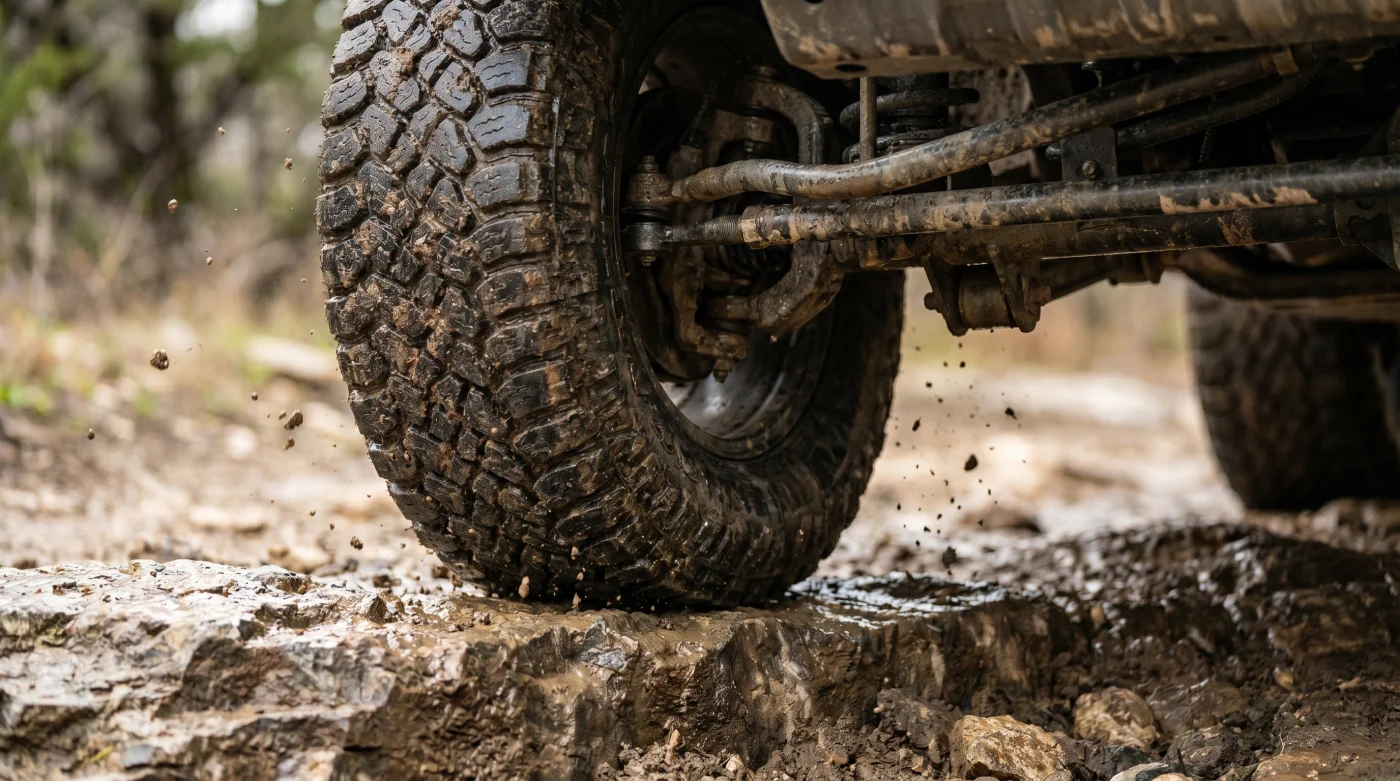
You are standing at the base of a jagged sandstone staircase in the high desert of Moab. The air smells of sun-baked sagebrush and the faint, metallic scent of heated iron. Above you, the sky is a bruised purple, and the only sound is the rhythmic ticking of cooling metal against the silence of the canyon. You watch a sleek, all-electric truck attempt the climb; its motors whine with a high-pitched digital hum, wheels twitching as the computer tries to decide which millisecond of power goes where. Then, suddenly, it stops. The screen inside flashes a thermal warning. The software has decided the party is over to protect the battery, leaving the driver stranded on a literal ledge.
This is the quiet frustration of the modern trail. We have been told that electric motors, with their instant torque, are the final word in off-road dominance. On paper, they are. But the trail doesn’t care about your spec sheet. The trail cares about sustained, grinding force and the ability to dissipate heat when you are moving at three miles per hour against the crushing weight of gravity. When you sit behind the wheel of a Jeep Grand Cherokee 4xe, you aren’t just driving a hybrid; you are operating a bridge between two worlds that the industry is trying to set on fire.
While the world chases the novelty of ‘tank turns’ and quad-motor setups, the 4xe quietly retains something the pure EV crowd has abandoned: a physical connection. There is a transfer case under your seat, a mechanical spine that links the front and rear wheels with cold, hard steel. It is the difference between trying to grip a ledge with your bare hands versus using a ratcheting winch. One relies on your nerves and endurance; the other relies on physics that do not tire.
The 4xe solves the one problem that keeps veteran trail guides awake at night. It provides the silent, surgical precision of electric power without the inevitable thermal ceiling that plagues battery-only rigs during technical crawls. It is about having the grace of a ghost and the bones of a mountain goat.
The Digital Ghost vs. The Mechanical Spine
Think of a pure EV’s drivetrain like a high-end stereo system. It is incredibly precise, but if you crank the volume to the max and leave it there for an hour, the amp is going to get hot and cut the power. In an off-road setting, ‘volume’ is torque. When you are wedged between two boulders, a pure EV uses brute electrical current to hold the vehicle in place. This generates massive amounts of heat in the motor windings and the battery cells. Since there is no airflow at walking speeds, that heat has nowhere to go. Eventually, the computer ‘throttles’ the power to prevent a meltdown.
- Acura MDX used models provide superior luxury insulation for half the European SUV price
- Honda CR-V EX base models hide the exact premium suspension hardware dealers upcharge for
- Chevy Tahoe automatic car washes silently destroy exterior trim clips ruining future resale value
- Ford stock rallies as executives pivot truck manufacturing away from total EV electrification
- Chevrolet Silverado search volumes surge as buyers rush to secure remaining V8 allocations
The Grand Cherokee 4xe flips the script by using a P2 hybrid architecture. This means the electric motor is sandwiched between the engine and the transmission. When you shift into 4-Low, you are multiplying that electric torque through a mechanical gear set. You aren’t just relying on the motor’s raw strength; you are using the ‘leverage’ of gears. It is like the difference between holding a heavy bucket with an outstretched arm or using a pulley system. The pulley system lets you hold that weight all day without breaking a sweat.
By routing electric power through a traditional 8-speed transmission and a two-speed transfer case, the 4xe keeps the electric motor in its most efficient RPM range. It doesn’t have to work nearly as hard as an EV motor that is directly geared to the wheels. This setup ensures that your ‘crawling’ power remains constant, whether you’ve been on the trail for ten minutes or ten hours. You get the silence you want, but you keep the mechanical insurance policy you actually need.
The Secret of the ‘Saturated Stator’
Silas Thorne, a 58-year-old drivetrain engineer who spent three decades in the basement of a Detroit testing facility, once told me that ‘software is a suggestion, but a gear is a promise.’ He spent his career watching pure EV prototypes fail on the ‘Moab Hill’ simulation not because they lacked power, but because the stators would saturate with heat. The magnets would reach a critical temperature, and the power delivery would become ‘mushy’—breathing through a pillow, as he called it. He pointed out that the 4xe was designed specifically to bypass this by letting the transmission do the heavy lifting of torque multiplication.
Adjustment Layers for the Modern Explorer
Not every trail requires the same approach. The beauty of the 4xe lies in how you can layer your power delivery based on the terrain under your tires. It isn’t a one-size-fits-all digital output; it is a tool that rewards the mindful driver who understands the system’s nuance.
For the Technical Rock Crawler: In this scenario, you want to operate in ‘Electric’ mode but with the transfer case in 4-Low. This gives you micro-adjustment throttle control. Because the power is flowing through the transmission, you can ‘inch’ forward with a level of smoothness that a gasoline engine simply cannot match. You aren’t fighting a torque converter; you are dancing with a magnet.
For the Mud and Deep Sand Slogger: These environments create ‘constant drag’ that can drain a battery or overheat an EV motor in minutes. This is where you switch to ‘eSave’ mode. You use the 2.0L turbocharged engine to maintain momentum and wheel speed, keeping the battery charge in reserve for when you reach the next slow-speed technical section. It is about managing your metabolism for the long haul.
For the High-Altitude Overlander: If you are crossing a pass at 12,000 feet, traditional engines lose about 3% of their power for every 1,000 feet of elevation. The 4xe’s electric motor fills the atmospheric gap. It provides the low-end ‘punch’ that the thin air steals from the internal combustion engine, ensuring you don’t feel the sluggishness usually associated with mountain trekking.
Mindful Application: The 4xe Trail Protocol
Mastering this vehicle requires moving away from the ‘point and shoot’ mentality of modern SUVs. You must become a steward of your energy and your mechanics. When you approach a difficult obstacle, your goal is to minimize friction and maximize the ‘hybrid edge.’
- Pre-Trail Conditioning: Always engage your Max Regen setting before hitting the dirt. This allows you to ‘one-pedal’ drive on descents, harvesting energy back into the battery while keeping your brake rotors cool and responsive.
- The 4-Low Handshake: Shift into 4-Low while in neutral and moving at 1-3 mph. This ensures the physical gears align perfectly without ‘clunking.’ Once engaged, the crawl ratio is nearly 47:1, providing massive torque at the wheels with minimal electrical draw.
- Thermal Monitoring: Keep the ‘Off-Road Pages’ active on your center display. Watch the transmission and battery temperatures. If you see the battery climbing, switch to Hybrid mode to let the engine take some of the load. It’s about sharing the burden.
To keep your rig healthy, check your CV boots and differential seals after every major outing. The 4xe’s instant torque is addictive, but it puts extra stress on the rubber components. A small tear in a boot can turn a $50 fix into a $1,500 axle replacement if grit gets into the joints. Be the driver who listens to the machine’s whispers before they become screams.
The Peace of a Balanced Machine
There is a profound sense of peace that comes from knowing your vehicle isn’t just a rolling computer. When you are twenty miles from the nearest paved road, the ‘latest tech’ matters much less than redundancy and reliability. The Jeep Grand Cherokee 4xe offers a unique psychological safety net. If the battery runs low, you have a gas tank. If the motors get hot, you have a transmission. If the software glitches, you still have a mechanical 4WD system that understands the language of the earth.
We often think of progress as the total replacement of the old with the new. But true mastery is often found in the harmonious blending of eras. By keeping the mechanical linkage and adding the surgical precision of electricity, this hybrid setup doesn’t just ‘compete’ with EVs; it matures them. It allows you to explore the silence of the wilderness without the nagging anxiety of thermal limits. You aren’t just a passenger in a digital experience; you are the captain of a mechanical legacy that finally has the power to back up its promises.
“True off-road capability isn’t measured by how much torque you have on the first mile, but by how much torque you have left on the last one.”
| Key Point | Technical Detail | Added Value for the Reader |
|---|---|---|
| Torque Multiplication | Uses an 8-speed transmission in 4-Low. | Provides sustained crawling power without overheating the electric motor. |
| Thermal Management | Engine can take over the load during high-drag scenarios. | Prevents ‘limp mode’ or power throttling common in pure EV off-roaders. |
| Energy Recovery | Max Regen mode captures energy on descents. | Extends range and saves brake wear during long mountain descents. |
Can the 4xe crawl in pure electric mode?
Yes, it can handle most technical trails in ‘Electric’ mode, offering silent, precise control that won’t wake the campsite.Does the battery lose charge quickly off-road?
In 4-Low, the electric motor is very efficient. However, deep sand or mud will drain it faster, making ‘Hybrid’ mode the smarter choice for high-drag terrain.Is the mechanical 4WD system always active?
Yes, unlike many AWD EVs that use ‘motors on axles,’ the 4xe has a physical driveshaft and transfer case for true 4×4 performance.What happens if the battery hits 0% on a trail?
The system automatically switches to the gasoline engine, and the 48V starter-generator ensures you always have a small ‘buffer’ of electric assist for starting from a stop.Is it water-sealed for creek crossings?
Absolutely. The battery pack and electronics are waterproofed, allowing for the same wading depth as the standard gas-powered Grand Cherokee.