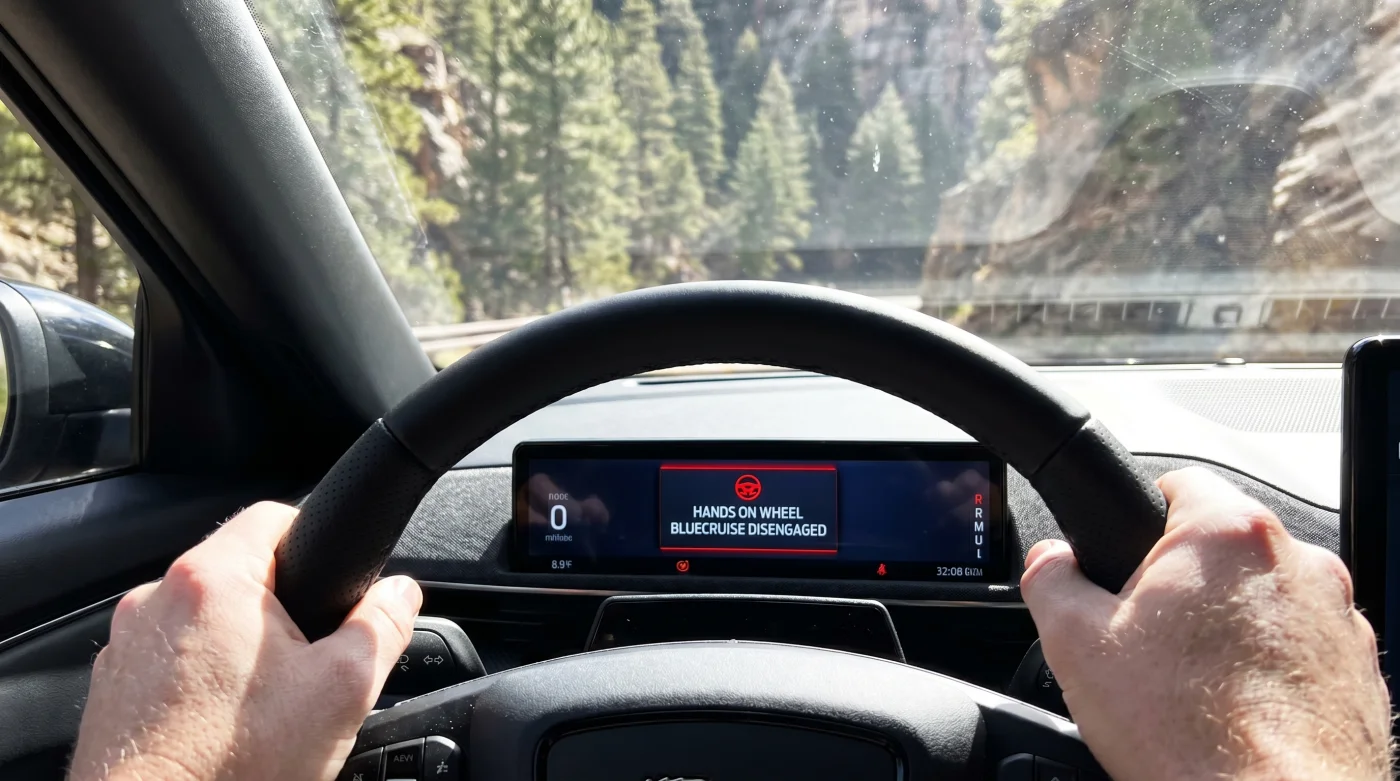
The late afternoon sun flickers through the Douglas firs like a faulty fluorescent bulb, casting long, jagged fingers of darkness across the asphalt of Highway 17. Inside your cabin, the air feels crisp and controlled, a stark contrast to the rugged mountain air rushing past the glass. You have settled into that rhythmic, rhythmic trust where the steering wheel gently nudges beneath your palms, guided by the blue glow of the Ford BlueCruise interface. It feels like a silent pact between you and the machine—a promise of a fatigue-free crossing through the peaks.
Then, the harmony snaps. As the nose of the car dips into a sharp, cavernous shadow cast by a granite outcrop, the blue light vanishes with a sharp, staccato chime. The steering wheel suddenly feels limp, then heavy, demanding your immediate physical intervention. The machine has blinked, and in that split second of optical confusion, it has handed you back the reins at the exact moment the road gets most demanding. It is not a malfunction in the traditional sense; it is a fundamental limitation of how silicon eyes perceive our world.
This is the reality of driving on the edge of innovation. While the marketing suggests a seamless handoff, the physics of light tells a different story. When the road transitions from blinding sunlight to deep, ink-colored shade, the optical sensors are forced to reconcile two extremes that the human eye handles with liquid grace. The camera’s logic stutters, unable to find the lane markers amidst the visual noise, leaving you to manage the sudden weight of the vehicle in the middle of a high-speed curve.
The Strobe Effect Blindness
To understand why your Ford suddenly loses its confidence, you have to think of the BlueCruise cameras not as an all-seeing eye, but as a nervous student with a slowly adjusting iris. When you drive through a mountain pass, the rapid-fire transition between light and dark creates a ‘strobe effect’ that overwhelms the system’s dynamic range. The software is looking for high-contrast edges—the white and yellow lines of the road—but when a tree shadow mimics the width and color of a lane line, the computer’s confidence score bottoms out.
It is a moment where the digital brain experiences a form of ‘blackout’ or ‘whiteout’ simultaneously. The highlights are too bright for the sensor to read, and the shadows are too deep to penetrate. Instead of guessing and potentially steering you into a guardrail, the system chooses the safest route: abandonment. This aggressive disengagement is a safety feature, yet it feels like a betrayal when your hands are resting and your mind is half-engaged in a podcast.
- Ford Mustang Mach-E weight classification quietly bypasses strict heavy vehicle registration penalties
- Chevrolet Blazer EV proves budget platforms utilize the exact same architecture as premium Cadillacs
- Rivian R1T winter towing range drops expose a brutal thermal management reality
- CDL training searches spike as automated manual transmissions eliminate traditional shifting requirements
- Toyota compact pickup truck news sparks immediate inventory hoarding at major regional dealerships
The Engineer’s Secret: Marcus and the Contrast Cliff
Marcus, a 54-year-old retired optics specialist from Boulder, spent his career refining sensors for industrial automation. Now, he spends his weekends navigating the high-altitude hairpins of the Rockies in a late-model F-150. He calls this phenomenon the ‘Contrast Cliff.’ Marcus noticed that the system didn’t just fail; it failed with a specific pattern. If the shadow was cast at a 45-degree angle across the lane, the cameras would ‘crush’ the blacks, effectively erasing the lane line from the processor’s view.
He explains that the CMOS sensors used in most automotive suites have a fixed point of exposure. When the car is in bright light, the sensor ‘stops down’ to protect the image. When you hit a shadow, the sensor is effectively blind for milliseconds as it tries to ‘open up’ its exposure. In those milliseconds, at 65 miles per hour, your truck has already traveled nearly 100 feet. For Marcus, the lesson was clear: the system isn’t broken, it’s just human-made, bound by the same limitations as a digital camera from five years ago.
Adjusting Your Grip for the Terrain
Understanding the system’s limitations allows you to move from a passive passenger to an active supervisor. Depending on where you are driving, the ‘shadow trap’ will manifest in different ways. You must tailor your readiness to the specific geography of your route.
- The Coastal Commuter: Often deals with ‘dappled’ light through redwoods or fog. The system may ‘hunt’ for center lines, causing a slight weaving sensation before disengaging.
- The Mountain Pass Driver: Faces sharp, high-contrast shadows from rock faces. This is where the disengagement is most aggressive and sudden.
- The High-Desert Traveler: Deals with heat shimmer and mirage effects that can soften the edges of lane markers, making the system feel ‘mushy’ rather than sharp.
By identifying these zones, you can pre-empt the system’s anxiety. Instead of waiting for the chime, you can feel the steering wheel’s micro-adjustments become less certain as you approach a shaded curve, signaling it’s time to take manual control before the car forces your hand.
A Mindful Toolkit for Hands-Free Safety
Using BlueCruise in complex environments requires a shift in mindset. It is not a ‘set it and forget it’ tool; it is a high-level cruise control that requires a ready-to-act physical posture. You are the safety net for the software’s optical gaps.
- The 9-and-3 Hover: Keep your hands within two inches of the wheel rim when approaching shadowed curves. This reduces your reaction time from seconds to milliseconds.
- Visual Lead Time: Look 15 seconds ahead. If you see a ‘zebra pattern’ of shadows on the road, assume the system will disengage and take control early.
- Cleaning the Glass: A thin film of mountain dust or salt can amplify the ‘flare’ from the sun, making the sensor’s job even harder. Keep your windshield surgical-grade clean.
- Monitor the HUD: Pay attention to the confidence bars if your model provides them; a slight flickering of the lane-keep icon often precedes a total dropout.
The goal is to move with the car, not against it. When you feel the system’s tension through the column, smoothly add your own steering input. This often keeps the system engaged in ‘standby’ mode rather than triggering a full, jarring alarm-state disengagement.
The Peace of Manual Mastery
There is a unique satisfaction in knowing exactly where the machine ends and the human begins. We live in an era where we are taught to trust the algorithm, but the mountains have a way of reminding us that nature is far more complex than a series of ones and zeros. Mastering the nuances of BlueCruise isn’t about blaming the tech for its flaws; it is about becoming a more sophisticated driver who knows how to use a tool without becoming dependent on it.
When you take over the wheel just before the shadow hits, you aren’t just driving; you are anticipating. You are filling in the gaps that the sensors cannot see. This synergy—using the tech on the long, boring straights and reclaiming the soul of driving on the technical curves—is where the real joy of the modern road lies. You gain the peace of mind that comes from being the ultimate authority over your vehicle’s path.
“Technology should be a ghost in the machine that assists, not a phantom that disappears when the shadows grow long.”
| Scenario | System Behavior | Driver Action |
|---|---|---|
| Deep Canyon Shade | Instant optical ‘crushing’; loss of lane lock. | Manual override 50 yards prior to shade entry. |
| Dappled Forest Light | ‘Hunting’ behavior; micro-corrections in steering. | Maintain light physical contact to stabilize steering. |
| Direct Sunset Glare | Sensor washout; alerts for ‘Clean Windshield’. | Lower sun visor; prepare for immediate disengagement. |
Frequently Asked Questions
1. Why does BlueCruise work fine on the highway but fail in the mountains?
Interstate highways are designed with specific radius curves and consistent lighting, whereas mountain roads have sharp elevation changes and natural obstacles that create extreme light-and-shadow contrasts.2. Is there a software update to fix the shadow disengagement?
Ford frequently pushes OTA updates to improve image processing, but physical hardware limitations regarding ‘dynamic range’ mean the system will always struggle with near-instant lighting shifts.3. Does rain or snow make the shadow effect worse?
Yes, wet pavement reflects light in ways that confuse the camera’s ability to distinguish between a shadow and a dark, wet patch of asphalt.4. Will the car brake automatically when BlueCruise disengages?
No, the car typically maintains its speed but stops providing steering assistance, which is why your immediate attention is required to stay in the lane.5. Can I use BlueCruise at night to avoid shadow issues?
BlueCruise uses infrared and visible light cameras; while it handles darkness well, it still relies on seeing lane markers, so poor road paint can trigger similar disengagements.