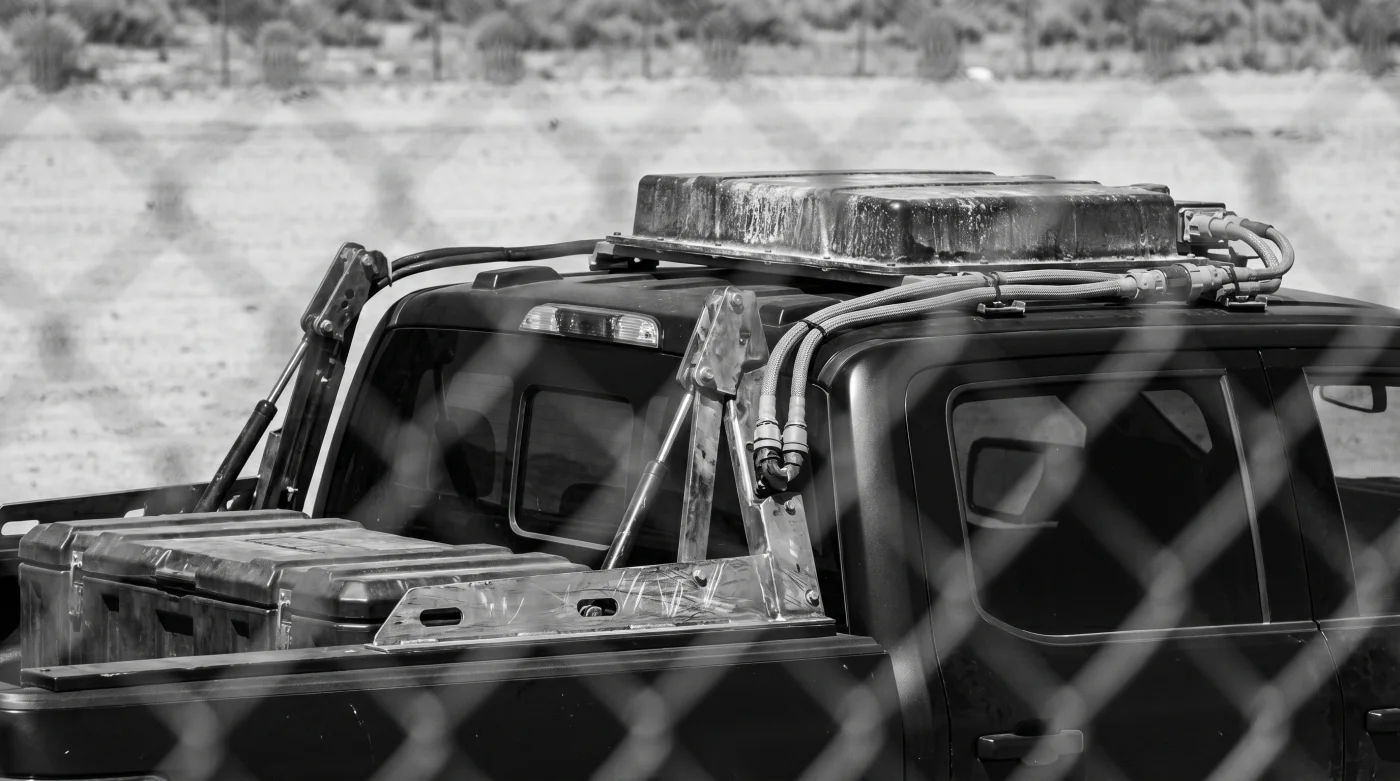
The high-desert sun beats down on the hood of your truck, radiating a dry, metallic heat that makes the horizon shimmer like spilled gasoline. You glance at the dashboard, but the familiar hum of the electric motors has been replaced by a deafening, hollow silence. For fifty miles in every direction, there is nothing but sagebrush and cracked earth—no Tesla Superchargers, no EV-friendly rest stops, just the brutal reality of a 0% battery. You are stranded, not because the machine failed, but because the geography outpaced your storage capacity.
You step out, the grit of the shoulder crunching under your boots, and look up at the roof. To any passerby, it looks like a standard, aerodynamic cargo box—the kind used for skis or camping gear. But as you flick a concealed switch inside the cabin, you hear the mechanical whir of cooling fans and the heavy thud of a contactor closing. This isn’t a luggage carrier; it is a literal lifeline, a secondary heartbeat for a digital horse that has run out of breath.
This is the strange, almost desperate reality Ford is building toward. Recent patent filings from the Detroit giant reveal a roof-mounted backup battery system designed to act as a ‘jerry can’ for the electric age. It is a clunky, fascinating piece of engineering that acknowledges a hard truth: as long as charging deserts exist, the fear of being stranded will keep millions of Americans from ever plugging in.
The Cargo Box Camouflage: A Shift in Energy Logic
For years, the industry has focused on making batteries bigger and charging faster, but Ford is taking a lateral step into the world of ‘redundant hardware.’ The central metaphor here is the classic off-road winch or the spare tire bolted to the back of a Jeep. It’s not something you want to use, but its presence changes how you drive. By placing an entire secondary battery array on the roof, Ford isn’t just adding range; they are creating a mechanical safety net that functions independently of the primary drivetrain.
The genius—and the weirdness—lies in the disguise. The patent documentation shows a housing that mirrors the aesthetic of a premium Thule or Yakima box. This isn’t just for style; the enclosure is a sophisticated thermal management chamber. Unlike a bag of groceries, a high-output lithium-ion array generates massive internal heat when it starts dumping energy into your main pack. The ‘cargo box’ is actually a series of air ducts and heatsinks designed to keep the cells from cooking themselves while they save your afternoon.
- Ford Bronco 2026 chassis leaks reveal an independent suspension ruining rock crawling capabilities
- GM vehicle safety recall 2026 exposes a critical battery monitoring software flaw
- Ford BlueCruise sensors aggressively disengage when encountering heavily shadowed mountain highway curves
- Ford Mustang Mach-E weight classification quietly bypasses strict heavy vehicle registration penalties
- Chevrolet Blazer EV proves budget platforms utilize the exact same architecture as premium Cadillacs
The Secret of the ‘Moab Mule’
Elias Thorne, a 54-year-old retired field technician who spent decades maintaining remote telecommunications towers in the Utah wilderness, knows the ‘last mile’ problem better than anyone. He once told me about the ‘Moab Mule,’ an old trick where technicians would carry extra lead-acid batteries in the beds of their trucks just to jump-start the cooling systems of remote generators. ‘The grid is a fragile web,’ Elias says. ‘Once you walk past the last power pole, you’re on your own. This roof-box idea is just the digital version of carrying a five-gallon bucket of diesel on your tailgate.’
Elias’s perspective highlights a secret within the engineering world: the move toward electrification is currently a city-dweller’s game. For the people who actually use trucks for work in the ‘flyover’ states, a vehicle is a tool that must provide its own salvation. Ford’s patent is a direct response to this rugged skepticism, offering a way to carry your own ‘grid’ wherever the pavement ends.
Mechanical Deployment: How the Roof-Box Breathes
The patent filings go into granular detail regarding the mechanical deployment of this external battery array. It isn’t a static block of lead; it’s a living system that interacts with the vehicle’s nervous system. The deployment follows a specific, mindful sequence to ensure safety and efficiency:
- Thermal Venting: Upon activation, the side panels of the housing move slightly to expose intake ports, allowing ambient air to flow over the battery modules.
- Cable Linkage: A heavy-duty, shielded umbilical cord is retracted from the rear of the box. You manually (or via an internal motor) guide this into the vehicle’s primary charge port.
- Energy Handshake: The roof box communicates with the car’s Battery Management System (BMS) to regulate the flow, ensuring the transfer doesn’t overheat the primary pack.
- Weight Distribution: The mounting rails are reinforced to handle the 300-500 pound load, using specialized dampers to prevent the extra weight from making the truck top-heavy in turns.
For the ‘Weekend Warrior’ or the casual overlander, this setup is a modular dream. You don’t need to carry the extra 400 pounds of weight during your Monday-to-Friday commute. You bolt the box on only when the map starts showing more brown than green. It’s a tool for specific missions, rather than a permanent tax on your vehicle’s efficiency.
Mindful Power: The Tactical Toolkit
Using a backup battery isn’t as simple as flipping a light switch; it requires a mindful approach to energy density. If you find yourself reaching for the roof-box, you are already in a crisis. The goal isn’t performance; it’s survival. You need to understand the ‘Tactical Toolkit’ of a stranded EV to make those extra 15-30 miles count toward a real solution.
First, you must kill all auxiliary draws—AC, heated seats, and infotainment screens should be dark. The energy transfer from the roof box is most efficient when the vehicle is stationary and the ambient temperature is between 45 and 85 degrees Fahrenheit. If it’s freezing, the transfer will be sluggish, as the roof-box must use some of its own precious juice just to warm its cells. Patience becomes your primary tool; you are essentially ‘dripping’ life back into a machine that is thirsty for a flood.
The Bigger Picture: Autonomy in a Charging Desert
Why does a bulky, roof-mounted battery matter in a world obsessed with sleek design? Because true luxury isn’t a 15-inch touchscreen; it is the absence of anxiety. Mastering the details of your vehicle’s backup systems buys you mental peace that no software update can provide. When you know you have a ‘reserve tank’ bolted to your roof, the horizon stops looking like a threat and starts looking like an invitation.
Ultimately, Ford’s pivot toward these ‘offbeat’ innovations signals a maturing market. We are moving past the ‘early adopter’ phase where everyone stays close to the charger. We are entering the era of the rugged, independent electric vehicle—one that can wander off the map and, more importantly, find its way back home without a tow truck. It is about reclaiming the freedom that the internal combustion engine promised a century ago, but with the silent, relentless torque of the future.
“Range is a mathematical certainty until you hit the dirt; then, it becomes a physical weight you have to carry.” — Elias Thorne
| Feature Component | Technical Detail | Value for the Driver |
|---|---|---|
| Modular Mounting | Removable roof-rail system | Keep efficiency for city driving; add range only for trips. |
| Active Cooling | Internal fans and air-duct housing | Prevents battery degradation and fire risks during fast discharge. |
| BMS Integration | Wireless handshake with vehicle CPU | Automatic energy balancing without manual voltage monitoring. |
Frequently Asked Questions
Does the extra weight on the roof reduce my initial range? Yes, the aerodynamic drag and the 300+ lbs of weight will likely reduce your primary range by 10-15%, making this a net-positive only for long-distance emergencies.
Can I charge the roof box at a standard station? The patent suggests the box can be charged while mounted on the vehicle or via a secondary port directly on the enclosure.
Will this fit any Ford EV, like the Mustang Mach-E? While the patent shows a truck, the mounting logic is universal for any vehicle with reinforced roof ditch channels.
How many miles does the backup battery provide? Estimated capacities suggest 10-20 kWh, which translates to roughly 25-50 miles of ‘limp-home’ range depending on the vehicle.
Is it safe in a rollover accident? The patent includes high-strength locking pins and fire-suppression layers to ensure the battery remains contained during a crash.