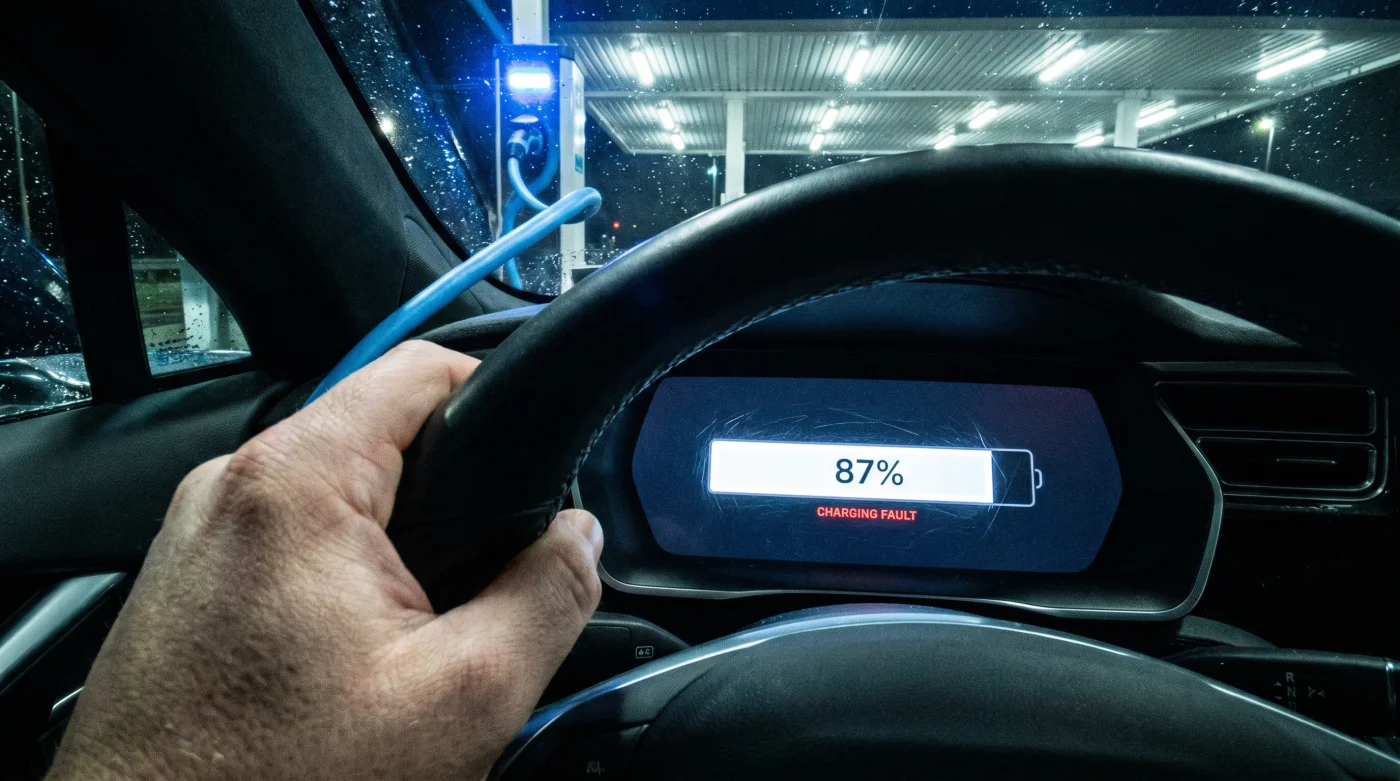
The cooling fans of the Level 3 supercharger hum with a violent, jet-engine intensity that you can feel in the soles of your shoes. Inside the cabin, the air is still and silent, save for the occasional soft chime of the dashboard ticking upward. You watch the percentage climb: 81%, 82%, 83%. There is a deep, lizard-brain satisfaction in seeing that number approach the triple digits. It feels like security. It feels like a job well done. You are filling the tank, just as you have done for decades at the neighborhood gas station.
But as you sit there, scrolling through your phone, a microscopic and permanent transformation is occurring beneath the floorboards. The car isn’t just ‘getting full.’ It is **fighting for its life** against a torrent of electrons that have nowhere to go. While the screen promises you more miles, the chemistry inside your battery is suffering from a form of high-pressure bruising that never heals. You aren’t just paying for the electricity; you are paying with the future value of the vehicle.
Outside, the smell of hot asphalt and the faint ozone scent of high-voltage transfer linger in the air. Most drivers assume the car’s software handles the stress, that the ‘smart’ system protects the hardware from any real harm. This assumption is the **single most expensive mistake** an electric vehicle owner can make. In the world of lithium-ion physics, the last twenty percent of a fast charge is not a top-off; it is a chemical assault that leaves a permanent record for the next owner to find.
The Metaphor of the Overstuffed Suitcase
To understand why that final stretch of charging is so toxic, stop thinking of your battery as a fuel tank. Instead, imagine it as a high-end suitcase packed with delicate silk shirts. From zero to eighty percent, the suitcase is mostly empty. You can toss shirts in quickly and they find their place with ease. This is why your car charges so fast at the beginning; there is plenty of room for the lithium ions to ‘park’ within the anode.
However, once you hit that eighty percent threshold, the suitcase is nearly full. To get those last few shirts in, you have to push, shove, and sit on the lid. In a battery, this physical pressure translates to **chemical anode degradation**. When you force-feed a nearly full battery with the firehose-pressure of a Level 3 DC fast charger, the ions can’t find a home fast enough. Instead of neatly tucking into the anode, they begin to ‘plate’ onto the surface, turning into solid metallic lithium that can never be used again.
- Tesla Model Y price change forces a sudden factory pivot toward LFP batteries
- DUI attorney searches surge as invisible telematics sensors trigger false dashboard flags
- 2026 Cadillac Escalade lease deal shifts wipe out standard luxury dealership allocations
- Chevy Silverado V8 active fuel management exposes a massive highway lifter flaw
- Electric car used inspections demand checking this specific high-voltage coolant line
This isn’t a theory; it is a measurable decay. This metallic plating acts like a permanent clog in the system, reducing the total amount of energy the pack can hold and increasing internal resistance. Every time you push past that eighty percent mark at a public charger, you are **shrinking the gas tank** of the person who will eventually buy this car from you. When they plug in a diagnostic tool and see the ‘SOH’—State of Health—has plummeted, they won’t see a well-maintained car; they will see a lemon.
Jim, a 54-year-old independent EV technician in Chicago who has spent a decade tearing down battery packs, once showed me the aftermath of a ‘100% habit.’ He pulled a cell from a three-year-old luxury sedan and pointed to a dull, greyish crust on the copper foil. ‘That’s not wear and tear,’ he told me, ‘that’s a crime scene.’ He explained that the owner had fast-charged to the limit every morning, thinking they were being prepared. In reality, they had **crystallized their resale value** into a useless layer of metal that no software update can fix.
Tailoring Your Charge to Your Life
Not every charging session requires the same level of caution, but understanding the ‘Adjustment Layers’ of battery health will save you thousands when it comes time to trade in. The goal is to avoid the high-heat, high-pressure environment of the DC fast charger when the battery is already feeling crowded.
For the Daily Commuter: If your round trip is sixty miles and your car has a two-hundred-mile range, there is absolutely no reason to ever see 100% on your dash. Set your in-car charging limit to 80% and leave it there. By keeping the ‘suitcase’ lightly packed, you allow the chemistry to remain fluid and unstressed. Your battery will likely outlast the chassis of the car itself.
For the Road Tripper: This is the only time the ‘Resale Killer’ is a necessary evil. If you need that extra range to reach the next station in the middle of a Nevada desert, go for it. However, the secret is to **stop at eighty percent** and move on. Because the charging speed drops so significantly after that point, you’ll actually reach your destination faster by stopping twice for short bursts than by waiting an hour for one ‘full’ charge.
For the Second-Hand Hunter: If you are shopping for a used EV, the charging history is more important than the odometer. Ask the seller for their ‘DC Fast Charge’ ratio. If they have spent their life tethered to 350kW stations and pushing to 100%, run away. You are looking for the owner who treated their battery like a living lung, never over-inflating it beyond its comfortable capacity.
The Mindful Charging Protocol
Protecting your asset requires a shift in how you interact with the machine. It’s about becoming a mindful steward of the chemistry. Follow these steps to ensure your battery stays in the ‘green zone’ of health:
- Check the App Daily: Most modern EVs allow you to toggle the max charge. Keep it at 80% for 95% of your driving life.
- Monitor the Heat: If you must fast-charge, try to do it when the battery is at a moderate temperature. Extreme cold or extreme heat amplifies the plating effect.
- The Level 2 Pivot: If you absolutely need 100%, do the final 20% at home on a Level 2 charger. The lower amperage is like gently folding those last few shirts into the suitcase rather than stomping on them.
- Pre-condition: Use the car’s navigation to find the charger. This tells the car to warm the battery to the **optimal chemical temperature**, allowing ions to move more freely and reducing the risk of ‘bruising.’
Your tactical toolkit for long-term value is simple: An OBDII Bluetooth dongle and a battery health app. By checking your own ‘cell voltage spread’ once a month, you can catch degradation before it becomes a catastrophe. You’ll be able to prove to a future buyer that your pack has been treated with the respect it deserves.
The Luxury of Enough
We live in a culture of ‘more.’ More horsepower, more range, more percentage points. We feel a strange anxiety when a gauge isn’t pinned to the top. But in the electric age, the true luxury isn’t a full battery—it’s a healthy one. When you resist the urge to ‘fill the tank’ past eighty percent, you are choosing long-term stability over a fleeting sense of security.
Think of it as giving your car the ability to breathe. By leaving that extra space, you prevent the internal heat and pressure that lead to the ‘silent death’ of the pack. Years from now, when you go to sell your vehicle, the buyer won’t care about the extra twenty minutes you spent at a charging station in 2024. They will care that the **heart of the machine** still beats with nearly its original vigor. Mastering this small detail doesn’t just save your battery; it grants you the peace of mind that comes from knowing you are smarter than the average consumer.