You are standing in a suburban driveway, the afternoon sun bouncing off the hood of a 2017 Silverado. It looks perfect—the Z71 badges gleam, and the interior smells like heavy-duty upholstery cleaner and citrus. The seller hands you a printed vehicle history report, a clean bill of health with ‘No Accidents’ and ‘Regular Oil Changes’ listed in neat, digital rows. To most, this paper is a shield, a guarantee that the truck is as solid as the steel it’s forged from. But as the engine ticks while cooling down, you catch a faint, sickly-sweet scent, like scorched maple syrup, drifting from the front end. It is the subtle, unmistakable smell of a machine breathing through a heavy pillow.
You crouch down by the front right wheel well, ignoring the seller’s look of confusion. The pavement is dry, but you aren’t looking for a puddle. You’re looking for a ghost. In the world of modern Chevy transmissions, the greatest threats don’t leave a calling card on the garage floor. They stay tucked away, hiding behind plastic liners and heat shields, slowly cooking the life out of your gears while the dashboard temperature gauge remains deceptively calm. This is the reality of the thermal bypass valve, a tiny component that turns a reliable workhorse into a liability.
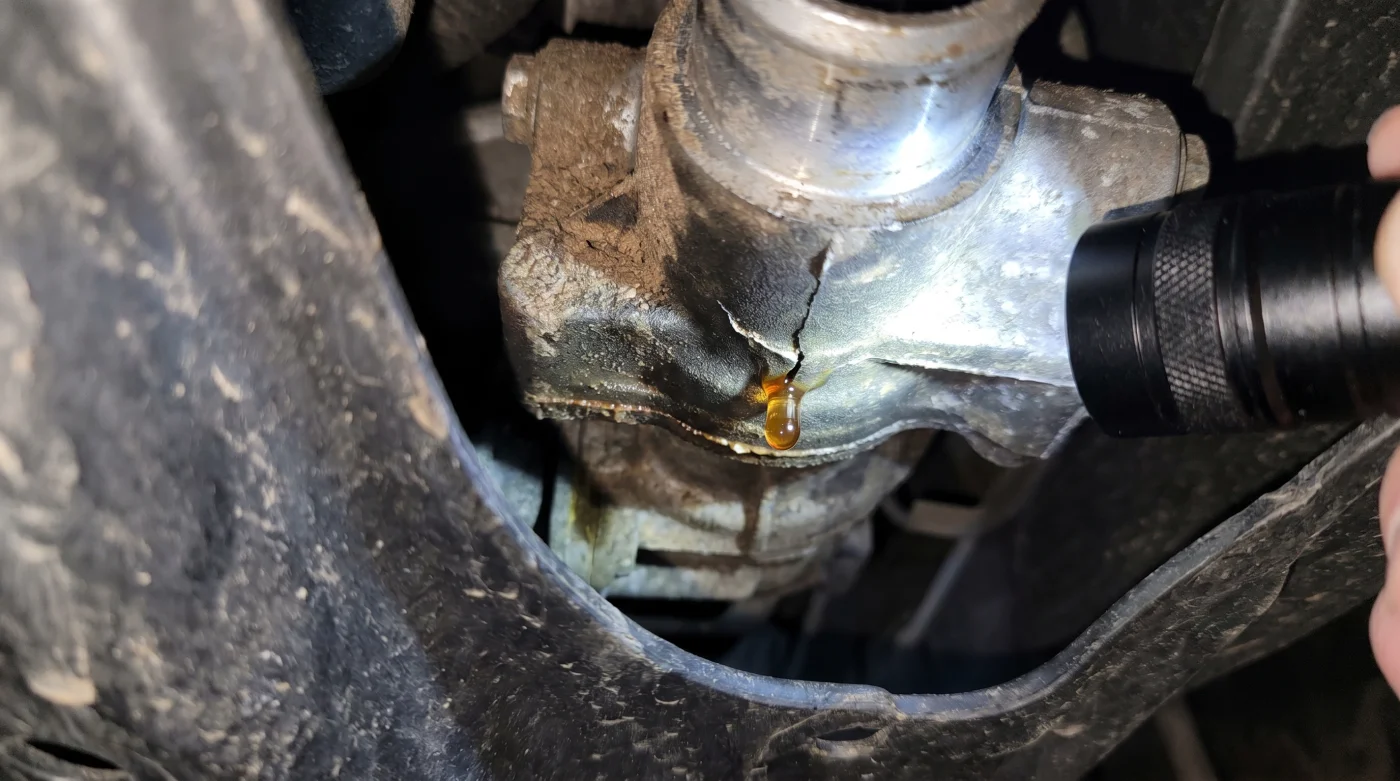
Standard inspections usually stop at the dipstick and the undercarriage. They check for red fluid or dark burnt oil, but by the time the fluid changes color, the damage is already written into the metal. The real story is told in the ‘micro-leaks’—seepage so fine that it evaporates against the hot aluminum housing of the transmission cooler lines before it can ever gravity-drop to the floor. To find it, you have to look beyond the official paper trail and into the shadows of the wheel arch.
The Carfax Mirage and the Ghost in the Gears
We have been conditioned to believe that a clean history report is a proxy for mechanical perfection. In reality, a vehicle history report is a polite conversation; the thermal bypass valve is a confession. The valve is designed to stay closed to help the transmission fluid reach operating temperature faster, then open to send that fluid through the cooler. However, these valves often fail in the ‘closed’ position or develop hairline fractures in the seals. Because this part sits high up, tucked away from the road, it doesn’t leak like a punctured radiator. It mists into the engine bay, leaving nothing but a faint, dusty residue that standard inspections miss.
- Tesla Model Y price change exposes an artificial scarcity tactic used lots exploit
- Chevy Silverado EV payload realities prove why traditional hybrid powertrains dominate towing
- Electric car depreciation models deliver exact German flagship luxury under forty thousand
- Chevy Tahoe LS base models hide the exact premium powertrain dealers upcharge for
- Electric car fast charging past eighty percent silently destroys battery resale value
Think of the transmission as the heart of the truck, and this valve as the artery that regulates blood flow to the lungs. When it fails, the fluid stays trapped in a loop, getting hotter with every mile. Your dashboard might tell you everything is fine, but inside the casing, the friction plates are slowly glazing over. By the time the ‘Transmission Overheat’ light flickers on, you aren’t looking at a repair—you are looking at a complete replacement. The system isn’t broken yet, but it is suffocating, and the only way to hear it gasp is to look where the mechanics don’t.
The Secret of the 54-Year-Old Tech
Mike Vance, a veteran transmission specialist out of Columbus, Ohio, has spent three decades opening up Chevy gearboxes that ‘should have lasted forever.’ He calls the 2014–2018 Silverado era the ‘Age of the Silent Cooker.’ Mike doesn’t trust a computer to tell him if a truck is healthy. He has a rule: ‘The eyes see what the sensors ignore.’ He taught me that a clean truck is often just a washed truck, and that the truest data lives in the dust accumulated on the bypass housing. If that dust looks damp or clumped, the truck is a ticking clock.
Identifying Your Silverado’s Risk Profile
The Heavy Hauler vs. The Commuter
If you are looking at a Silverado that spent its life with a trailer hitch attached, the thermal bypass valve isn’t just a point of interest—it is the primary fail point. Heavy loads generate immense heat, and if the valve has even a slight hesitation in its cycle, the fluid degrades at twice the normal rate. Look for trucks that show signs of ‘purple’ fluid on the dipstick; this indicates the fluid has reached its absolute thermal breaking point. Even if the truck shifts smoothly now, the internal seals have already begun to harden like old plastic.
For the ‘Mall Crawler’ or the daily commuter, the risk is different but equally real. These trucks rarely reach the high temperatures needed to fully exercise the valve’s internal wax pellet. Over time, the valve can seize from lack of movement. When the owner finally decides to tow a boat to the lake for the weekend, the valve stays shut, and the transmission cooks within the first fifty miles of the trip. You must verify the valve’s physical integrity regardless of how ‘easy’ the truck’s life appeared to be on the surface.
The Three-Minute Flashlight Revelation
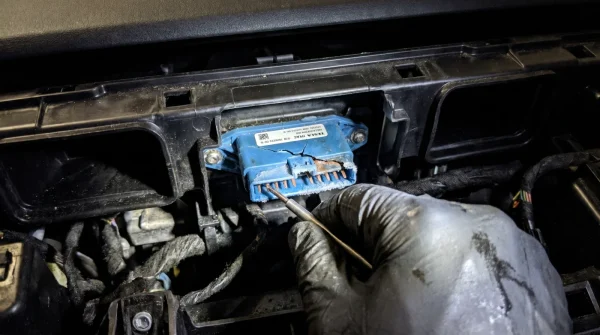
To perform this inspection, you don’t need a lift or a specialized scan tool. You only need a high-lumen flashlight and a bit of flexibility. Turn the front wheels all the way to the left to open up the gap behind the passenger-side tire. You are aiming your light toward the area where the two metal lines enter the transmission casing, specifically looking for the square-shaped block—the thermal bypass valve. This is where you perform the mechanical interrogation.
- Position your flashlight at a 45-degree angle behind the right wheel well liner.
- Look for ‘wet dust’—dark, grimy buildup around the clip that holds the lines into the valve.
- Check the ‘weep hole’ on the side of the valve body for any dried pink crust.
- Trace the lines back six inches; if they feel tacky to the touch, they are venting fluid.
- Smell the area immediately after a test drive; a hot ‘candy’ scent confirms a micro-leak.
If you see a faint, oily sheen that has collected road grit, the valve’s seals have failed. This is the ‘invisible’ leak. It isn’t enough to drip, but it is enough to drop the system’s pressure and starve the gears of cooling. This discovery gives you the ultimate leverage: you either walk away from a doomed transmission or negotiate $4,000 off the price to cover the inevitable rebuild. It is a small detail that defines the entire value of the purchase.
Beyond the Steel and the Fluid
Mastering this specific inspection hack does more than save your bank account; it changes how you relate to the machines you depend on. When you stop looking at a truck as a collection of features and start seeing it as a living system of pressures and temperatures, you gain a sense of agency. You are no longer at the mercy of a salesman’s pitch or a digital report’s limitations. You are seeing the truth in the shadows.
There is a profound peace of mind that comes from knowing exactly what is happening under the hood. In an era where everything is automated and ‘self-diagnosing,’ the human eye remains the most powerful tool in the garage. By checking that thermal bypass valve, you aren’t just buying a truck; you are ensuring your own future freedom on the road, knowing that your engine isn’t just running, but truly breathing.
“A clean vehicle history report tells you where a truck has been, but a flashlight behind the wheel well tells you how much longer it has to live.”
| Key Inspection Point | Hidden Detail | Value to the Buyer |
|---|---|---|
| Thermal Bypass Block | Damp road dust accumulation | Identifies ‘invisible’ fluid loss before catastrophic failure. |
| Cooler Line Clips | Tacky or sticky residue | Indicates seal degradation that history reports always miss. |
| Wheel Well Gap | Direct visual line to the TBV | Allows for a 30-second verification without mechanical tools. |
Frequently Asked Questions
Does the dashboard temp gauge show if the valve is failing? No, the gauge often averages temperatures and won’t spike until the damage to the friction plates is already severe.
Can I just replace the valve as a precaution? Yes, many owners swap the factory valve for an ‘always-open’ bypass to ensure the transmission stays cool 100% of the time.
What does a healthy valve look like? It should be bone-dry and the aluminum should have a dull, matte finish with no dark staining.
Is this issue present on all Silverados? It is most prevalent on 6-speed and 8-speed models from 2014 to 2019; newer models have revised parts but still require checks.
Will a standard mechanic’s inspection catch this? Usually not, unless they are specifically looking for transmission line seepage or performing a dedicated cooling system pressure test.