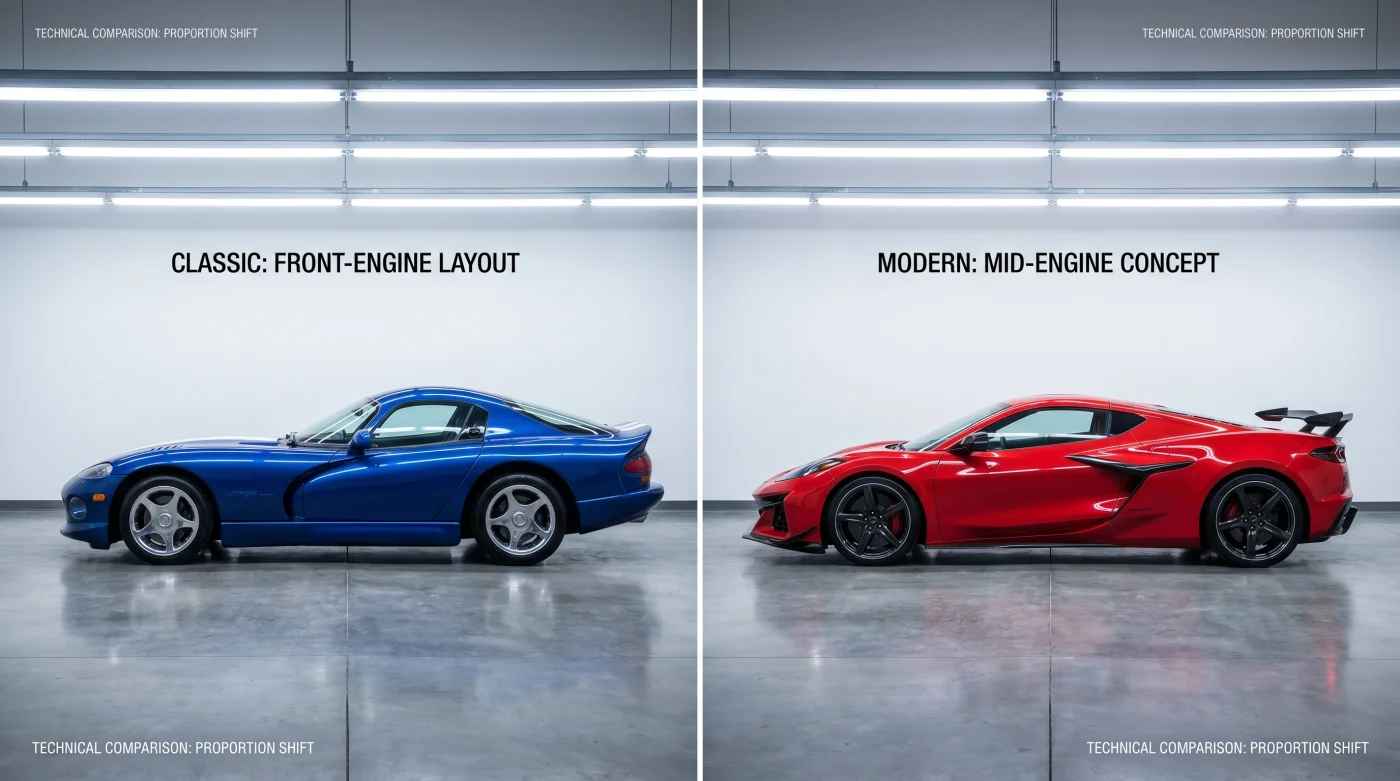
The scent of curing clay and warm motor oil hangs heavy in the quiet workspace of an independent Detroit design studio. Outside, the autumn rain taps against high windows, but inside, the focus is entirely on a scale model illuminated by harsh fluorescent lamps. For decades, the recipe for an American icon was written in its silhouette—the ridiculously long hood, the low roofline, and a cabin pushed so far back that the driver practically sat on the rear axle. It was a visual promise of mechanical violence.
Now, that historic silhouette is facing an existential crisis. The whispers surrounding the Dodge Viper successor suggest a radical departure that has purists gripping their steering wheels in anger. By moving the cabin forward to accommodate radical underbody Venturi tunnels, designers have traded classic, front-engine proportions for clinical, lap-time-optimized efficiency.
The struggle isn’t merely about aesthetics; it is a battle between romantic design and ruthless physics. While the old guard remembers the Viper as a wild, untamable beast that looked fast even standing still, modern aerodynamics demands a different sacrifice. To survive in an era of hyper-performance, a car can no longer just slice through the air; it must swallow it, process it, and use it to pin the chassis to the asphalt.
The Tyranny of the Wind Tunnel
To understand why the classic Viper silhouette is dead, you have to stop viewing air as empty space. Instead, think of air at 150 miles per hour as a thick, viscous fluid that behaves like cold honey. The long hood of the traditional front-engine layout is a gorgeous canvas, but to a high-speed pressure wave, it is a giant ramp that lifts the front nose off the ground.
The classic shape created a massive low-pressure pocket behind the cabin, acting like an invisible parachute that dragged the car backward. The new cabin-forward architecture shifts the driver toward the front wheels, transforming the car from a traditional sledgehammer into an aerodynamic wing. By shrinking the front frontal area and elongating the rear deck, engineers can manipulate the air underneath the floorboards, pulling the car down without resorting to giant, unsightly rear wings.
Marcus Vance, a 52-year-old veteran aerodynamicist who spent twelve years analyzing boundary layer separation for high-performance programs, recalls a closed-door session where early wind-tunnel data for a theoretical front-engine platform was analyzed. ‘The numbers were brutal,’ Vance admits, pointing to a computer screen displaying CFD heat maps. ‘At 180 mph, the classic long-nose design generated over 300 pounds of lift at the front axle. To cancel that out with wings, we would have needed a front splitter so large it would scrape on a pebble. Moving the cabin forward by just nine inches freed up the underbody real estate needed to generate 1,200 pounds of clean, passive downforce without ruining the drag coefficient.’
- Chevy V8 cooling systems require a hidden thermostat drill modification for heavy towing
- Newest electric cars hide a terrifying regenerative braking flaw on wet pavement
- Tesla Model 3 resale drops sharply when owners ignore this battery calibration cycle
- Mazda Skyactiv engine longevity demands a manual intake valve cleaning before 100k miles
- New car buyers abandon traditional dealership lots for hidden wholesale auto broker networks
The Purist’s Lament: Why the Front-Engine Romance Fails Modern Safety and Speed
For the collector who values the physical drama of driving, the loss of the long hood feels like a betrayal. This group craves the view through the windshield—an endless expanse of painted metal that vibrated with every stab of the throttle. However, this layout creates a massive packaging problem in the modern era, where crash-test safety zones and pedestrian impact standards require significant crumple zones that ruin classic low-slung profiles.
Beyond safety, the old layout is mathematically slow on a modern track. With power outputs now routinely crossing the 800-horsepower mark, rear-wheel traction is the ultimate bottleneck. Shifting the cabin forward allows for a mid-front or mid-rear engine placement, balancing the weight distribution so the rear tires can actually dig into the pavement instead of spinning into clouds of expensive smoke.
The Aerodynamic Reality: How Underbody Venturis Shape the New Nose
The heart of the controversy lies in the car’s throat—the massive air intakes required to feed modern venturi tunnels. In the new architecture, air is scooped up under the nose and accelerated through narrowing channels beneath the driver’s feet. This creates a powerful vacuum effect that literally glues the tires to the road.
To make these venturi tunnels work, the front suspension must be packaged tightly, forcing the windshield base forward. The result is a nose that looks shorter and steeper, sloping quickly to the ground. It is an incredibly efficient tool for setting lap records, but it lacks the menacing, predatory stance of the classic GTS coupe.
Finding the Balance: How to Evaluate Modern Downforce
If you are looking to purchase a modern performance machine or assess the merits of the upcoming Viper successor, you must learn to look past the surface sheet metal. True performance is no longer written in horsepower figures alone; it is written in how effectively a car manages its high-speed stability. You can evaluate a car’s aerodynamic health by observing key physical details during your inspection.
Look for clean exit vents behind the front wheels, smooth underbody paneling, and active rear diffusers that adjust to speed. These elements show that the vehicle is designed to work with the atmosphere rather than fighting against it.
- Analyze the splitter depth: A functional front splitter should extend at least two inches forward from the lower bumper to capture clean air.
- Check the wheel arch vents: Look for open louvers above the front tires; these release high-pressure air that would otherwise lift the front end.
- Inspect the flat underbody: Run your hand along the undertray; it should be completely smooth from the front bumper to the rear axle to maintain laminar flow.
- Measure the rear diffuser angle: A gradual 7 to 10-degree upward slope at the rear ensures the air under the car exits cleanly without causing turbulent wake.
The Evolution of Speed
Change is rarely comfortable, especially when it threatens the visual landmarks of our automotive youth. The classic Viper was a monument to an era when raw horsepower and driver bravery were enough to conquer the road. But as we push deeper into the territory of extreme performance, the wind tunnel becomes the ultimate stylist, shaping metal not for the eye, but for the invisible currents of the air.
Accepting this evolution doesn’t mean forgetting the past. It means recognizing that the cars of tomorrow will have a different kind of beauty—one born from pure, functional harmony with the physical laws of nature. The long hood may be fading into history, but the pursuit of terrifying, raw speed remains completely unchanged.
“Design must follow physics, or else you are just building a very fast brick.” — Marcus Vance, Aerodynamicist
| Key Point | Detail | Added Value for the Reader |
|---|---|---|
| Front Lift (at 180 mph) | +300 lbs vs -150 lbs | Shows how cabin-forward design stops the nose from floating at high speeds. |
| Underbody Airflow | Turbulent drag vs Venturi vacuum | Explains the invisible force pulling the car down without needing huge wings. |
| Weight Distribution | Front-heavy (53/47) vs Balanced (45/55) | Explains why the new shape yields superior cornering grip and throttle response. |
Frequently Asked Questions
Why is the long hood design bad for high-speed aerodynamics?
A long, flat hood acts as a ramp at high speeds, trapping air underneath the nose and creating lift, which destabilizes steering.What is a Venturi tunnel and why does it require a cabin-forward design?
It is an underbody air channel that narrows to create a vacuum. Moving the cabin forward provides the physical space underneath to shape these channels properly.Will the Dodge Viper successor have a V10 engine?
While unconfirmed, packaging a giant V10 into a cabin-forward layout is extremely difficult, making a compact twin-turbo V6 or hybrid setup highly likely.How does weight distribution change with the cabin-forward layout?
It shifts the heavy engine and cabin weight closer to the center of the car, balancing the chassis for more neutral handling.Can aftermarket wings fix the aerodynamic lift of classic shapes?
They can add rear downforce, but they do not solve front lift without causing massive aerodynamic drag that slows the car down on straights.