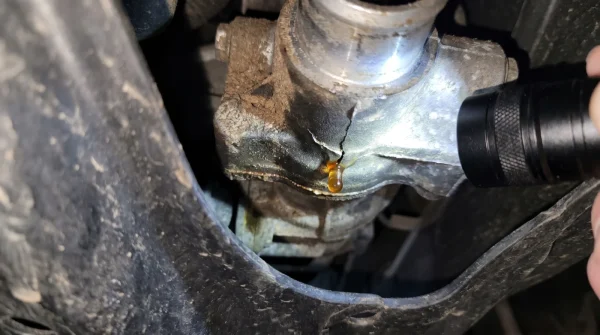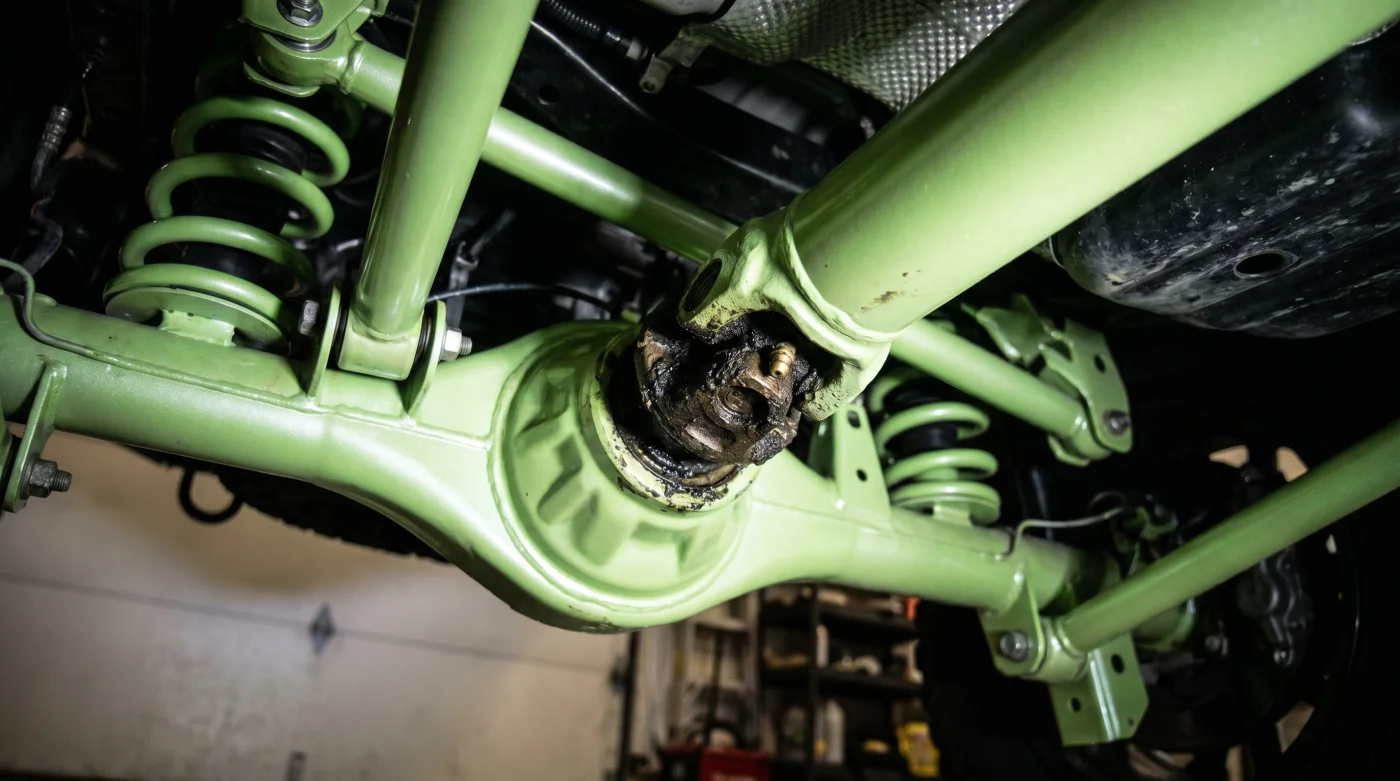
Slide under the cold steel belly of your truck on a quiet Sunday morning. The sharp, nostalgic scent of damp earth, road dust, and cured gear oil hangs heavy in the quiet space of your driveway. You shine a narrow beam of flashlight upward, past the silver heat shield of the exhaust system, tracing the heavy, balanced steel tube of the rear driveshaft.
There it is, tucked close to the universal joint: a tiny brass zerk fitting completely covered in a thick, sticky crust of black molybdenum grease and fine road grit. To the modern driver raised on lease agreements and digital screens, it looks like a strange relic from a bygone era, an unnecessary mechanical protrusion on an otherwise highly polished chassis. Most modern SUVs promise a completely maintenance-free lifestyle, wrapping their moving parts in sealed rubber boots that ask nothing of you until they fail entirely.
But this rugged machine operates under an older, more honest set of mechanical rules. The dealership service writers rarely mention this little brass nipple during your routine oil changes, operating on high-throughput schedules that prioritize quick filter swaps over manual, tactile labor.
If you ignore this detail, your truck eventually begins to protest with a subtle, physical complaint. It is a symptom that many drivers misdiagnose as transmission slip or a sticking brake caliper, yet the fix is far simpler and infinitely more satisfying.
The Phantom Bump: Decoding the Slip Yoke Clunk
Have you ever felt that sudden, jarring thud right as you come to a complete stop at a red light, or just as you release the brake pedal to accelerate? It feels like another vehicle has gently tapped your rear bumper. This is not a transmission problem; it is the physical result of dry, unlubricated metal splines binding together under torque load.
Think of the slip yoke as a metal slide trombone. As your rear suspension moves up and down over potholes and trail obstacles, the driveshaft must constantly contract and expand. Without a fresh barrier of grease, the metal splines bind together, locking the driveshaft’s length temporarily until the tension releases with a violent, metallic clunk.
- AAA Auto Buying service algorithms bypass hidden dealership regional assessment fees entirely during final negotiations
- Subaru Outback Wilderness used inspections demand checking the lower CVT pan seal for structural weeping
- Porsche 911 Carrera T dealership markups artificially hide mandatory ceramic coating packages inside finance sheets
- Ford F-150 PowerBoost hybrid thermal loops maintain transmission temperatures better than pure electric trucks
- Genesis G70 used models secretly feature identical Nappa leather hides sourced by Bentley suppliers
This binding puts immense stress on your transfer case output shaft and rear differential pinion bearings. Every clunk is metal-on-metal wear that slowly chips away at the tight tolerances engineered into your Japanese-built drivetrain.
A Master Tech’s Perspective
Marcus Vance, a fifty-two-year-old independent Toyota specialist in Silverton, Colorado, has spent three decades diagnosing these rugged four-wheel-drive systems. “People bring me their trucks convinced they need a three-thousand-dollar transmission rebuild,” Marcus says, wiping his hands on a blue shop towel. “A simple hand-pumped grease gun and ten minutes on a creeper is usually all it takes to restore that factory-smooth glide, yet modern service manuals barely give it a footnote.”
Chassis Profiles: Tailoring Your Service Interval
The Daily Commuter
Even if your truck never leaves the paved highway, the continuous stop-and-go cycle of city driving creates thousands of micro-adjustments along the splines. A strict fifteen-thousand-mile window keeps the grease from drying out under the intense heat radiating from the nearby exhaust system.
The Weekend Overlander
Crossing creeks and kicking up fine trail dust introduces abrasive grit to the slip yoke seals. If you frequently submerge your axles, you must grease the zerks immediately after your trip to purge any trapped water.
The Winter Warrior
Liquid road de-icers can easily seep past dry rubber dust seals, causing rapid oxidation of the internal splines. Prioritize a thorough grease service just before the first freeze to seal out winter’s corrosive chemicals.
The Zen of the Grease Gun: A Step-by-Step Ritual
Taking care of this yourself is a grounding, tactile ritual that connects you directly to your machine. It requires no complex electronic diagnostic tools—only patience, a manual lever-action grease gun, and the correct lubricant.
Never use standard wheel bearing grease for this specific task. The slip yokes require a heavy-duty lithium soap base grease fortified with at least three to five percent molybdenum disulfide to withstand the extreme sliding pressure.
- Locate the fittings: There are typically six zerk fittings on a 4WD model—three on the front driveshaft and three on the rear.
- Clean the zerk tips: Wipe every fitting meticulously with a clean microfiber cloth to avoid pumping road dirt directly into the needle bearings.
- Pump with restraint: For the slip yokes, pump slowly until you see the rubber boot just begin to swell. Do not over-pump, or you risk blowing out the dust seal.
- Purge the U-joints: For the universal joints, pump until old, dark grease is completely pushed out and clean, fresh grease emerges from all four cups.
The Tactical Toolkit
- Grease: NLGI No. 2 Lithium Complex with 3-5% Moly.
- Gun: Manual pistol-grip grease gun with a flexible 18-inch hose.
- Safety: Clear safety glasses to keep falling road grit out of your eyes.
- Wipes: Heavy-duty degreaser wipes for cleanup.
Preserving the Last of the Mechanical Giants
With the discontinuation of the iconic fifth-generation V6 engine, we are witnessing the end of an era for simple, analog utility. The transition to highly complex, turbocharged four-cylinders means these older, naturally aspirated powerplants are becoming prized heirlooms.
Taking ten minutes twice a year to slide under your chassis is more than just maintenance; it is an act of preservation. By mastering this simple chore, you guarantee your truck will smoothly navigate the long miles ahead, keeping a legendary platform running quietly for decades to come.
“A machine will always talk to you before it fails; you just have to learn to listen to the silence between the gears.” — Marcus Vance
| Key Point | Detail | Added Value for the Reader |
|---|---|---|
| Grease Specification | Use NLGI No. 2 with 3-5% Molybdenum Disulfide | Prevents metal-on-metal binding under extreme torque loads. |
| Pumping Technique | Pump until the slip yoke boot barely swells | Protects the fragile rubber seals from blowing out. |
| Frequency | Every 15,000 miles (or after deep water crossings) | Eliminates the annoying driveline clunk and stops premature wear. |
Frequently Asked Questions
Why does my 4Runner clunk when I stop? It is the slip yoke sticking due to dry splines. Greasing solves this instantly.
What kind of grease should I buy? Look for NLGI No. 2 grease with molybdenum disulfide.
Can I over-grease the slip yoke? Yes, too much grease can prevent the driveshaft from compressing, causing damage to the transfer case. Pump until the boot just begins to expand.
How many zerk fittings does my 4Runner have? Standard 4WD models have six fittings across both driveshafts.
Why doesn’t the dealership do this during regular oil changes? Modern dealer schedules prioritize fast, automated services; manual chassis greasing is often overlooked unless specifically requested.