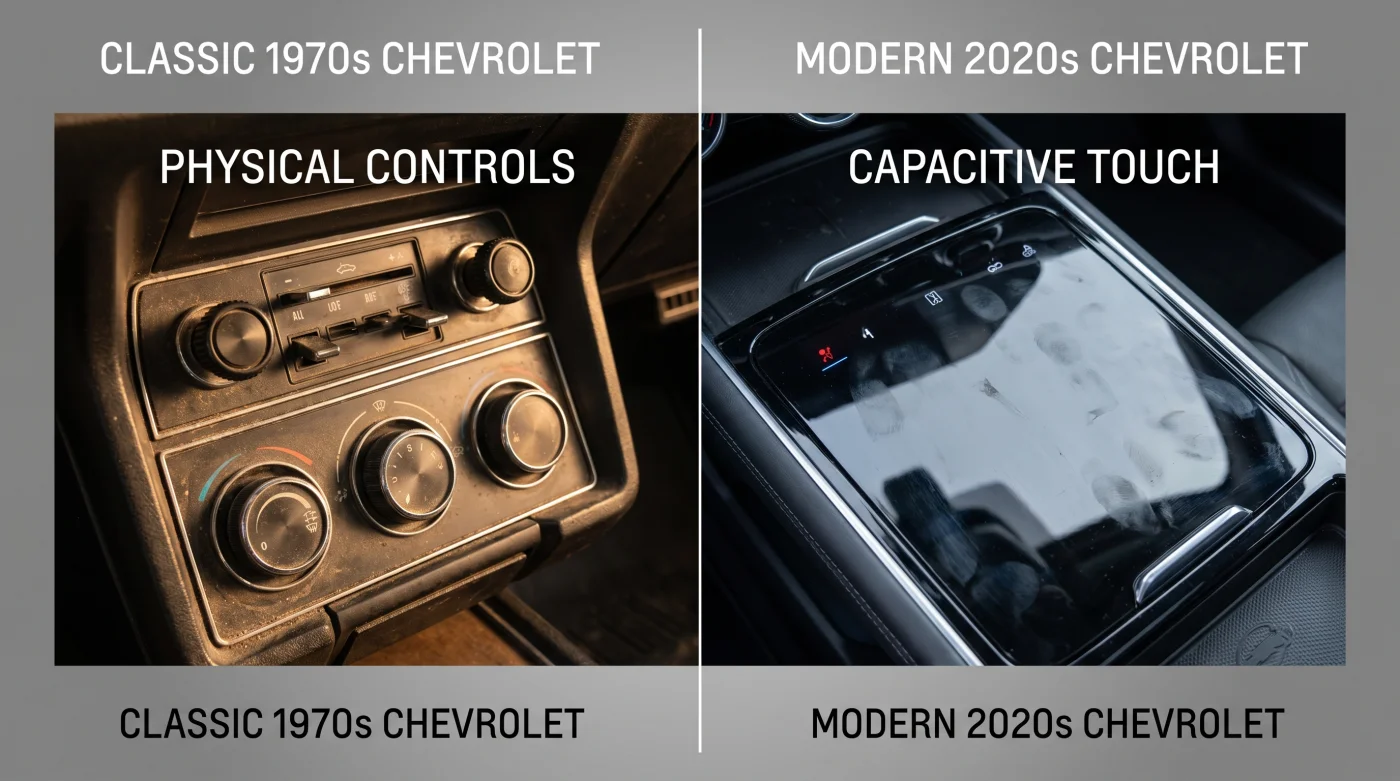
The sun hits the dashboard at a low angle, revealing a messy constellation of oily grease marks. Where a knurled aluminum knob once sat, reassuringly cold to the touch and ready to click into place, there is now only a flat, silent expanse of piano black trim. You reach out, your index finger searching for a physical edge, but find only the sterile slip of a perfectly flat surface. The tire roar below your feet reminds you that you are moving at seventy miles per hour, yet you are forced to stare at a glowing panel just to find the defroster.
Under the direction of CEO Mary Barra, a silent revolution has taken place inside the cabins of modern Chevrolets. The satisfying, mechanical thunk of a physical switch has been systematically hunted down and erased. In its place lies a 1.2-millimeter-thick capacitive panel that manages everything from temperature adjustments to drive modes. What was marketed as a minimalist leap into the future feels, in reality, like trying to play a piano through a thick winter glove.
The tactile cues that drivers relied on for over a century have vanished. You no longer feel the resistance of a spring-loaded toggle or the distinct detent of a fan-speed dial. Instead, your finger taps a lifeless piece of glass, waiting for a visual confirmation that requires you to take your eyes off the asphalt. It is a quiet design tragedy disguised as progress, transforming the intimate act of driving into an exercise in navigation menus.
The Illusion of the Glass Cockpit
For years, automotive marketing departments convinced us that screens represented the peak of capability. We fell for the clean lines and the promise of customization, viewing physical buttons as relics of a cluttered past. But this shift is not an upgrade; it is a clever cost-cutting measure wrapped in the sleek language of modern minimalism. The muscle memory of your hands is being traded for visual confirmation.
Think of physical buttons as natural tactile landmarks. When you remove them, you force your brain to switch from physical instinct to active visual processing. A simple two-degree temperature change now requires the same mental load as reading a text message. By turning the dashboard into an iPad, carmakers have traded safe driving habits for aesthetic convenience.
Marcus Vance, a 48-year-old human factors researcher who spent two decades testing cabin layouts for major Detroit suppliers, watched this transition with growing alarm. “We used to measure safety in off-road eye glance time,” Marcus explains over a cup of lukewarm coffee. “The golden rule was never to exceed 1.5 seconds of continuous visual focus away from the lane. With the new capacitive sheets, drivers are regularly hitting three to four seconds just trying to locate the rear wiper icon. We are designing distraction into the machine.”
- Ford Bronco base trims hide a factory suspension geometry perfect for aftermarket overlanding
- Subaru Forester moonroof recalls secretly trigger massive comprehensive insurance premium auto-renew hikes
- Kawasaki hydrogen combustion motorcycle prototypes expose a massive fuel storage thermal expansion flaw
- 2027 Dodge Durango pricing structures mask a controversial downgrade to mild hybrid platforms
- EV charging station thermal cables completely fail after extreme summer cooling pump degradation
The Commuter’s Blind Spot: Navigating the New GM Interface
The daily drive demands quick, instinctive adjustments that do not interrupt your focus. In the latest Chevrolet EV and internal combustion lineups, the loss of Apple CarPlay means you are locked into a proprietary system. This native interface prioritizes subscription-based services over intuitive utility, turning basic interactions into a multi-step digital chore.
For those driving in heavy city traffic, the lack of haptic feedback is particularly punishing. There is no physical edge to rest your thumb against while aiming for a virtual slider on a bumpy highway. A sudden pothole can cause your finger to slip, turning a simple radio adjustment into an accidental blast of hot air, which compromises real-world cabin safety during critical moments.
When you are managing kids in the back seat and navigating a sudden rainstorm, your cognitive bandwidth is already pushed to its limit. The absence of a physical volume knob means you cannot instinctively silence the cabin when an emergency siren approaches. You are left tapping a flat screen, hoping your finger registered on the correct millimeter-wide zone.
Reclaiming Control in a Touchscreen Cabin
You do not have to let poor dashboard design ruin your driving experience. While you cannot physically rebuild the dashboard, you can adapt your habits to minimize eyes-off-the-road time. By establishing a structured pre-drive routine, you can keep your focus where it belongs and treat your vehicle like a set-it-and-forget-it environment.
Use these mindful adjustments to bypass the worst of the touchscreen limitations:
- Map your steering wheel controls: Prioritize the physical buttons on the back of the steering wheel spoke for volume and station tracking.
- Establish a pre-flight setup: Set your cabin temperature, seat heaters, and navigation route before pulling out of the driveway.
- Utilize natural voice commands: Lean on the built-in Google Assistant to make temperature adjustments rather than hunting through the sub-menus.
- Apply a matte screen protector: A custom matte film reduces glare and fingerprints, making the capacitive zones slightly easier to locate in direct sunlight.
To assist with this transition, keep these specific tools on hand to manage the interface limitations:
- Matte anti-glare screen film (specifically cut for Chevrolet’s diagonal display sizes)
- Microfiber cloth stored in the center console (to clear the inevitable grease buildup)
- Voice command cheat sheet (for quick reference to climate control phrases)
The Return to Mechanical Honesty
True luxury is not a glowing screen that demands your constant attention; it is a machine that works in perfect, quiet harmony with your senses. The backlash against fully digitized cabins is already building, as drivers realize that some innovations are actually steps backward. Demanding a return to mechanical honesty in our cars is not old-fashioned—it is a fundamental requirement for safety and peace of mind.
When we push back against these screen-centric trends, we are advocating for a safer, more intuitive relationship with technology. Your car should be a sanctuary of focus, not a rolling smartphone that forces you to compromise your attention for a basic climate adjustment. Until the industry corrects its course, taking charge of your cockpit layout is the smartest way to keep your eyes firmly on the road ahead.
“The safest user interface is the one you can operate with your eyes closed, guided solely by the shape and texture of a physical switch.” – Marcus Vance, Cabin Ergonomics Expert
| Key Point | Detail | Added Value for the Reader |
|---|---|---|
| Grooved Rotary Dial | Physical detent clicks every half-degree, blind operation | Zero visual distraction, immediate tactile confirmation |
| 1.2mm Capacitive Panel | Flat touch zone with zero physical feedback, prone to smudges | Modern aesthetic but requires visual confirmation, high distraction risk |
| Steering Wheel Toggles | Mechanical rocker switches behind the steering wheel spoke | Allows blind audio adjustment without taking hands off the wheel |
Why did Chevrolet remove Apple CarPlay from its newer models?
GM chose to transition to a proprietary built-in software ecosystem to capture subscription revenue and tightly control the integration of vehicle diagnostics with digital services.
Is there any way to retrofit physical buttons into a touch-only dashboard?
While you cannot easily add aftermarket physical buttons for climate control, you can maximize your use of existing steering wheel switches and voice command shortcuts.
Do capacitive touch panels work reliably in extreme winter cold?
Capacitive touch panels rely on the electrical conductivity of your skin, meaning they can be sluggish to respond in freezing temperatures or completely non-functional when wearing standard gloves.
Are other car manufacturers also abandoning pure touchscreen layouts?
Yes, several luxury and mainstream brands are beginning to reintroduce physical buttons for critical climate and volume controls after facing severe pushback from consumers and safety rating organizations.
How do I clean the fingerprint-heavy piano black trim without scratching it?
Always use a clean, dry microfiber cloth and avoid harsh chemical sprays, which can degrade the delicate anti-reflective coating on the touch panel surface over time.