You are humming down the interstate at 70 miles per hour, tires singing that familiar, high-pitched drone against the concrete. The rain is coming down in steady sheets, turning the highway into a gray, reflective mirror that throws the headlights of oncoming traffic back into your eyes. You tap the right stalk twice. The blue steering wheel icon chimes into existence on the screen, signaling that your Model Y has taken the helm. You exhale, expecting the car to trace the lane with its usual, robotic perfection, letting the machine shoulder the mental weight of the storm.
But something feels unsettled beneath the floorboards. The steering wheel twitches in your grip, a subtle but nervous oscillation like a dog pulling at a leash. Suddenly, the lane lines on the display start dancing, merging with the textured road surface in a confused digital blur. A sudden, shrieking alarm demands your immediate intervention, handing control back to you in the middle of a gentle curve. It is a startling reminder that what you perceive as a clearly defined lane, the machine sees as chaos.
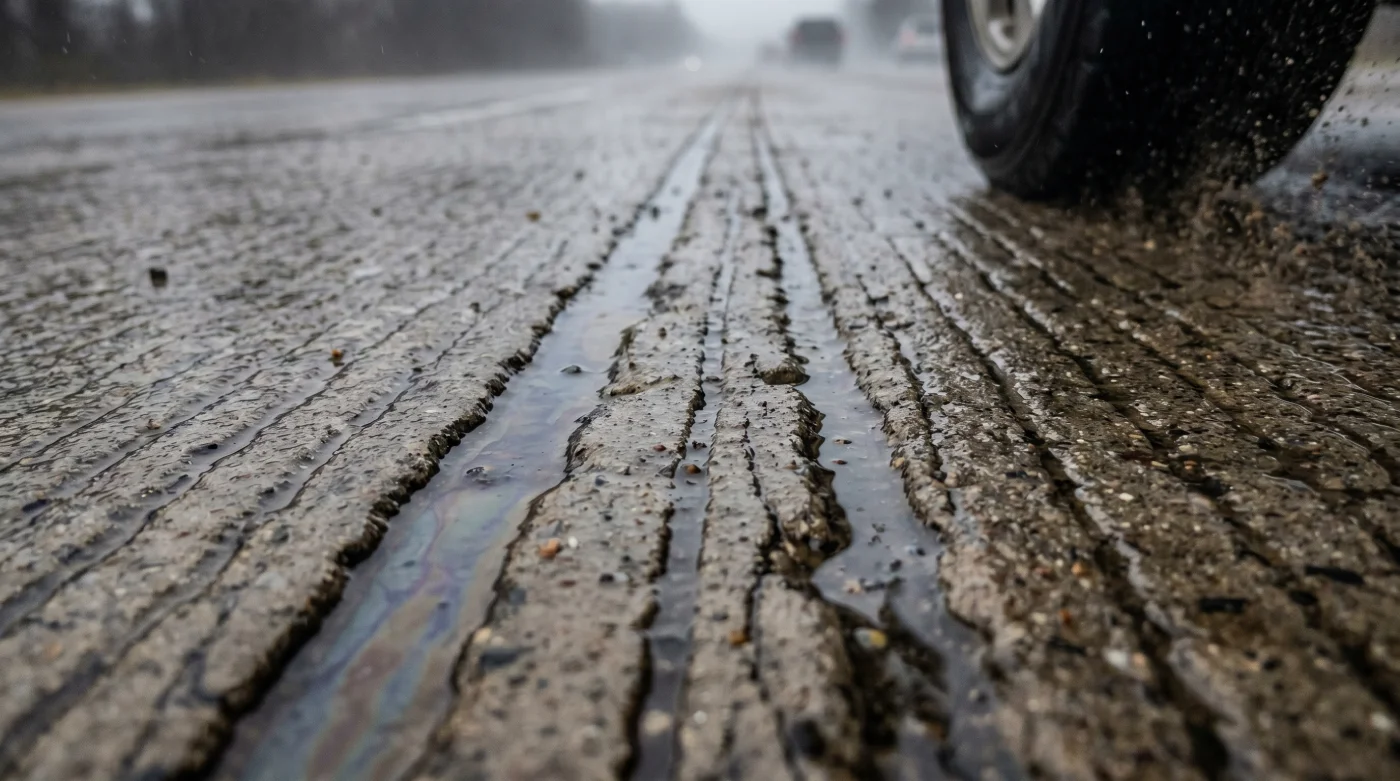
The culprit is not a software glitch or a dirty camera lens. The issue stems from the physical structure of the road itself interacting with heavy precipitation. Those thin, parallel cuts etched into the highway to channel water away—known to engineers as longitudinal tining—are playing a very specific trick on a system that relies entirely on visual data.
The Illusion of the Solid White Line
Humans process the roadway by context. You see the guardrail, the curvature of the earth, and the general flow of traffic, naturally filtering out the noise of the pavement texture. Tesla’s vision-only system, however, hunts fiercely for sharp contrast. When rain fills those longitudinal grooves, the water reflects ambient light, creating hundreds of shimmering, false white lines running exactly parallel to the actual lane markers.
Imagine trying to read a barcode that someone has smeared with a wet sponge. The car’s neural network experiences something akin to staring through a tear-filled eye; the geometric signals simply bleed together. The lines you effortlessly ignore become primary data points for the cameras, confusing the steering logic and causing the system to lose tracking entirely.
Understanding this physical limitation shifts your relationship with the car. You stop viewing Autopilot as a flawless chauffeur and start treating it like a highly skilled, yet visually sensitive learning partner. Anticipating its blind spots transforms a frustrating failure into a predictable, easily managed quirk.
- Tesla Model Y Panel Gaps Reveal A Frustrating Assembly Line Reality
- Tesla Model Y Phantom Braking Requires This Manual Calibration Fix
- Tesla Model Y Winter Range Losses Make Hybrids A Smarter Buy
- Tesla Model Y Used Buyers Miss This Critical Battery Check
- Tesla Model Y Suspension Failures Require This Hidden 100k-Mile Fix
Marcus Thorne, a 42-year-old civil engineer and daily commuter through the rain-soaked corridors of Seattle, spent weeks documenting this exact phenomenon. He noticed his Model Y consistently aborted Autopilot on the exact same stretch of I-5 whenever it rained. Armed with dashcam footage and highway construction schematics, Marcus realized the 3/4-inch concrete tining—designed specifically to prevent hydroplaning—was acting as a visual camouflage. The water-filled grooves matched the reflectivity and width of the faded painted lines perfectly, causing the algorithms to cross their eyes and give up.
Reading the Road Like a Machine
To navigate safely, you need to recognize the specific environments where this visual confusion peaks. Not all highways are created equal, and surface texture dictates system confidence more than you might realize. By categorizing the pavement, you can predict exactly when to take the wheel.
The Fresh Concrete Washout
Newly poured highways often feature bright, light-gray concrete with very stark, deep longitudinal grooves. When rain hits this pristine surface, the contrast between the dark wet grooves and the light concrete mimics the exact pixel density of a solid white line. In these zones, keep your hands firmly anchored, expecting sudden disengagements.
The Faded Paint Trap
Older interstates present a different challenge. Here, the painted lane markers have been worn down by years of tire friction and snowplows. During a downpour, the water trapped in the grooves actually becomes more reflective than the paint itself, pulling the car’s attention away from the boundaries and toward the center of the lane.
The Glare-Blinded Asphalt
While asphalt lacks the deep tining of concrete, heavy rain followed immediately by harsh sunlight creates a similar tracking failure. The road surface turns into a sheet of pure glare, blinding the forward-facing cameras. The system will usually warn you of reduced visibility before it drops steering control, giving you a precious few seconds to adapt.
Calibrating Your Highway Habits
Managing these edge cases does not require heightened anxiety; it requires mindful preparation. By adjusting your physical posture and digital settings before the rain intensifies, you maintain absolute fluid control over the vehicle. It is about bridging the gap between the car’s processing power and your situational awareness.
Start by physically grounding yourself. Rest your elbow on the door armrest and keep a gentle, steady grip at the four o’clock position on the wheel. This allows you to feel the micro-corrections the car is making and provides immediate resistance if the steering suddenly darts toward a false line.
- Lower your set cruising speed by at least 10 mph during heavy rain on grooved surfaces to give the cameras more processing time per foot of roadway.
- Increase your following distance to setting 4 or 5; the spray from the tires of the car ahead acts as a secondary visual disrupter.
- Keep your windshield wipers on a manual, high-speed setting rather than auto, ensuring the forward camera housing is swept clear of water pooling.
- Watch the lane lines on the visualization screen; if they begin to jitter or vanish, manually disengage before the car forces an abrupt handoff.
Your tactical toolkit relies on adjusting your visual baseline before the car panics. Set your speed to 55 mph, push the following distance to 4 car lengths, and anchor your hand low on the steering wheel. Treat these parameters as your baseline protocol the moment the pavement turns gray and the rain begins to bead on the glass.
Co-Piloting With a Growing Brain
There is a quiet satisfaction in understanding the physical limits of the technology you use every day. When you realize that your high-tech vehicle is occasionally confused by a simple puddle trapped in a groove of concrete, the frustration dissipates. You are not a passive passenger in an autonomous pod; you are an active supervisor overseeing a brilliant, yet imperfect, digital mind.
Embracing this dynamic removes the sudden jolt of adrenaline when the system chimes and hands you the wheel. You already knew it was coming. You saw the rain, you felt the grooves, and you stepped in seamlessly to guide the car through the chaos. It transforms a stressful commute into a deeply engaged driving experience, honoring both human intuition and machine capability.
“You cannot force an optical sensor to read context; you can only manage the environment it operates within, blending human foresight with digital reflexes.”
| Key Point | Detail | Added Value for the Reader |
|---|---|---|
| Longitudinal Grooves | Parallel concrete tining fills with rainwater, mimicking lane lines. | Removes the mystery of sudden Autopilot failures on specific highways. |
| Vision-Only Blind Spots | Cameras hunt for contrast, confusing wet grooves with faded paint. | Allows you to predict system dropouts before the car sounds an alarm. |
| Tactical Adjustments | Lowering speed by 10 mph and increasing follow distance to setting 4. | Provides concrete steps to maintain safety and reduce driving anxiety. |
Highway Autopilot Realities FAQ
Why does Autopilot fail on specific sections of the same highway?
The pavement texture changes. Long sections of concrete with longitudinal tining fill with water during rain, confusing the vision-only cameras by creating false lines.Is there a software fix for this groove tracking issue?
Tesla constantly updates its neural network, but physical visual camouflage—like water mirroring a painted line—remains a fundamental limitation of optical cameras.How can I tell if the car is about to lose lane tracking?
Watch the blue lane lines on your center display. If they start dancing, jittering, or blending with adjacent lanes, the system is struggling to read the road.Does changing the wiper speed actually help Autopilot?
Yes. Setting the wipers to a constant, manual high speed ensures the forward-facing camera housing at the top of the windshield remains clear of pooling water.Should I avoid using Autopilot entirely in the rain?
Not necessarily. Use it on smooth asphalt where water drains laterally, but take manual control on grooved concrete or when road spray severely limits visibility.