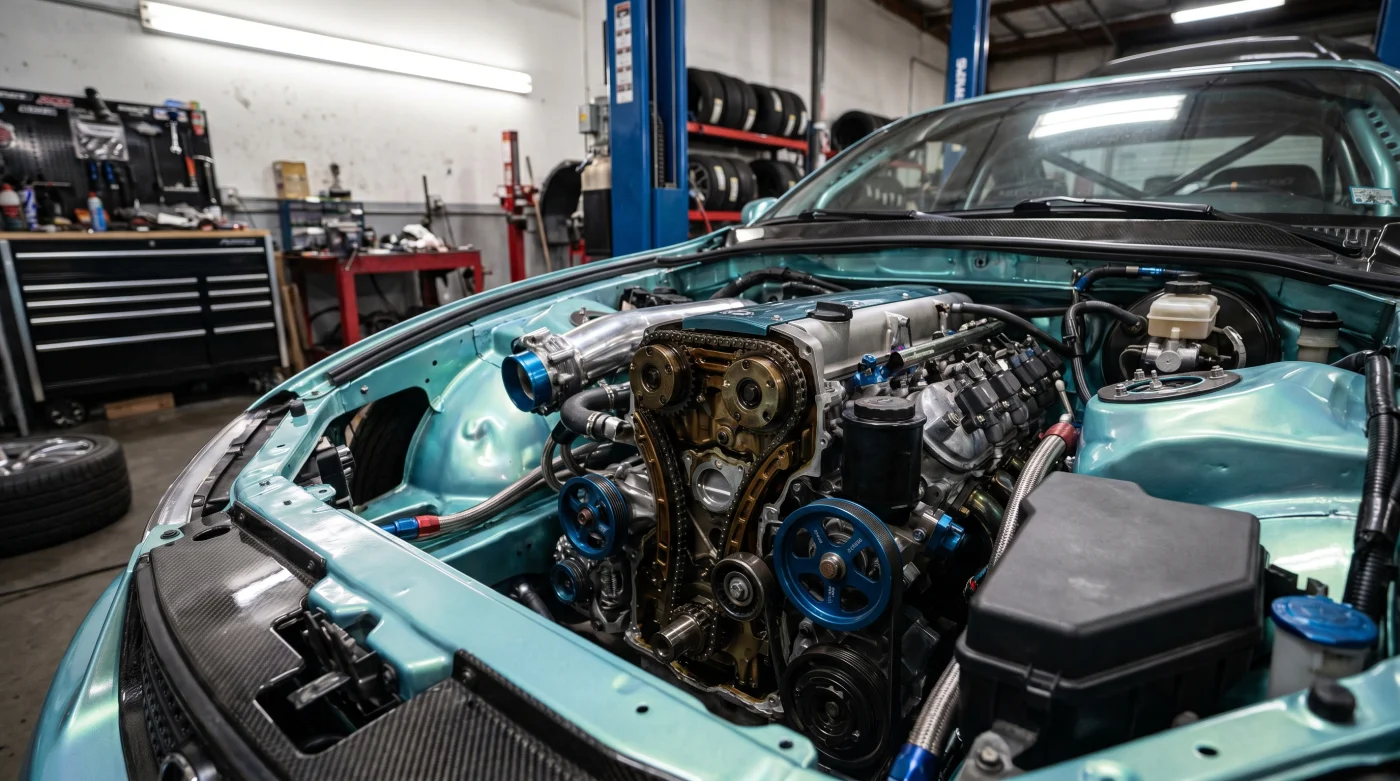
The garage is silent save for the faint, steady hum of an overhead fluorescent tube. On the lift sits an LS 460, its hood propped open, radiating a gentle wave of heat. You do not hear the frantic, metallic clicking common to modern direct-injected engines. Instead, there is only a deep, mechanical whisper, the sound of an engine operating with absolute precision.
Modern luxury car ownership often feels like waiting for a fuse to burn down. We have been trained to expect that any sophisticated, 32-valve powerplant will eventually demand a multi-thousand-dollar tribute at the altar of the service department. The common wisdom says that once the odometer crosses six figures, you must pull the engine to swap out fragile plastic guides and thin, bicycle-like timing chains.
But under the heavy aluminum cover of a Lexus UR-series V8, a different philosophy is at work. Here, the engineering looks less like a delicate timepiece and more like industrial machinery built to survive a century. The secret lies not in computer-controlled magic, but in a heavy-duty mechanical link that ignores standard service schedules entirely.
The Battleship Anchor: Why Lifetime Parts Actually Exist
Most modern engines treat the timing chain as a long-term wear item, using single-strand links that gradually stretch under tension. Think of these thin chains like cheap guitar strings under constant, high-speed stress. Over time, they slowly deform, throwing off valve timing and eventually threatening to smash valves into pistons. This design flaw turns pre-owned luxury cars into financial landmines.
The Lexus double-row chain changes this dynamic entirely by distributing the physical load across two parallel rows of heavy-duty steel links. Rather than fighting the immense rotational resistance of four overhead camshafts with a single strand, the UR-series engine uses pure mechanical redundancy. The system relies on an incredibly robust, oil-bathed hydraulic tensioner. This tensioner acts like a constant-pressure dam, utilizing engine oil pressure to keep the chain perfectly taut without applying the excessive, wear-inducing friction found in European setups. While European rivals use brittle plastic guides that crack and cause catastrophic engine failure, the Lexus setup remains bathed in a continuous, protective torrent of motor oil.
- BMW X5 air suspension struts fail miles before standard Mercedes coilover hardware
- Hyundai Ioniq 5 battery architecture exposes rapid degradation during constant fast charging
- 2026 Ford Ranger Tremor introduces severe highway wandering despite off-road upgrades
- Porsche 911 dashboard digital gauges completely ruin the classic driver sightline
- Toyota CVT transmissions require a specific bypass filter installation to survive
The Atlanta Tech Who Saw It All
Marcus Vance, a 54-year-old master technician in Atlanta, Georgia, has spent three decades staring into open engine bays. ‘In thirty years, I have seen countless German V8s hauled in on flatbeds because a plastic chain guide shattered or a single-row chain skipped a tooth,’ Marcus says, wiping grease from his hands. ‘But when we open up a Lexus 4.6 or 5.7 with 300,000 miles, the double-row chain looks almost identical to the day it left the Tahara plant. If the owner changed their oil, there is simply no stretch to measure. It is a massive relief for buyers who want V8 power without the V8 repair bills.’
Decoding the UR-Series: Finding Your Perfect Eight-Cylinder
The commuter’s choice is the 1UR-FE and 1UR-FSE, the 4.6-liter variants. Found in the flagship LS 460 and the mid-size GS 460, this engine is a masterpiece of quiet operation. It utilizes dual fuel injection to balance fuel atomization with long-term intake valve cleanliness. Because these sedans are often driven gently, the hydraulic tensioner experiences minimal pressure spikes, ensuring the double-roller chain remains completely unstressed for decades.
Built for relentless towing in the Tundra, Sequoia, and Land Cruiser LX 570, the massive 5.7-liter 3UR-FE is engineered for pure thermal durability. It runs on regular unleaded oil and lacks some of the complex direct-injection plumbing of its smaller siblings. The double-row chain in this utility giant is designed to withstand the immense shock loads of pulling 10,000-pound trailers up steep mountain passes without stretching a single millimeter. This explains why used LX 570s are currently surging in the pre-owned market as buyers run away from complex, fragile twin-turbo setups.
For the performance purist, the high-revving 5.0-liter 2UR-GSE powers the IS F, RC F, and LC 500, spinning joyfully to a 7,300 RPM redline. To handle the rapid engine speed transitions, Lexus equipped this variant with dual-chamber oil pumps and specialized chain guides. Even under track conditions, the double-roller chain resists the whip effect that commonly snaps lesser timing systems.
The Preservation Protocol: Keeping the Tensioner Primed
Maintaining this legendary reliability does not require expensive shop visits, but it does demand consistency. The hydraulic tensioner relies entirely on clean engine oil to maintain the correct tension against the double-row chain. If oil passages become clogged with varnish or sludge, the tensioner can lag, leading to momentary slack during cold starts. This is the only way to hurt these otherwise bulletproof components.
Clean oil is insurance for your entire valvetrain. By adopting a strict maintenance routine, you ensure that the oil-bathed tensioner never loses its firm grip on the steel links. To keep your engine operating in this peak mechanical state, follow these straightforward steps:
- Change your engine oil every 5,000 miles or six months, regardless of what the onboard service indicator suggests.
- Always use high-quality full synthetic API SP-certified oil to prevent varnish buildup.
- Stick to OEM Toyota or Lexus element filters, ensuring the replacement O-rings are lubricated and seated properly during installation.
- Listen for a short, one-second rattle upon a cold start after the vehicle has sat for several days; this is the primary indicator of tensioner health.
A Return to Mechanical Honesty
In an automotive market increasingly dominated by tiny, highly-strung turbocharged engines, the used Lexus V8 stands as a monument to over-engineering. It represents a brief, beautiful window in automotive history where durability took precedence over meeting arbitrary fleet emissions targets. When you buy a used UR-series vehicle, you are buying peace of mind.
Choosing mechanical longevity over transient high-tech trends is a quiet form of rebellion. It means knowing that while others are booking expensive rentals while their modern engines undergo open-heart surgery, your vehicle will simply continue to start, run, and whisper down the highway. At the heart of that quiet confidence is a simple, elegant piece of industrial art: the heavy, oil-soaked metallic links of the double-roller timing chain.
“The absolute best way to save ten thousand dollars on a modern V8 is to buy one that was engineered with a double-row steel chain instead of a rubber belt or a single-row wire.” — Marcus Vance, Master Diagnostic Technician
| Key Point | Detail | Added Value for the Reader |
|---|---|---|
| Double-Row Chain | Dual parallel steel links | Distributes torque load to prevent stretching over 300,000+ miles. |
| Oil-Bathed Tensioner | Constantly pressurized hydraulic guide | Eliminates the slack-induced chain slap common in European V8s. |
| Cast Aluminum Cover | Rigid front-engine sealing | Protects the timing assembly from dirt and prevents oil leaks. |
Frequently Asked Questions
Do Lexus V8 engines use timing belts or chains? Older UZ-series V8 engines (like the 4.0 and 4.7) use rubber timing belts that require replacement every 90,000 miles. Modern UR-series V8 engines (4.6, 5.0, and 5.7) use indestructible double-row steel timing chains designed to last the lifetime of the vehicle.
How do I know if my Lexus timing chain is wearing out? If you hear a distinct metallic rattling noise for two seconds immediately after a cold start, your hydraulic tensioner may be losing pressure. This is rarely a chain failure and is usually resolved with more frequent oil changes or a fresh tensioner.
Why are used Lexus V8 cars surging in price? Buyers are seeking relief from the high maintenance costs and fragility of modern turbocharged engines. The UR-series V8s offer old-school durability with modern luxury, making them highly sought after on the pre-owned market.
Does low engine oil damage the Lexus double-roller chain? Yes. Because the chain tensioner is pressurized by engine oil, running the engine low on oil can cause the tensioner to slacken, leading to premature guide wear and noise.
Is an engine-out service required to fix Lexus V8 timing chains? No. Unlike many European rivals that place their timing chains at the back of the engine, the Lexus UR-series features a front-mounted assembly that can be accessed without removing the entire engine from the vehicle.