The garage door rolls up with a heavy, metallic groan, inviting a gust of biting November air to swirl around your ankles. Inside the cabin of the 911, the leather feels like a sheet of ice, and the steering wheel is a frozen ring that bites into your palms. You turn the key, or twist the dummy fob, and that legendary flat-six bark echoes off the concrete walls before settling into a rhythmic, high-strung pulse. It sounds healthy, but in these sub-freezing temperatures, the engine feels tight, restricted, and fragile.
Your instinct is to protect the investment. You step back into the warmth of your kitchen, let the engine sit there at a steady 1,200 RPM, and wait for the heater to eventually blow something other than a draft. You think you are doing the mechanical equivalent of a slow stretch before a sprint. You imagine the oil thinning out, gently coating the cylinders while the metal expands in a controlled, safe environment. It feels like the **responsible way to treat** a hundred-thousand-dollar machine.
But as the exhaust condensation puddles on the floor, a silent, microscopic violence is occurring inside the engine block. The very act of ‘babying’ the car in the driveway is actually **grinding the cylinder walls** into a state of irreversible decay. This quiet morning ritual is the primary reason why otherwise pristine Porsches end up as ‘roller’ projects with five-figure repair bills, effectively murdering the resale value of a car you thought you were saving for the next generation.
The Thermal Trap: Why Silence is a Cylinder Killer
To understand why idling is a death sentence, you have to stop thinking of your engine as a campfire and start seeing it as a complex assembly of different alloys that ‘grow’ at different speeds. In a Porsche flat-six, the pistons are made of one material and the cylinder liners—often coated in a material called Lokasil or Alusil—are another. When you idle a cold engine, the piston heats up significantly faster than the massive, coolant-jacketed engine block surrounding it. This creates a **lethal lack of clearance** where the piston expands and begins to physically scuff the cylinder wall.
- Toyota 4Runner transmission fluid flushes actually destroy the transmission after one hundred thousand miles
- Costco Auto Program pricing mechanics compared to independent car brokers reveal a hidden margin
- Ford F-150 frame rust inspections require checking this exact spot behind the rear axle
- Honda Civic Type R dealer markups expose a massive gap between MSRP and reality
- Toyota RAV4 Hybrid thermal efficiency proves why full EVs remain unnecessary for most drivers
Think of it like a wooden door swelling in the humidity of a basement until it no longer fits the frame. When the engine idles, it generates very little internal heat compared to its massive cooling capacity. The oil remains thick and sludge-like, struggling to reach the top of the cylinders, while the fuel injectors spray a rich, ‘wet’ mixture to keep the cold engine running. This excess fuel acts as a solvent, **washing away the thin** film of lubrication that is supposed to prevent metal-on-metal contact. You aren’t warming the car up; you are running it through a chemical and mechanical gauntlet without any protection.
The Shop Floor Secret: Lessons from Julian
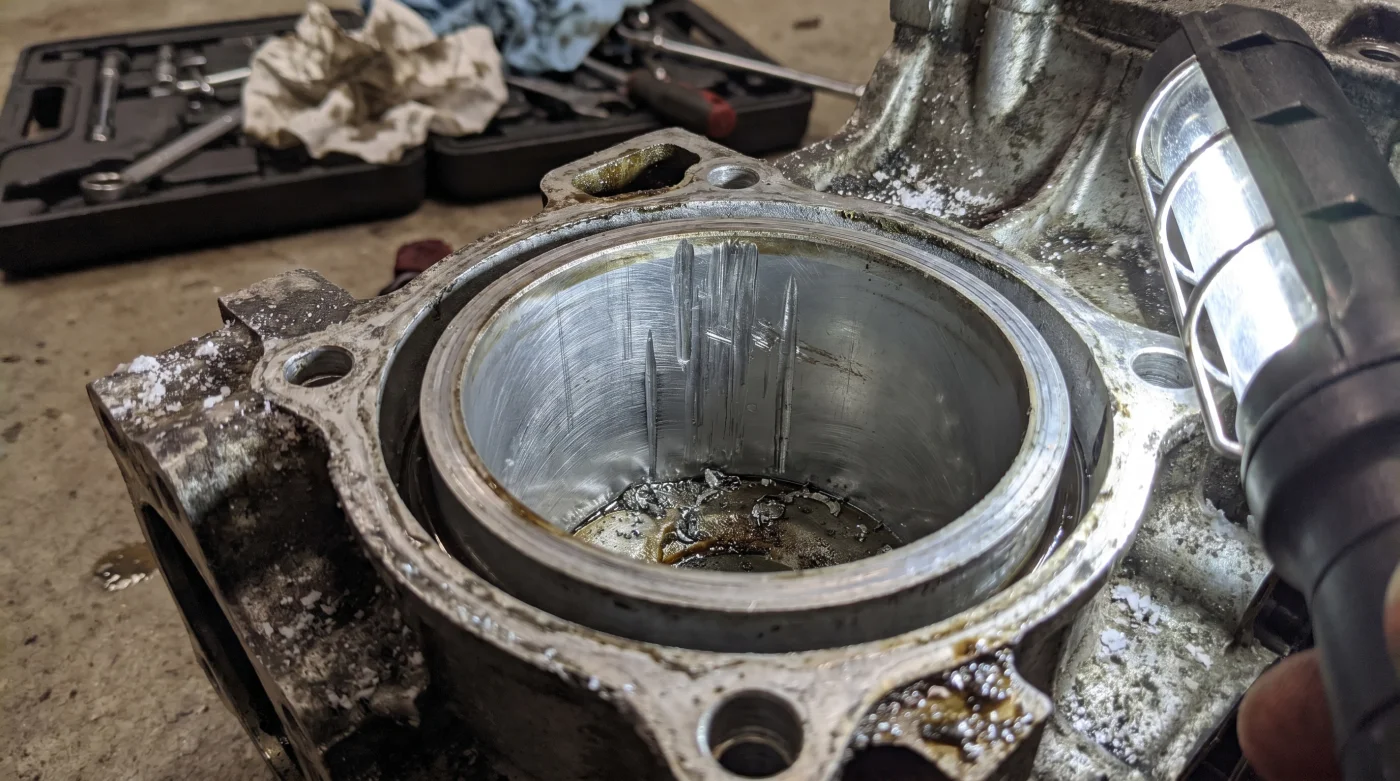
Julian, a 58-year-old master technician at a renowned independent shop in Connecticut, has seen this horror story play out on dozens of 996 and 997-generation cars. Last winter, a client brought in a Carrera 4S with only 32,000 miles, complaining of a faint ‘ticking’ sound from the rear. The owner was a perfectionist who never drove the car hard until it was fully warm, yet a borescope revealed deep, vertical gouges in cylinders four and six. ‘The guy thought he was a saint for letting it idle for ten minutes every morning,’ Julian told me while pointing at a scarred engine block. ‘He basically paid $25,000 to **slowly sand down his** own engine because he didn’t want to be cold for five minutes.’
Adapting Your Routine: The Three Stages of Cold Starts
Not every 911 requires the same level of paranoia, but the physics of bore scoring remain constant across the water-cooled era. You must adjust your behavior based on the specific heart beating behind your rear axle to ensure the car stays out of the scrap heap.
For the M96/M97 Purist: These engines (found in 1999-2008 models) are the most vulnerable to scoring. If you own one of these, you cannot afford to idle for more than thirty seconds. The goal is to get the engine under a light load as quickly as possible to build oil pressure and generate even heat throughout the block. You must resist the urge to turn on the heated seats and wait; the car **needs to move now** to survive the winter.
For the Direct-Injection Collector: Owners of the 997.2, 991, and 992 generations have better cylinder coatings, but the fuel-wash issue is actually more pronounced due to direct injection. The injectors spray fuel at incredible pressures directly into the cylinder. If the engine is cold and idling, that fuel doesn’t atomize well; it sticks to the walls and **destroys the oil film** just as effectively as the older models. Your car is tougher, but it is not immune to a lazy morning routine.
The Tactical Toolkit for a Healthy Flat-Six
The solution is a mindful, minimalist departure. It requires you to be comfortable with a few minutes of shivering in exchange for a lifetime of mechanical health. Follow these steps the moment you turn the key in temperatures below 40 degrees Fahrenheit:
- The 30-Second Rule: Start the engine and wait only long enough for the oil pressure needle to stabilize and the initial high-idle to drop slightly.
- The 3,000 RPM Ceiling: Once moving, keep your shifts early and your throttle inputs light. You want the engine to work, but you do not want to stress the cold components.
- The Oil Temp Benchmark: Ignore the water temperature gauge. It lies. Your engine is only ‘warm’ when the oil temperature reaches at least 180°F. Until then, you are in the ‘protection zone.’
- The Moisture Purge: Short trips are the second-best way to kill a 911. If you start it, drive it long enough to stay at operating temperature for at least 15 minutes to evaporate any moisture in the oil.
The Bigger Picture: Stewardship Over Comfort
Owning a Porsche is a lesson in delayed gratification. We wait for the perfect road, we wait for the right weather, and we must also wait for the machine to find its rhythm. By choosing to drive immediately under light load rather than idling in the driveway, you are participating in a **higher form of maintenance**. You are acknowledging that the car is a living, breathing entity that functions best when it is performing the task it was designed for: movement.
This shift in perspective transforms the cold-weather start from a chore into a ritual of preservation. When you finally see that oil temperature needle climb into the safe zone, you aren’t just ready to drive fast—you’re driving a car that will actually last. In the world of high-end automotive collecting, the greatest luxury isn’t a warm seat in the morning; it’s the **absolute peace of mind** that comes from knowing your cylinder walls are as smooth as glass, protecting both the soul of the machine and the value of your investment.